Highlight
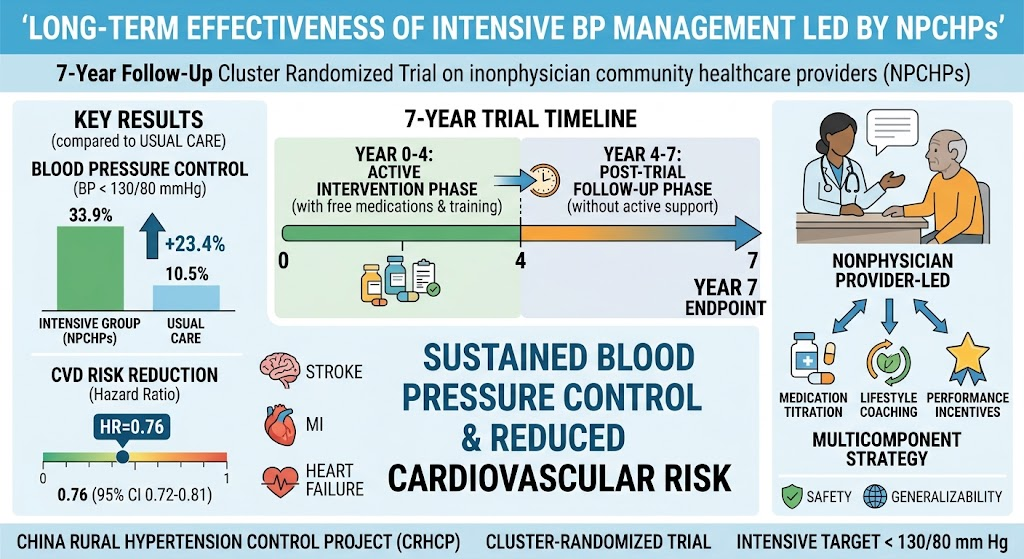
• Intensive blood pressure management targeting <130/80 mm Hg by nonphysician community healthcare providers (NPCHPs) in rural China achieved sustained blood pressure control over 7 years.
• The intervention reduced the incidence of major cardiovascular events by approximately 24% during the 7-year follow-up, including a 21% risk reduction sustained after active intervention withdrawal.
• The program’s effects were consistent across subgroups and associated with increased mild adverse events such as hypotension and hypokalemia.
• Posttrial continuation of care without additional medication subsidies still maintained much of the cardiovascular benefit, suggesting durable impact of the initial intensive management.
Study Background
Hypertension remains the leading modifiable risk factor for cardiovascular disease (CVD) globally, contributing significantly to morbidity and mortality. Despite established evidence supporting intensive blood pressure (BP) lowering to reduce cardiovascular events, implementation in resource-limited rural settings is challenging, especially where physician availability is limited. The China Rural Hypertension Control Project (CRHCP) sought to address this gap by leveraging nonphysician community healthcare providers (NPCHPs) trained to deliver guideline-based antihypertensive care and lifestyle counseling. While intensive BP management reduces cardiovascular risk during trial-supported initiatives, it remains unclear if benefits endure after such structured support ceases, underscoring the need for long-term effectiveness data.
Study Design
The CRHCP was a large-scale, cluster-randomized controlled trial conducted across 326 villages in rural China. Participants aged 40 years or older with elevated BP (≥140/90 mm Hg or ≥130/80 mm Hg if high cardiovascular risk or already receiving treatment) were enrolled between May and November 2018.
Villages were randomized 1:1 to receive either an intensive BP control intervention led by NPCHPs or continue with local usual care. The intervention involved NPCHPs initiating and adjusting antihypertensive medications under primary care physician supervision, using a standardized treatment protocol to achieve a target BP <130/80 mm Hg. The program also incorporated patient coaching on home BP monitoring, lifestyle modification, medication adherence support, discounted/free antihypertensive medications, additional NPCHP training, and performance incentives for providers.
During the 4-year active intervention period, these resources were fully provided. From years 4 to 7 (posttrial period), participants continued NPCHP-led care but without medication discounts, additional provider training, or monetary incentives. Physician and hypertension specialist consultations remained accessible.
The primary outcome was a composite of major cardiovascular events, including myocardial infarction, stroke, hospitalization for heart failure, and cardiovascular death. Outcomes were assessed over the full 7-year period and specifically during the 3-year posttrial phase. Predefined subgroup analyses examined consistency of treatment effects by patient demographics and baseline characteristics.
Key Findings
A total of 33,995 participants were enrolled, with 31,334 entering the posttrial follow-up. By the end of 7 years, the intervention group achieved significantly lower mean BP of 138.8/80.7 mm Hg compared to 152.3/86.1 mm Hg in the usual care group, a between-group difference of −13.5/−5.4 mm Hg (P<0.0001 for both systolic and diastolic). BP control to <130/80 mm Hg was attained in 33.9% of the intervention group versus only 10.5% in the control group (P<0.0001).
The incidence rate of composite cardiovascular events was 2.4% per person-year in the intervention arm versus 3.0% in usual care (hazard ratio [HR] 0.76; 95% confidence interval [CI], 0.72–0.81; P<0.0001) over the entire 7-year follow-up, indicating a 24% relative risk reduction. Notably, during the 3-year posttrial period when additional support ceased, the intervention group still experienced significant CVD risk reduction (HR 0.79; 95% CI, 0.73–0.85; P<0.0001).
Subgroup analyses demonstrated consistent benefit regardless of baseline age, sex, education level, or prior antihypertensive treatment, suggesting broad applicability. However, the intervention was associated with an increased risk of adverse events such as hypotension (risk ratio 1.58; 95% CI, 1.39–1.79) and mild hypokalemia (risk ratio 1.38; 95% CI, 1.23–1.56; both P<0.001), highlighting the need for monitoring during intensive BP management.
Expert Commentary
The CRHCP study represents important evidence supporting the scalability and durability of intensive hypertension management delivered by nonphysician providers in rural, resource-limited settings. The findings align with global guideline trends advocating lower BP targets to reduce cardiovascular outcomes but uniquely demonstrate sustained impact even after formal intervention withdrawal.
Such task-shifting approaches can mitigate healthcare workforce shortages, leveraging trained NPCHPs to maintain chronic disease control and improve outcomes. The modest increase in mild adverse effects underscores the critical role of supervision and careful titration to balance safety and efficacy.
Limitations include the regional setting, which may influence generalizability to urban or different healthcare systems. Additionally, while NPCHPs continued care posttrial, loss of medication subsidies and incentives could affect adherence and outcomes beyond the studied period. Further research is needed to explore mechanisms sustaining long-term adherence and to evaluate cost-effectiveness in varied contexts.
Conclusion
This landmark cluster-randomized trial demonstrates that an intensive, multicomponent blood pressure management program led by nonphysician community healthcare providers substantially reduces cardiovascular risk and maintains blood pressure control over 7 years in rural China. The persistence of benefit for 3 years after withdrawal of additional intervention resources is a promising indicator of durable effect. Incorporating such task-shifting models into hypertension control strategies could be transformative for global cardiovascular health, especially in underserved populations. Nonetheless, monitoring for adverse events and sustaining patient engagement remain essential components of safe, effective BP control.
Future efforts should focus on implementation logistics, scalability, and integration into broader healthcare frameworks to maximize public health impact.
Funding and Clinical Trial Registration
The China Rural Hypertension Control Project was supported by appropriate funding bodies (details not specified in the provided text) and is registered with ClinicalTrials.gov (NCT03527719).
References
1. Sun G et al. Long-Term Effectiveness of Intensive Blood Pressure Management Led by Nonphysician Community Healthcare Providers on Cardiovascular Events: 7-Year Follow-Up of a Cluster Randomized Trial. Circulation. 2026 Aug 28. PMID: 42666029.
2. Whelton PK et al. 2017 ACC/AHA Guideline for the Prevention, Detection, Evaluation, and Management of High Blood Pressure in Adults. J Am Coll Cardiol. 2018;71(19):e127-e248.
3. Mills KT et al. Global Disparities of Hypertension Prevalence and Control: A Systematic Analysis. Circulation. 2016;134(6):441-450.