Highlight
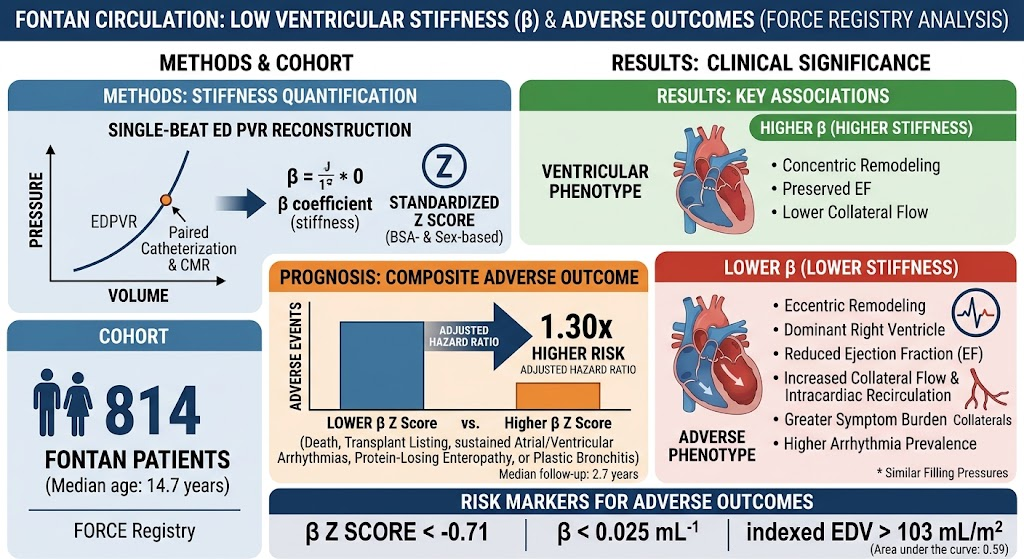
- Contrary to traditional views, Fontan circulatory failure associates with low—not high—ventricular chamber stiffness.
- Lower chamber stiffness identifies a high-compliance phenotype marked by eccentric ventricular remodeling and dilation.
- This phenotype correlates with right ventricular dominance, reduced ejection fraction, increased arrhythmia, and clinical symptom burden.
- Chamber stiffness Z scores independently predict adverse outcomes in Fontan patients, offering potential for risk stratification.
Study Background
The Fontan procedure, a palliative surgical approach for single-ventricle congenital heart defects, directs systemic venous return directly to the pulmonary arteries, bypassing a subpulmonary ventricle. Over time, many patients with a Fontan circulation experience a gradual decline in cardiac function culminating in Fontan failure, characterized by elevated end-diastolic pressures, circulatory inefficiency, arrhythmias, and end-organ complications. The prevailing hypothesis has been that progressive ventricular stiffening drives these adverse changes, contributing to higher filling pressures and impaired ventricular compliance. However, end-diastolic pressure is influenced by loading conditions and extracardiac factors, potentially limiting its accuracy as a surrogate for intrinsic chamber stiffness. The clinical imperative remains to better identify and characterize pathophysiological phenotypes within the Fontan population to guide prognostication and targeted therapies.
Study Design
This investigation leverages the FORCE (Fontan Outcomes Registry Using Clinical Examinations) registry cohort, encompassing 814 patients with Fontan circulation and a median age of 14.7 years. Ventricular chamber stiffness was quantified through the exponential coefficient β, derived from a novel single-beat reconstruction of the end-diastolic pressure-volume relationship. This method integrated paired invasive catheterization measurements and cardiovascular magnetic resonance imaging data for precise volumetric and pressure assessment. The β coefficient was normalized to body surface area and sex, yielding Z scores. Associations between β Z scores and clinical variables, ventricular geometry, remodeling patterns, and a composite adverse outcome encompassing death, transplantation listing, sustained arrhythmias, and protein-losing enteropathy or plastic bronchitis were evaluated. Follow-up spanned a median of 2.7 years.
Key Findings
The median β was 0.034 mL⁻¹, with notable variability across patients. Contrary to traditional expectations, lower β Z scores—which indicate decreased ventricular chamber stiffness or higher compliance—correlated strongly with a dominant right ventricular morphology. This subgroup displayed eccentric remodeling characterized by ventricular dilation, reduced ejection fraction, increased collateral blood flow, and intracardiac recirculation. Clinically, patients with lower β Z scores reported greater symptom burden and had a higher prevalence of sustained atrial and ventricular arrhythmias, despite similar filling pressures compared to patients with higher stiffness.
Crucially, lower β Z scores independently predicted the composite adverse outcome, with an adjusted hazard ratio of 1.30 per standard deviation decrease in β (95% CI, 1.04 to 1.61). Thresholds such as a β Z score below -0.71, β less than 0.025 mL⁻¹, or indexed end-diastolic volume exceeding 103 mL/m² demonstrated modest discrimination ability (area under the curve around 0.59), with enhanced predictive value in patients with dominant right ventricles. These data challenge the dogma that progressive stiffening drives Fontan failure, instead highlighting a high-compliance, dilated phenotype as a key risk state.
Expert Commentary
These findings redefine the understanding of ventricular remodeling in the Fontan circulation. Traditional models implicate increased ventricular stiffness as the hallmark of failing Fontan physiology, with stiff ventricles causing elevated filling pressures and poor adaptability. However, the present FORCE registry analysis suggests that a subset of patients exhibits ventricular unloading failure manifested by chamber dilation and increased compliance, a phenotype associated with worse clinical outcomes including arrhythmogenesis and functional decline.
Mechanistically, this eccentric remodeling may reflect maladaptive responses to chronic volume overload, abnormal loading conditions, or differences in myocardial architecture, especially in right ventricular morphology. Right ventricular dominance was strongly linked with low chamber stiffness, possibly reflecting intrinsic myocardial structural vulnerabilities. These insights have profound implications for clinical management: targeting therapies solely aimed at reducing stiffness might overlook patients with a high-compliance, dilated phenotype who might benefit from volume unloading or mechanical support strategies.
Limitations include the single-beat modeling approach and the modest discriminatory performance for adverse outcomes, underscoring the complexity of Fontan pathophysiology. Additionally, the heterogeneity of patient anatomy and surgical history warrants cautious extrapolation. Future longitudinal studies incorporating tissue characterization and molecular biomarkers could further elucidate underlying mechanisms.
Conclusion
The FORCE registry analysis overturns longstanding assumptions by demonstrating that low ventricular chamber stiffness, indicative of high compliance and eccentric remodeling, identifies a high-risk phenotype in patients with Fontan circulation. This phenotype is characterized by ventricular dilation, reduced ejection fraction, and increased arrhythmic and symptomatic burden, and it independently predicts adverse outcomes. These findings call for a paradigm shift in the clinical evaluation and management of Fontan patients, emphasizing the need to recognize and address diverse remodeling phenotypes beyond the simplistic framework of progressive stiffening. Tailored therapeutic strategies that consider ventricular mechanics and remodeling patterns may improve long-term outcomes in this complex population.
Funding and Clinical Trials
The study was conducted under the FORCE Investigators collaboration, with data curated from multicenter clinical examinations. Funding sources and trial registrations were not detailed in the abstract.
References
1. Van den Eynde J, Van De Bruaene A, Slesnick T, et al. Low Ventricular Chamber Stiffness Identifies a High-Risk Eccentric Remodeling Phenotype in the Fontan Circulation: A FORCE Registry Analysis. Circulation. 2026 Aug 28. PMID: 42663127.
2. Gewillig M. The Fontan circulation. Heart. 2005;91(6):839–846.
3. Keller AM, Fontan F, Hirsch JC, et al. Ventricular remodeling in single ventricle physiology: implications for Fontan failure. J Am Coll Cardiol. 2018;71(19):2205–2215.
4. Fernandes SM, Pignatelli RH, Gentles TL, et al. Fontan failure and Fontan rehabilitation. Curr Opin Cardiol. 2017;32(2):213–220.
5. De Leval MR, et al. Long-term results of the Fontan operation: critical review of hemodynamic and physiology. J Am Coll Cardiol. 2018;71(21):2379–2391.