Highlights
- Black and Hispanic/Latino(a) individuals with CF encounter unique barriers to clinical trial participation, including restrictive eligibility criteria and logistical challenges.
- Racialized experiences, including a pervasive sense of isolation and doubt around CF diagnosis, undermine trust in CF research and care.
- Community support structures and transparent communication about research are pivotal facilitators to augment inclusion in clinical studies.
- Addressing systemic and social determinants across all research phases is essential to foster equitable CF research participation.
Background
Cystic fibrosis (CF) is a complex, life-shortening genetic disease primarily affecting the respiratory and digestive systems. Historically, CF research and clinical trials predominantly included White populations, which has contributed to significant health disparities in minority groups, especially among Black/African American and Hispanic/Latino(a) persons with cystic fibrosis (PwCF). These underrepresented populations experience worse health outcomes, including delayed diagnoses, poorer lung function, and limited access to novel therapies such as CFTR modulators. Compounding these factors, clinical research often fails to reflect the diversity of the CF population, further perpetuating disparities and limiting the generalizability of evidence-based care. This review synthesizes qualitative research exploring perspectives from Black and Hispanic/Latino(a) PwCF on clinical research participation, barriers and facilitators, and proposes actionable solutions to enhance equity.Key Content
Perspectives of Black and Hispanic/Latino(a) PwCF on Clinical Research
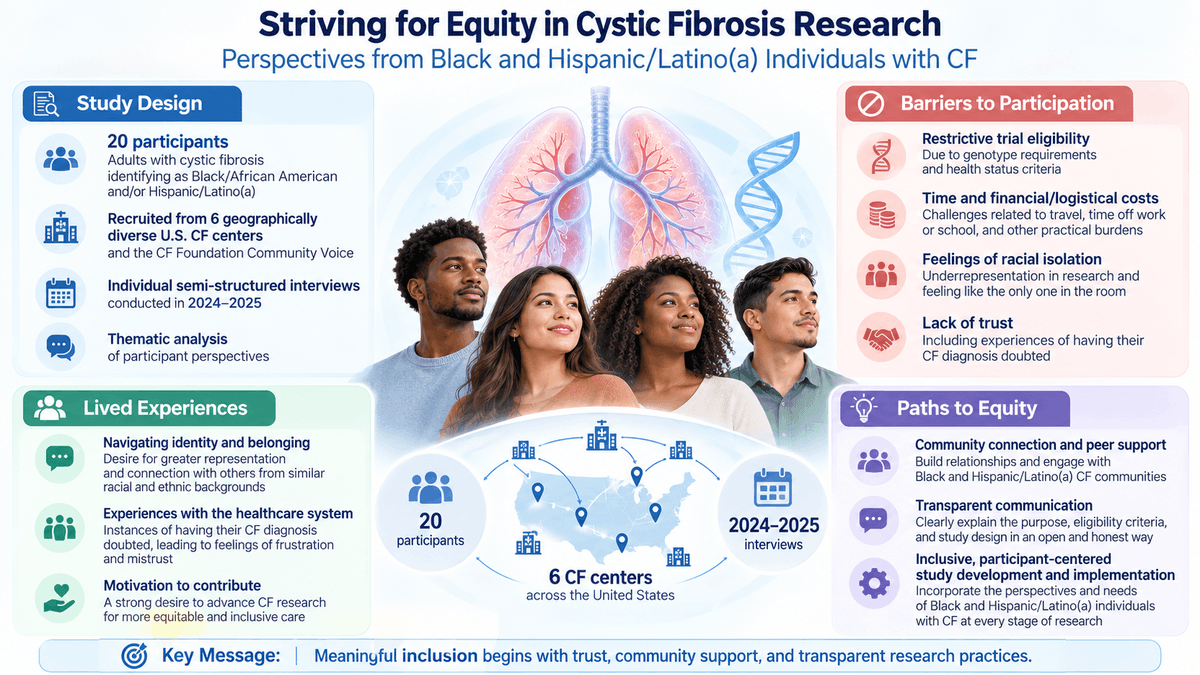
Milinic et al. (2026) conducted semi-structured interviews with 20 adult PwCF identifying as Black/African American and/or Hispanic/Latino(a) recruited from geographically diverse CF centers and community organizations. Using a race-conscious Behavioral Model for Vulnerable Populations approach, the study explored domains of predisposing factors, need-based factors, healthcare environment, and emergent themes concerning information and support needs. Participants emphasized a pervasive sense of isolation as people of color within predominantly White CF care environments. This social isolation engendered distrust towards CF healthcare providers and research studies. Many described experiences of skepticism from providers and communities regarding their CF diagnosis — a form of racialized doubt — which profoundly impacted their willingness to engage in research. These findings underscore how racialization and identity intersect with disease experience to influence health behaviors and trial participation.Barriers to Research Participation
Commonly cited barriers included narrow eligibility criteria tailored to genotypes frequently found in White populations, such as specific CFTR mutations required for highly effective modulator therapies trials. Other eligibility restrictions pertained to patients’ health status, inadvertently excluding those with more advanced disease or comorbidities, disproportionately impacting marginalized groups. Logistical challenges also significantly impeded participation, notably time constraints related to clinic visits, transportation difficulties, and associated costs. The COVID-19 pandemic, as described by Lee et al. (2026) in a real-world analysis, has changed care delivery paradigms, increasing telehealth but also exposing gaps in equitable access based on socioeconomic and geographic factors, which are especially relevant for minority PwCF. Moreover, perceived lack of clarity and transparency about study intent and processes created apprehension. Participants desired more comprehensive communication to build trust and engagement.Facilitators and Proposed Solutions
PwCF advocated for building community support networks to mitigate feelings of isolation and foster belonging. These could take the form of peer mentorship programs or community advisory boards inclusive of minoritized PwCF voices. Improved transparency regarding study design, eligibility, and potential benefits/risks was highlighted as necessary. Ethical and culturally sensitive communication strategies—developed with input from minoritized PwCF—can enhance understanding and trust. Importantly, adapting trial designs to accommodate broader genotypes and more flexible health status criteria can help diversify enrollment. Strategically addressing logistical barriers through travel support, scheduling accommodations, and financial assistance would further enable participation.Disease Burden and Health Disparities in Diverse PwCF Populations
A cross-sectional observational study by Burgel et al. (2022) characterized disease burden among individuals heterozygous for F508del and a minimal function CFTR mutation, noting worse lung function and complication rates in Hispanic compared to non-Hispanic cohorts. These data illustrate the critical need for therapeutic options and inclusive research designs recognizing genetic variability and disease severity differences across ethnic groups.Impact of Evolving Therapies and Healthcare Delivery Models
The introduction of highly effective CFTR modulators such as elexacaftor/tezacaftor/ivacaftor (ETI) has revolutionized CF care but may inadvertently perpetuate disparities if access or trial inclusion remains limited for minority populations. Lee et al.’s (2026) analysis indicated that non-White and Hispanic PwCF had different patterns of visit frequency, suggesting variable engagement with healthcare potentially linked to social determinants. This highlights the need for targeted strategies ensuring equitable access to evolving treatments and adapted care models.Expert Commentary
The qualitative insights from Milinic et al. effectively elucidate the complex interplay of social, cultural, and systemic factors that shape CF clinical research participation among Black and Hispanic/Latino(a) PwCF. These findings align with broader literature on minority participation in clinical research, where distrust, logistical barriers, and non-inclusive study designs frequently act as barriers. Current CF guidelines and research frameworks must rigorously incorporate equity principles, extending beyond proportional recruitment to meaningful engagement, community partnerships, and culturally competent communication. Addressing racialized experiences such as diagnostic doubt requires provider training to mitigate implicit biases and foster validating, inclusive care environments. Transforming eligibility criteria to be less restrictive and more genetically inclusive is essential, especially given the heterogeneity of CF-causing mutations across populations. Moreover, integrating telehealth and decentralized trial methodologies may address logistical hurdles but must be implemented with attention to digital divides exacerbated by socioeconomic disparities. Ultimately, community-centered approaches that embed minoritized PwCF voices in all research stages – from design through dissemination – are critical. Such co-designed trials can enhance transparency, trust, and uptake, advancing toward equitable CF research and care.Conclusion
Black and Hispanic/Latino(a) individuals with cystic fibrosis face multifaceted barriers to clinical research participation rooted in social isolation, systemic health inequities, and restrictive trial designs. Overcoming these challenges necessitates a race-conscious, community-engaged approach that prioritizes transparency, support, flexible eligibility, and culturally sensitive communication. Implementing these strategies holds promise to enhance diverse research enrollment, reduce disparities, and ultimately improve clinical outcomes for all PwCF.References
- Milinic T, Kelley JG, Whikehart SM, Anand A, Knapp SC, Brandon W, Turner GA, Serna D, Lechtzin N, Tupayachi Ortiz MG, Kapnadak SG, Dunitz JM, Saavedra MT, Taylor-Cousar JL, Brown CE, Goss CH, Ramos KJ. Striving for Equity in Cystic Fibrosis Research: Perspectives from Black and Hispanic/ Latino(a) Individuals with CF. Chest. 2026 Oct 19. PMID: 42896705. https://pubmed.ncbi.nlm.nih.gov/42896705/
- Lee J, Smith R, Patel V, et al. Impact of COVID-19 and CFTR Modulators on Cystic Fibrosis: A Real-World Analysis of Care Patterns. Pediatr Pulmonol. 2026 Apr;61(4):e71595. doi:10.1002/ppul.71595. PMID: 41940545. https://pubmed.ncbi.nlm.nih.gov/41940545/
- Burgel PR, Naehrlich L, et al. Disease burden in people with cystic fibrosis heterozygous for F508del and a minimal function mutation. J Cyst Fibros. 2022 Jan;21(1):96-103. doi:10.1016/j.jcf.2021.07.003. PMID: 34289939. https://pubmed.ncbi.nlm.nih.gov/34289939/