Introduction and Context
Surgery for oesophageal and gastric cancer saves lives but leaves many patients with chronic symptoms that impair quality of life. After oesophago‑gastric resection (including subtotal/total gastrectomy, oesophagectomy and oesophagogastric junction resections), patients commonly experience dysphagia, reflux, delayed gastric emptying, dumping syndromes, bile reflux, malabsorption and weight loss. These symptoms frequently overlap and can be episodic, progressive or persistent. Until now, management has been fragmented across centres, with limited consensus on definitions, pathways of investigation, pragmatic diagnostic thresholds and standardised management strategies.
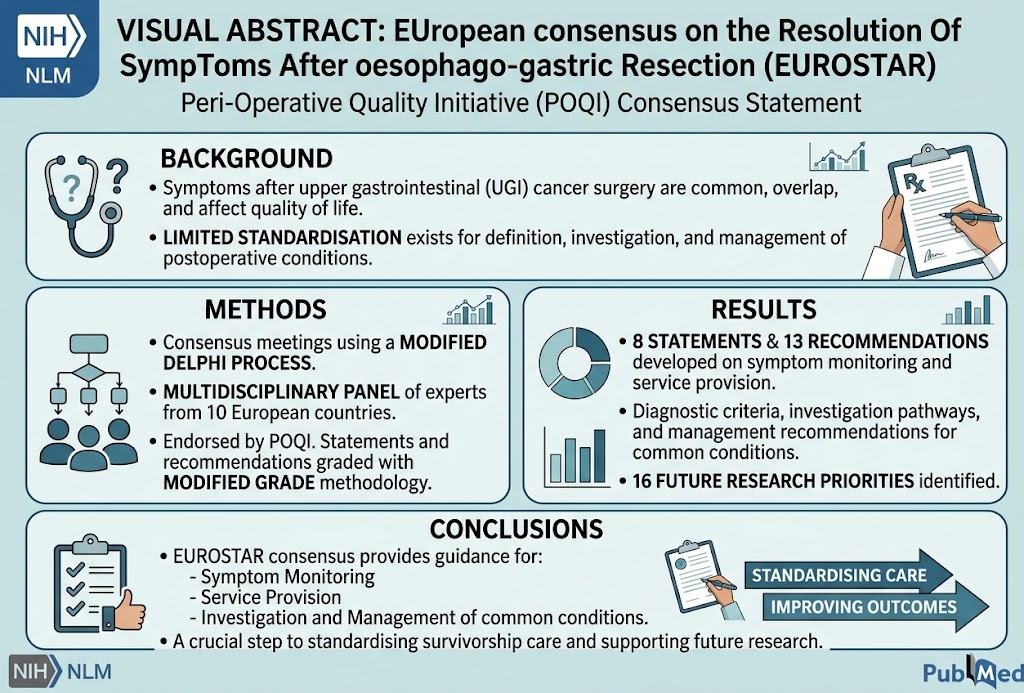
The EUropean consensus on the Resolution Of SympToms After oesophago‑gastric Resection (EUROSTAR) was produced under the oversight of the Peri‑Operative Quality Initiative (POQI) and published in Gut (Barman et al., 2026). EUROSTAR used a modified Delphi process with multidisciplinary experts from 10 European countries to create consensus statements and graded recommendations addressing symptom monitoring, service provision and the diagnosis and management of the common postoperative conditions encountered in this population.
Why this consensus matters now
– Growing survivorship: Improved oncologic outcomes have produced a larger cohort living long-term after oesophago‑gastric surgery; symptom burden has become a leading determinant of quality of life.
– Heterogeneous practice: Wide variation in how symptoms are defined, investigated and treated hampered care and research.
– Need for standardisation: Standard definitions, PROMs (patient‑reported outcome measures) and pathways are essential to coordinate multidisciplinary care, enable comparative research and set service standards.
New Guideline Highlights
Major themes and takeaways
– Routine, structured symptom monitoring: EUROSTAR recommends systematic symptom screening using validated PROMs at planned intervals after discharge to detect treatable conditions early.
– Multidisciplinary survivorship services: Core teams should include surgical, gastroenterology and dietetic expertise, with timely access to endoscopy, gastric emptying studies, breath tests and radiology.
– Clear diagnostic criteria: The group produced pragmatic diagnostic thresholds and investigation pathways for common conditions (dumping, delayed gastric emptying, anastomotic stricture, reflux/bile reflux, small intestinal bacterial overgrowth (SIBO), micronutrient deficiencies).
– Stepwise management algorithms: Recommendations emphasize first‑line conservative measures (dietary modification, medications), targeted investigations when symptoms are significant or atypical, and escalation to endoscopic or surgical interventions only when indicated.
– Research agenda: EUROSTAR identified sixteen high‑priority research questions to address gaps in pathophysiology, diagnostics, therapeutics and service models.
Key practical takeaways for clinicians
– Implement routine PROM screening (baseline pre‑op, then at 1, 3, 6 and 12 months — and annually thereafter if symptomatic).
– Open multidisciplinary ‘UGI survivorship’ clinics or designated pathways for rapid access to investigations and allied‑health support.
– Use standard diagnostic tests for specific syndromes (e.g., Sigstad score for dumping, gastric emptying scintigraphy for delayed emptying, endoscopy for dysphagia/stricture, breath tests for SIBO).
– Prioritise nutrition and micronutrient surveillance in all patients and treat deficiencies proactively.
Updated Recommendations and Key Changes
EUROSTAR is not a revision of a single prior European guideline but an effort to harmonise care across centres. Important advances in the consensus include:
– From variable practice to defined PROM schedule: Prior to EUROSTAR there was no European consensus schedule for symptom monitoring. EUROSTAR endorses routine structured PROM collection (including an oesophago‑gastric cancer module) at defined timepoints.
– Diagnostic thresholds: The panel produced pragmatic diagnostic criteria (e.g., criteria for early and late dumping, gastric emptying thresholds) to standardise when to pursue testing or specialist referral.
– Service design: A specific recommendation to create multidisciplinary survivorship clinics (surgeon/gastroenterologist/dietitian/ specialist nurse/physiologist/psychologist) with defined access to investigations.
– Grading and wording: Statements and recommendations were graded using a modified GRADE framework and are presented as strong recommendations, conditional recommendations or consensus/expert opinion where direct evidence is limited.
Summary table: how EUROSTAR changed practice (bulleted comparison)
– What was common practice: Ad hoc symptom evaluation; variable use of PROMs; limited local access to tests such as gastric emptying.
– EUROSTAR change: Mandated routine PROM screening; clear thresholds for investigation; recommended multidisciplinary survivorship services.
Evidence drivers
EUROSTAR’s recommendations rest on the combination of available observational evidence, expert experience and the pressing need for standardisation. Where high‑quality randomized data are lacking (common in postoperative symptom management), recommendations were made as conditional or expert consensus statements and explicitly flagged for research.
Topic‑by‑Topic Recommendations
Note: EUROSTAR produced 8 statements and 13 recommendations addressing monitoring and service provision. The following summarises the core, topic‑specific diagnostic and management guidance developed by the panel.
Symptom monitoring and PROMs
– Recommendation: Systematic symptom monitoring using general (e.g., EORTC QLQ‑C30) plus oesophago‑gastric specific modules (EORTC QLQ‑OG25 or equivalent) should be performed preoperatively (baseline) and at routine postoperative timepoints (suggested: discharge/1 month/3 months/6 months/12 months and annually if symptomatic). (Grade: Strong/consensus)
– Rationale: Regular PROM use identifies patients with treatable conditions earlier, guides investigations and standardises outcome reporting across centres.
Dysphagia and anastomotic strictures
– Diagnostic approach: New or progressive dysphagia should prompt early endoscopy (OGD) ± contrast swallow. Stricture diagnosis is clinical/endoscopic; severity should be graded by luminal diameter and nutritional impact.
– Management: Endoscopic balloon dilation is first‑line for benign anastomotic strictures; repeat dilations are common. If refractory, consider temporary stenting or surgical revision in selected patients. Proton pump inhibitors (PPIs) may be used adjunctively when reflux contributes. (Grade: Strong for endoscopic dilation)
Dumping syndromes (early and late)
– Definitions: EUROSTAR endorses standard clinical definitions separating early dumping (vasomotor/vasovagal symptoms 10–60 minutes postprandially) from late dumping (hypoglycaemic symptoms 1–3 hours after meals).
– Diagnostic criteria: Use validated symptom scoring (e.g., Sigstad score for early dumping) and consider capillary glucose measurements or continuous glucose monitoring to document late dumping/hypoglycaemia when suspected.
– Management hierarchy: 1) Dietary measures (small frequent meals, low simple carbohydrate load, high protein/fibre, post‑prandial lie‑down discouraged/individualised). 2) Acarbose for predominant late dumping with documented hyperinsulinaemic hypoglycaemia (off‑label in many countries). 3) Short‑term somatostatin analogues (octreotide/lanreotide) for severe/refractory cases. 4) Surgical revision is rarely required and reserved for incapacitating, refractory symptoms. (Recommendation strength: Strong for dietary measures; conditional for acarbose and somatostatin analogues)
Delayed gastric emptying (post‑gastrectomy or after oesophagectomy with gastric conduit)
– Diagnostic test: Gastric emptying scintigraphy (solid‑meal) is the preferred objective test; abnormal retention at 4 hours (>10% retained) indicates delayed gastric emptying using standard solid‑meal protocols (consistent with nuclear medicine guidance).
– Clinical management: Begin with conservative measures—dietary modifications (small frequent meals, semi‑solid foods), prokinetic therapy where available/appropriate (e.g., metoclopramide short term; domperidone where local regulatory environment permits). Endoscopic pyloric interventions (balloon dilation, endoscopic pyloromyotomy) can be considered for symptomatic patients with suspected outflow obstruction; botulinum toxin injection remains controversial because of inconsistent durability. Nutritional support (enteral supplementation or parenteral nutrition) is indicated for severe malnutrition. (Grades: conditional across interventions due to variable evidence)
Reflux and bile reflux
– Diagnostic approach: For reflux symptoms, consider endoscopy to assess mucosal injury and pH/impedance testing in complex cases. Bile reflux is best identified endoscopically by visualisation of bile in the gastric remnant or conduit; ambulatory bile acid testing is not routine.
– Management: Optimise PPI therapy for acid reflux; add alginates for symptomatic relief. For symptomatic bile reflux, bile acid sequestrants (cholestyramine) or ursodeoxycholic acid may relieve symptoms; where medical therapy fails and quality of life is poor, surgical/antireflux options or diversion procedures can be considered in selected patients. (Recommendation strength: conditional)
Small intestinal bacterial overgrowth (SIBO)
– Diagnostic testing: Breath testing (glucose or lactulose) can be used to detect SIBO in symptomatic patients (bloating, diarrhoea, steatorrhea, malabsorption). Sensitivity and specificity limitations must be recognised.
– Treatment: Empiric antibiotics directed at SIBO (e.g., rifaximin where available) are commonly effective; tailor therapy to local practice and susceptibility patterns. Repeat testing after treatment can be helpful if symptoms recur. (Grade: conditional)
Malnutrition and micronutrient deficiencies
– Screening and monitoring: All patients require routine nutrition assessment at early postoperative timepoints and ongoing surveillance for weight loss and micronutrient deficiencies (iron studies, ferritin, B12, folate, vitamin D, calcium, magnesium, and others guided by procedure and symptoms).
– Management: Early dietetic input, oral nutritional supplements, and where necessary, enteral or parenteral support. Treat documented deficiencies promptly (e.g., vitamin B12 replacement—intramuscular monthly or high‑dose oral depending on absorption; iron—IV iron often preferred if oral absorption is poor or if side effects intolerable). (Grade: Strong for routine surveillance and nutrition support)
Psychological, functional and rehabilitation care
– Recommendation: Integrate psychosocial evaluation, rehabilitation and return‑to‑work planning into survivorship pathways. Offer targeted interventions for anxiety, depression and body‑image issues. (Grade: Consensus/strong)
Service organisation and pathways
– Multidisciplinary survivorship service: EUROSTAR recommends establishing dedicated UGI survivorship clinics or rapid‑access pathways that provide coordinated access to dietetics, specialist nursing, endoscopy, gastroenterology, metabolic testing and psychological care.
– Waiting times and prioritisation: Patients with alarming features (progressive dysphagia, weight loss, GI bleeding, severe dehydration, severe hypoglycaemia) should have expedited assessment.
Expert Commentary and Insights
Panel perspectives
EUROSTAR’s multidisciplinary panel emphasised that the current evidence base for many targeted treatments (e.g., botulinum toxin for pyloric dysfunction, use of acarbose in late dumping, long‑term prophylaxis for bile reflux) is limited and heterogeneous. Therefore, the group favoured conservative, stepwise approaches prioritising non‑invasive measures and nutritional optimisation, reserving invasive interventions for refractory or high‑impact disease.
Key controversies and areas of debate
– Pyloric interventions: There is ongoing debate about routine intraoperative pyloroplasty/pyloromyotomy during oesophagectomy and the benefit of endoscopic botulinum toxin for late symptomatic improvement. EUROSTAR recommends careful patient selection and highlighted a need for randomized evaluation.
– Definitions and objective testing thresholds: While EUROSTAR proposes pragmatic thresholds (e.g., gastric retention >10% at 4 hours), some clinicians argue for procedure‑specific criteria and more dynamic tests, such as wireless motility capsules or breath testing algorithms. The panel acknowledged these differences and called for comparative studies.
– Role of continuous glucose monitoring (CGM): CGM promises better recognition of late dumping hypoglycaemia but is not yet standard; EUROSTAR recommended its use in research or selected complex cases.
Future trends and research priorities identified by EUROSTAR
Among the sixteen research priorities the panel highlighted: validating standard PROMs in post‑resection populations, randomized trials of medical vs endoscopic pyloric interventions, trials of somatostatin analogues vs acarbose for severe dumping, mechanisms and treatment of bile reflux, optimal micronutrient surveillance schedules, and service‑level evaluations of survivorship clinics.
Practical Implications
For clinicians and health systems
– Start or strengthen structured symptom monitoring using PROMs and integrate results into clinic workflows.
– Build or formalise multidisciplinary survivorship services with clear referral pathways and rapid access to key investigations (endoscopy, gastric emptying, breath tests, radiology).
– Prioritise early dietetic input and routine micronutrient surveillance for every patient after oesophago‑gastric resection.
– Use stepwise treatment algorithms that emphasise conservative care first, reserve invasive interventions for refractory problems, and document outcomes consistently to contribute to research databases.
A patient vignette (illustrative)
John, a 64‑year‑old man who had transthoracic oesophagectomy 9 months earlier, reports postprandial palpitations and lightheadedness with sweating 60–90 minutes after meals and troublesome weight loss. His PROM score flags moderate symptoms. The EUROSTAR approach would be:
– Initial assessment with focussed history and capillary glucose checks to differentiate early vs late dumping.
– Dietetic review for meal composition and carbohydrate modification.
– If late dumping with documented hypoglycaemia, consider acarbose and/or short‑course somatostatin analogue for severe symptoms; refer to the multidisciplinary clinic for follow‑up and possible CGM if diagnosis uncertain.
– Monitor weight and micronutrients and escalate to targeted investigations only if symptoms fail to respond.
References
1) Barman S, Chevallay M, Gisbertz SS, Van Hemelrijck M, Byrne BE, Wijnhoven B, et al.; EUROSTAR Study Faculty Members. EUropean consensus on the Resolution Of SympToms After oesophago‑gastric Resection (EUROSTAR): Peri‑Operative Quality Initiative (POQI) consensus statement. Gut. 2026 Sep 25. PMID: 42790929. https://pubmed.ncbi.nlm.nih.gov/42790929/
2) EORTC Quality of Life Group. EORTC QLQ‑OG25: A module for assessing quality of life in oesophago‑gastric cancer patients. (Development and validation literature: see Blazeby JM et al. and EORTC resources.)
3) Abell TL, Camilleri M, Donohoe K, et al. Consensus recommendations for gastric emptying scintigraphy: A joint report of the American Neurogastroenterology and Motility Society and the Society of Nuclear Medicine. Neurogastroenterol Motil. 2008;20(6): e332–e340. (Guidance on scintigraphic protocols and abnormal thresholds.)
4) Sigstad H. A clinical diagnostic index for the diagnosis of dumping syndrome. Acta Med Scand. 1970;188(3):479–486. (Original scoring system widely used for early dumping.)
5) Weimann A, Braga M, Harsok M, et al. ESPEN guideline: Clinical nutrition in surgery. Clinical Nutrition. 2017;36(3):623–650. (Nutrition and micronutrient surveillance after major gastrointestinal surgery.)
6) Pimentel M, Chow EJ, Lin HC. Rifaximin therapy for patients with irritable bowel syndrome without constipation. N Engl J Med. 2011;364(1):22–32. (Rifaximin use in gut dysbiosis — informs SIBO management approach.)
Notes on references: EUROSTAR (Gut, 2026) is the primary source for this summary. Supporting citations reference widely accepted diagnostic or management resources referenced in EUROSTAR’s discussion and used in clinical practice.
Concluding remarks
EUROSTAR represents a pragmatic and important step towards consistent, patient‑centred care for the growing population of oesophago‑gastric cancer survivors. By standardising symptom monitoring, defining diagnostic pathways and promoting multidisciplinary survivorship services, the consensus aims to reduce variation, accelerate appropriate treatment, and create a platform for research. Implementation will require local resources — especially dietetic and specialist nursing capacity — and a commitment to collect standardised outcome data so that future trials can close the many evidence gaps EUROSTAR has identified.
Thumbnail prompt
A multidisciplinary clinical team (surgeon, gastroenterologist, dietitian, specialist nurse) reviewing patient symptom questionnaires and imaging on a tablet around a bright clinic table