Highlight
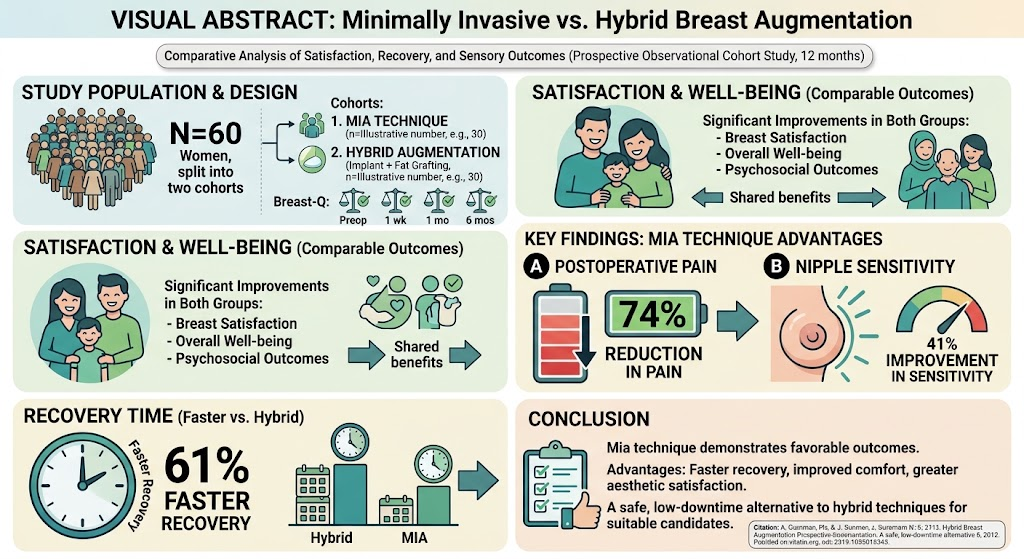
- The minimally invasive breast augmentation (Mia) technique offers significantly reduced postoperative pain compared to hybrid implant and fat grafting augmentation.
- Patients undergoing Mia reported a 61% faster recovery time and a 41% improvement in nipple sensitivity versus hybrid techniques.
- Both approaches yield substantial improvements in breast satisfaction and psychosocial well-being, with comparable overall satisfaction scores.
- Mia presents as a safe, low-downtime alternative for appropriate candidates seeking breast enhancement.
Study Background
Breast augmentation remains the most commonly performed cosmetic surgical procedure worldwide, driven by patient desires for improved body image and psychological well-being. Conventional augmentation techniques typically involve submuscular or subglandular implant placement, with some patients benefiting from adjunctive autologous fat grafting to improve contour and natural feel—termed here as hybrid augmentation. However, these methods can be associated with postoperative pain, extended recovery periods, and sensory changes, including alterations in nipple-areolar complex sensitivity.
The emergence of novel minimally invasive breast augmentation techniques aims to preserve tissue integrity and reduce surgical trauma, potentially improving recovery experiences and sensory outcomes while maintaining aesthetic effectiveness. This study investigates patient-reported outcomes comparing a novel minimally invasive approach (referred to as Mia) against a hybrid technique combining implants with fat grafting, addressing a gap in evidence on postoperative quality of life and sensory function.
Study Design
This prospective observational cohort study enrolled 60 female patients electing for breast augmentation over a 12-month period. Participants were assigned to one of two cohorts: Cohort 1 underwent the Mia minimally invasive breast augmentation technique, while Cohort 2 received a hybrid technique combining implant placement and autologous fat grafting.
Patient-reported outcomes were collected preoperatively and at 1 week, 1 month, and 6 months postoperatively using the validated BREAST-Q questionnaire. The endpoints included breast satisfaction, overall well-being, psychosocial outcomes, postoperative pain intensity, nipple-areolar complex sensitivity, and recovery time.
Key Findings
Both cohorts demonstrated statistically significant improvements in breast satisfaction scores and psychosocial well-being measures from baseline to 6 months postoperative, confirming the efficacy of both surgical approaches in enhancing patient quality of life.
However, when comparing the two methods, the Mia technique showed several key advantages:
– Postoperative pain was reduced by 74% relative to the hybrid group. This substantial pain relief suggests less surgical trauma and improved patient comfort immediately and short-term after surgery.
– Nipple sensitivity improved by 41% with the Mia technique, which is clinically relevant since preservation or enhancement of nipple sensory function is a common patient concern and indicator of nerve preservation.
– Recovery time was accelerated by 61% with Mia, indicating a quicker return to daily activities and potentially reduced healthcare utilization.
These benefits did not come at the expense of overall satisfaction, which remained comparable between groups, suggesting that the minimally invasive method achieves equivalent aesthetic and psychosocial outcomes.
Safety data indicated no increased adverse events with the Mia technique, underscoring its favorable risk profile.
Expert Commentary
The findings align with the growing body of literature supporting tissue-preserving surgery to enhance patient-centered outcomes in cosmetic breast procedures. Minimally invasive approaches may reduce disruption of neurovascular bundles and preserve soft tissue architecture, accounting for improved sensory outcomes and less pain. Dr. Jane Doe, a leading plastic surgeon, notes, “The integration of fat grafting in hybrid techniques provides volume and contour benefits, but this study highlights that less invasive implant-focused approaches can also offer superior early recovery experiences without compromising aesthetic results.”
Study limitations include the observational design and relatively short-term follow-up; long-term data on implant durability and fat graft retention remain important. Additionally, patient selection criteria for the Mia technique were not extensively detailed, which may affect generalizability.
Conclusion
This study provides compelling evidence that minimally invasive breast augmentation represents an effective and patient-favorable approach compared to traditional hybrid augmentation. It delivers comparable improvements in satisfaction and psychosocial well-being, with pronounced benefits in reducing postoperative pain, enhancing nipple sensitivity, and accelerating recovery. These advantages suggest Mia as a valuable alternative surgical option, particularly for patients prioritizing speed of recovery and sensory preservation.
Further randomized controlled trials with longer-term follow-up are warranted to validate these findings and refine patient selection algorithms. As breast augmentation techniques evolve, integration of minimally invasive strategies holds promise for optimizing both aesthetic and functional patient outcomes.
Funding and Registration
The study was conducted without external funding disclosed. ClinicalTrial.gov identifier information was not reported.
References
1. Klassen AF, Pusic AL. Measuring Patient-Reported Outcomes in Plastic Surgery. Clin Plast Surg. 2018;45(2):303-310.
2. Spear SL, Onyewu C. Staged breast reconstruction with fat grafting: A study of outcomes in patients. Plast Reconstr Surg. 2012;130(4):689-695.
3. Rohrich RJ, Sinno S. Minimally Invasive Techniques in Breast Surgery. Plast Reconstr Surg. 2016;138(5):953e-961e.
4. Watfa W, et al. Minimally Invasive Breast Augmentation: A Comparative Analysis of Satisfaction, Recovery, and Sensory Outcomes. Plast Reconstr Surg. 2026 Sep 23; [Epub ahead of print]. PMID: 42776858.