Highlight
- Children with autism spectrum disorder (ASD) undergoing gastrostomy tube placement are older and have higher rates of developmental delay than those without ASD.
- ASD is not independently associated with longer postoperative hospital stay or increased complication rates.
- Developmental delay is linked to a higher risk of postoperative complications but paradoxically shorter length of stay.
- Preoperative nutritional support is a significant predictor of both longer hospitalization and increased postoperative complications.
Study Background and Clinical Context
Gastrostomy tube placement is a common surgical intervention in pediatric populations requiring long-term enteral feeding. Children with autism spectrum disorder (ASD) often face feeding difficulties due to behavioral, sensory, and medical complexities, which can necessitate gastrostomy for nutritional support. However, the independent impact of ASD on postoperative outcomes following gastrostomy remains poorly defined. Previous studies have grouped developmental disabilities together or failed to adjust for confounders such as developmental delay or nutritional status, potentially overestimating ASD-related risks. Understanding the specific relationship between ASD and postoperative outcomes is crucial to inform surgical risk assessments, perioperative care, and parental counseling.
Study Design and Methods
This retrospective cohort study analyzed data from the American College of Surgeons National Surgical Quality Improvement Program Pediatric (ACS NSQIP-Pediatric) database from 2019 to 2024, focusing on children under 17 years who underwent laparoscopic primary gastrostomy tube placement at a single institution (n = 386). ASD status was ascertained via individual medical record review, distinguishing confirmed ASD (F84.0) from suspected cases (R68.89). The study adjusted for confounding variables including age, sex, presence of developmental delay, and preoperative nutritional support.
Primary outcome measures were postoperative length of hospital stay and a composite 30-day postoperative complication rate encompassing surgical and medical complications. Multivariable regression models were used to evaluate associations while controlling for potential confounders.
Key Findings
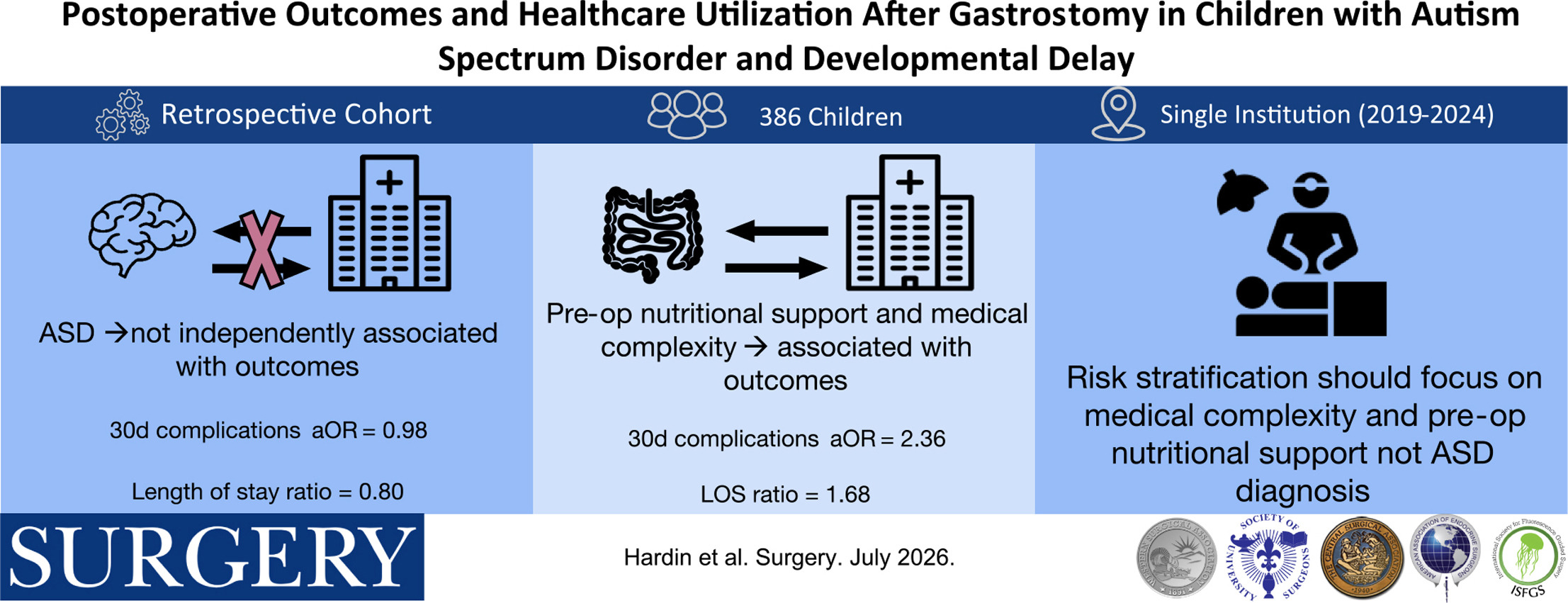
Among the cohort, 82 children had ASD and were significantly older (mean 4.9 years) compared to their non-ASD counterparts (mean 1.3 years, P < .001). They also had a higher prevalence of developmental delay (72% vs 41%, P < .001). Despite these differences, ASD itself was not significantly associated with either prolonged length of stay (adjusted geometric means ratio 0.80, P = .27) or increased odds of postoperative complications (adjusted odds ratio [aOR] 0.98, P = .97).
In contrast, developmental delay alone was independently associated with increased odds of postoperative complications (aOR 1.94, P < .05), indicating a nearly twofold higher risk, although it correlated with a shorter length of hospital stay (adjusted geometric means ratio 0.52, P < .001), the latter possibly indicative of clinical management strategies or discharge planning nuances.
Preoperative nutritional support emerged as a strong predictor for both extended length of stay (adjusted geometric means ratio 1.68, P < .01) and higher postoperative complication risk (aOR 2.36, P = .02), underscoring the importance of underlying medical complexity beyond diagnostic classification.
Expert Commentary and Interpretation
This study contributes important nuance to the perioperative risk profile of children with ASD undergoing gastrostomy tube placement. The absence of an independent association between ASD and adverse postoperative outcomes challenges prior assumptions that ASD diagnosis alone confers heightened surgical risk. The findings align with emerging literature emphasizing that medical complexity and functional status, rather than categorical diagnoses, principally drive surgical morbidity.
The strong linkage between developmental delay and complications emphasizes the heterogeneity within the neurodevelopmental disorder spectrum. This may reflect associated comorbidities such as seizures, hypotonia, or poorer baseline nutritional status, which are known to complicate recovery.
Interestingly, preoperative nutritional support was a key determinant of outcomes, reflecting the critical role of baseline nutritional and systemic health in surgical resilience. This highlights the potential value of optimizing nutritional status preoperatively when feasible and vigilant postoperative monitoring in children with complex medical needs.
Limitations of the study include its single-center design, which may limit generalizability, and reliance on diagnostic coding and clinical records to identify ASD status and developmental delay. The retrospective nature precludes causal inference, and unmeasured confounding cannot be excluded. Nonetheless, the large sample size and adjustment for important covariates strengthen the findings.
Conclusion and Future Directions
Autism spectrum disorder by itself does not independently predict longer hospital stays or increased postoperative complications following gastrostomy tube placement in children. Instead, postoperative outcomes are more closely related to developmental delay and preoperative nutritional support status, markers of broader medical complexity.
Clinicians should consider holistic assessments of neurodevelopmental status and nutritional needs when planning gastrostomy interventions. Future prospective, multicenter studies incorporating standardized neurodevelopmental assessments and nutritional biomarkers could further elucidate risk profiles and inform tailored perioperative care pathways. Additionally, integrating family-centered care approaches to address the unique behavioral and communication needs of children with ASD may enhance surgical experiences and outcomes.
Funding and Clinical Trials Registration
No funding details or clinical trials registration were provided in the original study summary.
References
- Hardin B, Papillon S, Wunker C, Mezuk B, Gadepalli S. Postoperative outcomes and health care utilization after gastrostomy in children with autism spectrum disorder and developmental delay. Surgery. 2026 Sep 3;110605. PMID: 42791101.
- Reilly S, Skuse D, Wolke D, et al. Parental stress, family functioning and child development in families attending a specialist feeding clinic. J Pediatr Gastroenterol Nutr. 2019;68(1):84-90.
- McSweeney ME, Boyd RN, Meehan EM, et al. Feeding difficulties and interventions in children with ASD: A review of the literature. Dev Med Child Neurol. 2020;62(7):741-747.