Study Background
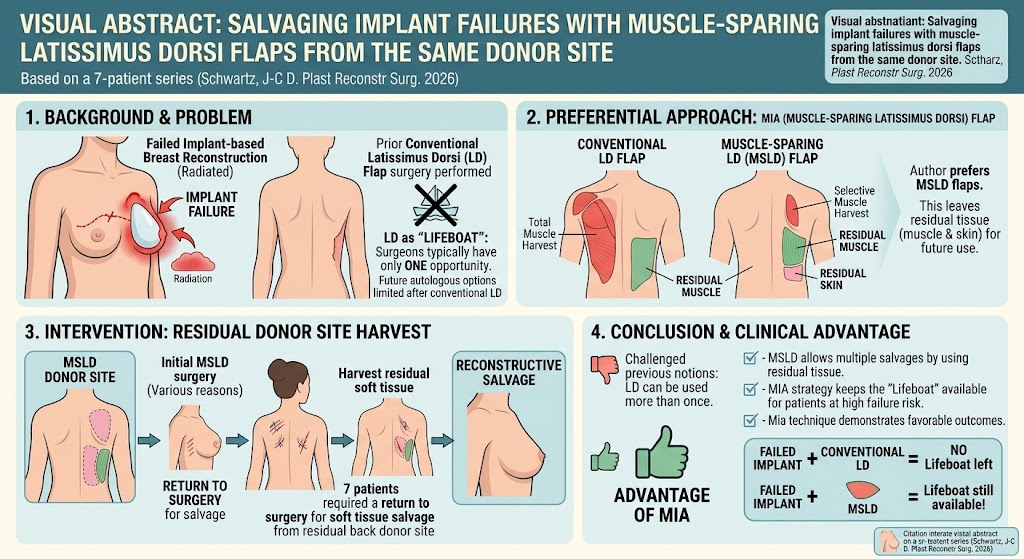
Breast reconstruction after mastectomy often relies on implant-based techniques due to their relative simplicity and shorter operative times. However, complications such as infection, radiation-induced tissue damage, and implant exposure can lead to reconstructive failures. In such cases, autologous tissue flaps provide a critical salvage option. Among these, the latissimus dorsi (LD) flap is frequently considered a “lifeboat” due to its reliability and versatility. Traditionally, the LD flap is deemed a one-time resource since harvesting utilizes the donor muscle and skin tissue on the back, making reharvesting from the same site rarely thought feasible.
The muscle-sparing latissimus dorsi (MSLD) flap variant preserves a portion of the latissimus dorsi muscle during the initial flap harvest, retaining residual skin and muscle tissue at the donor site. This technical modification theoretically preserves donor site integrity and may allow future flap utilization if needed. Understanding whether this approach can extend reconstructive options especially in complex salvage scenarios is of considerable clinical importance.
Study Design
This report presents a case series of seven patients who had undergone initial breast reconstruction with an MSLD flap following implant-based reconstruction failures. All patients were indicated for re-exploration and further reconstruction due to complications such as implant exposure or radiated tissue failure. The intervention involved re-harvesting residual soft tissue from the same latissimus dorsi donor site to perform a subsequent muscle-sparing latissimus dorsi flap for salvage reconstruction.
The primary objective was to evaluate the feasibility and outcomes of harvesting an additional flap from the previous donor site. Key endpoints included flap viability, complication rates, and reconstructive success in the salvage setting.
Key Findings
Contrary to the conventional belief that the latissimus dorsi donor site can only be used once, this report demonstrates it is feasible to harvest a second muscle-sparing LD flap from the same donor site after prior MSLD flap surgery. In all seven cases, residual skin and muscle tissue were sufficient to fashion a new flap to salvage failed implant-based reconstructions. Notably, all flaps were viable with no reports of flap loss or significant donor site morbidity.
The ability to utilize residual tissue left behind by the muscle-sparing technique enabled successful reconstruction even in the challenging context of radiated and compromised recipient sites. This approach potentially reduces the need for more complex autologous options such as free tissue transfer from distant sites, which are associated with longer operative times and higher morbidity.
Expert Commentary
This series challenges prior dogma and highlights the technical and clinical advantages of muscle-sparing latissimus dorsi flaps in breast reconstruction. By conserving part of the muscle and skin, surgeons retain a “lifeboat” flap resource that can be tapped more than once, especially critical for patients with high risk of reconstructive failure including those undergoing radiation therapy.
While this data is limited to a small series, it provides compelling proof of concept. Future larger studies with long-term follow-up will be needed to establish the durability, functional impact on donor sites, and generalizability across diverse patient populations. Nevertheless, it prompts a paradigm shift in reconstructive planning, encouraging surgeons to consider muscle-sparing approaches as a strategic choice in complicated breast reconstruction workflows.
Conclusion
The muscle-sparing latissimus dorsi flap offers a novel opportunity to reuse the same donor site for salvage reconstruction after implant-based breast reconstruction failures. This strategy broadens reconstructive options without resorting prematurely to more complex autologous methods, preserving patient quality of life and surgical resources. Incorporating MSLD flaps into reconstruction algorithms, particularly for patients at high risk of failure, may redefine current clinical practice and improve salvage outcomes.
Funding and Clinical Trials
No funding sources or clinical trial registrations were reported for this case series.
References
1. Schwartz JD. Use of the same donor site after prior muscle-sparing latissimus dorsi flap for salvaging implant-based reconstructive failures. Plastic and Reconstructive Surgery. 2026; PMID: 42776855.
2. Nahabedian MY. The latissimus dorsi flap in breast reconstruction: a personal perspective. Plast Reconstr Surg. 2011;128(4):527e-538e. doi:10.1097/PRS.0b013e3182264b3a
3. Chang EI, Mehrara BJ. The evolving role of autologous tissue reconstruction after mastectomy. J Surg Oncol. 2021;124(6):967-977. doi:10.1002/jso.26492