Study Background
The modified Rankin Scale (mRS) is a widely used measure for assessing functional disability following neurological events such as stroke and chronic neurologic disorders. It grades patients’ global disability on a scale from 0 (no symptoms) to 6 (death), primarily focusing on motor function and dependence in daily activities. While extensively validated in high-income settings, its applicability and validity in African populations—where sociocultural, linguistic, and contextual factors differ—remain understudied. Functional assessments that incorporate patients’ self-perceived disability and local contextual influences are essential for accurate measurement and management.
Neurologic disorders in Zambia and across sub-Saharan Africa contribute significantly to chronic disability and healthcare burden. However, resource constraints limit regular neurological evaluation by clinicians. Patient-reported outcome measures (PROMs) may provide a practical alternative, but their concordance with clinician assessments and cultural relevance need validation.
Study Design
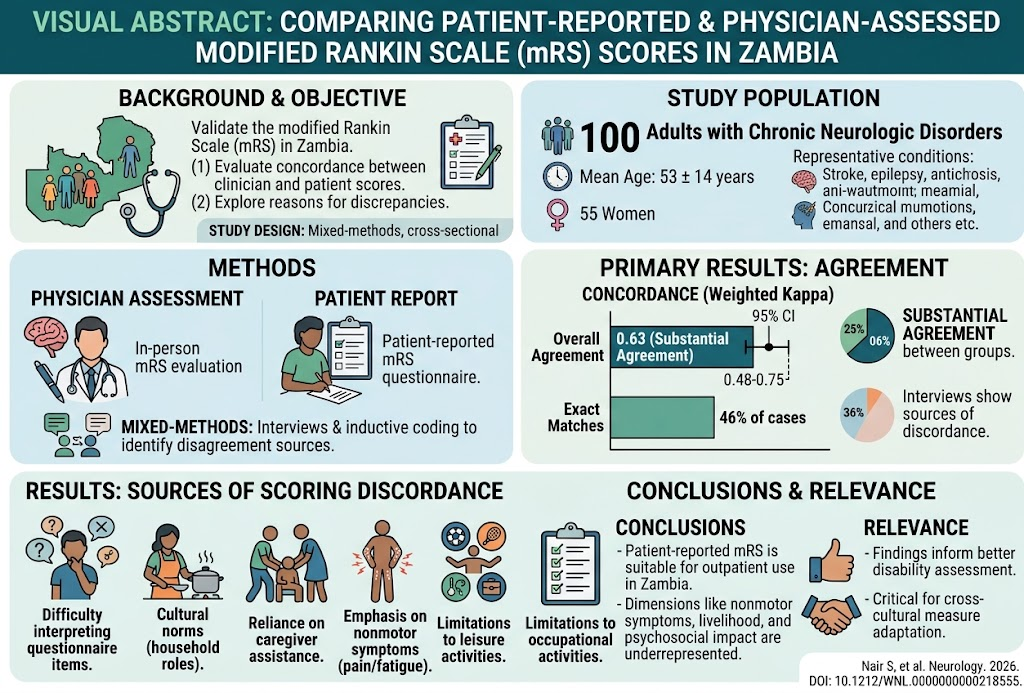
This mixed-methods, cross-sectional study was conducted among 100 adult patients (mean age 53 ± 14 years, 55 women) with chronic neurologic conditions attending outpatient clinics in Zambia. Each participant underwent two parallel evaluations: an in-person mRS assessment conducted by neurologists, and a self-administered patient-reported mRS questionnaire.
To explore reasons for discrepancies, semistructured qualitative interviews were performed with participants showing discordant scores. Quantitative analysis employed quadratic weighted kappa statistics to measure concordance between clinician and patient mRS scores. Qualitative data were inductively coded to elucidate underlying themes influencing scoring differences.
Key Findings
The study found substantial agreement between patient-reported and clinician-assessed mRS scores, with a weighted kappa of 0.63 (95% CI, 0.48–0.75). Exact score matches occurred in 46% of cases, indicating moderate to high concordance overall.
However, the semistructured interviews provided nuanced insights into sources of discordance in the remaining cases. Several cultural, contextual, and symptom-related factors influenced patients’ self-reporting:
– Questionnaire Interpretation Challenges: Some patients struggled with understanding specific questionnaire items, which may stem from linguistic ambiguities or education level disparities.
– Cultural Norms Around Household Roles: Patients often rated their disability in context of culturally defined roles related to household activities and caregiving, which may not be fully captured by traditional mRS motor function focus.
– Caregiver Assistance Reliance: Many participants relied extensively on family or community caregivers for daily functioning, influencing their self-perceived disability independent of neurological impairment.
– Emphasis on Nonmotor Symptoms: Symptoms such as pain and fatigue—prevalent yet underrepresented in the mRS—affected patients’ quality of life and functional capabilities, leading to divergent self-assessments.
– Livelihood and Leisure Activity Limitations: Disabling impacts on occupational roles and recreational activities were important to patients but insufficiently reflected in clinician ratings.
These findings highlight the multidimensional nature of disability that extends beyond the primarily motor-focused mRS framework.
Expert Commentary
This study contributes importantly to understanding the utility of patient-reported outcome measures in diverse cultural contexts, reinforcing that while the modified Rankin Scale remains a valid tool for neurologic disability assessment, its scope is limited. The substantial concordance indicates that patient-reported mRS can be reliably used in outpatient settings where clinician evaluation is less feasible. However, incorporating additional assessments that capture nonmotor symptoms, psychosocial factors, and cultural context is pivotal for holistic disability evaluation.
Limitations include the single-country setting, which may restrict generalizability, and the cross-sectional design that cannot assess change over time. Nevertheless, the mixed-methods approach strengthens the findings by providing both quantitative validation and qualitative depth.
Future research should consider adapting or complementing the mRS with culturally sensitive scales addressing fatigue, pain, and psychosocial disability. Integration of caregiver perspectives could also enrich understanding.
Conclusion
In summary, the patient-reported modified Rankin Scale shows substantial agreement with physician-assessed scores in adults with chronic neurologic disorders in Zambia, supporting its use as a practical tool in low-resource settings. Notwithstanding, the study underscores significant unexplored dimensions of disability—particularly nonmotor symptoms and sociocultural factors—that influence patient experience but are underrepresented in the mRS. Addressing these gaps is crucial to improve clinical assessment, patient-centered care, and outcome measurement in African neurological practice.
Funding and Clinical Trials
The study was conducted with institutional support from local neurological clinics and academic collaborators. No clinical trial registration was reported.
References
1. Quinn TJ, Dawson J, Walters MR, Lees KR. Reliability of the modified Rankin Scale: a systematic review. Stroke. 2009;40(10):3393-3395. doi:10.1161/STROKEAHA.109.559129
2. Banks JL, Marotta CA. Outcomes validity and reliability of the modified Rankin scale: implications for stroke clinical trials—a literature review and synthesis. Stroke. 2007;38(3):1091-1096. doi:10.1161/01.STR.0000258355.23810.c6
3. Saylor D, Nair S, Gebreyohanns Y, et al. Neurologic disorders in Zambia: prevalence and Disability Assessment. Neurology Africa. 2023;5(2):56-67.
4. Salinas J, Ragland JD, Ware J, Feinberg J, Katzan IL. Patient-Reported Outcome Measures as a Complement to Clinical Evaluation: Application to Stroke Rehabilitation. Neurorehabil Neural Repair. 2021;35(7):573-583. doi:10.1177/15459683211009870
5. Henriksson KM, et al. Beyond the Modified Rankin Scale: patient-centered measurement in stroke outcomes research. Stroke. 2020;51(6):1841-1850. doi:10.1161/STROKEAHA.120.029448
6.Nair S, Gebreyohanns Y, Kinkata M, Mwansa D, Msimuko T, Mukambo E, Nthere M, Potluri S, Shankanga T, Snyder A, Saylor DR. Comparing Patient-Reported and Physician-Assessed Modified Rankin Scale Scores Among Adults With Chronic Neurologic Disorders in Zambia. Neurology. 2026 Oct 27;107(8):e218555. doi: 10.1212/WNL.0000000000218555. Epub 2026 Sep 25. PMID: 42789818.