Study Background
Prostate cancer is one of the most common malignancies affecting men worldwide, with many patients receiving androgen deprivation therapy (ADT) as a primary treatment modality. ADT, while effective for cancer control, has been associated with adverse cardiovascular effects including increased risk factor burden and potentially higher rates of cardiovascular events. Cardiovascular disease (CVD) remains the leading cause of morbidity and mortality in prostate cancer survivors, highlighting an unmet clinical need to optimize cardiovascular risk management within this population.
Despite this, cardiovascular risk factors such as dyslipidemia, hypertension, and smoking are frequently under-recognized or poorly controlled in prostate cancer patients undergoing ADT. The potential benefit of systematically engaging cardiovascular specialists to manage these risk factors during routine oncology care has thus been proposed but not rigorously tested in large, randomized trials.
Study Design
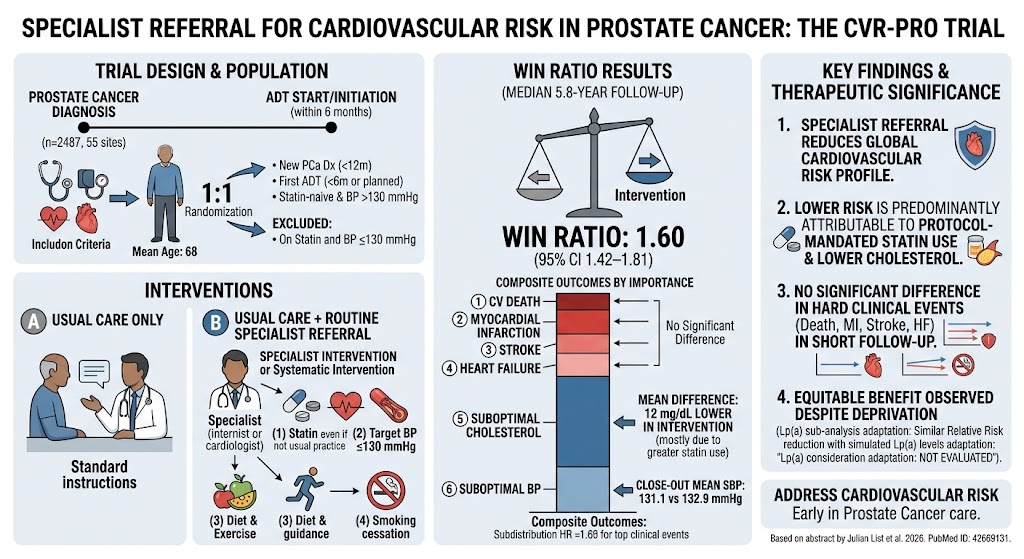
This multinational randomized clinical trial enrolled 2,487 patients with prostate cancer from 55 sites across 8 countries between 2015 and 2025. Eligible participants were diagnosed within 12 months, had either recently initiated ADT (within 6 months) or were planned to start ADT imminently. Patients already on statins with systolic blood pressure (SBP) ≤130 mm Hg were excluded to focus on undertreated individuals.
Participants were randomized 1:1 to receive either usual care alone or usual care plus mandatory referral to a cardiovascular specialist (internist or cardiologist). The specialists implemented a systematic risk factor management strategy targeting SBP ≤130 mm Hg and recommending statin therapy regardless of baseline lipid profiles. Additional interventions included encouragement of smoking cessation, and guidance on diet and exercise, aiming for comprehensive cardiovascular risk mitigation.
The primary outcome was a hierarchical composite evaluated using the win ratio, incorporating cardiovascular death, myocardial infarction, stroke, heart failure, and surrogate markers of cardiovascular risk control defined as suboptimal cholesterol (total cholesterol >155 mg/dL) and suboptimal SBP (>130 mm Hg).
Key Findings
Over a median follow-up of 5.8 years (IQR 2.7–8.2), the intervention group demonstrated a statistically significant improvement in the primary composite outcome, with a win ratio of 1.60 (95% CI, 1.42–1.81) favoring specialist referral. This benefit was predominantly driven by better cholesterol management; the intervention group had a mean total cholesterol reduction of 12 mg/dL (95% CI, 9-15 mg/dL) compared with controls, attributed largely to higher protocol-directed statin use.
Blood pressure control differences were modest: mean SBP was 131.1 mm Hg (SD 16.9) in the intervention arm versus 132.9 mm Hg (SD 18.3) in controls. Importantly, there was no significant difference between groups regarding time to clinical cardiovascular events such as cardiovascular death, myocardial infarction, stroke, or heart failure (subdistribution hazard ratio 1.08; 95% CI, 0.79-1.49).
The findings suggest that while enhanced cardiovascular risk factor management is achievable and sustainable with specialist involvement, this did not translate into reduced major adverse cardiovascular events within the study timeframe.
Expert Commentary
This large, well-designed randomized trial addresses an important clinical question arising at the intersection of oncology and cardiology. The results confirm that proactive referral to cardiovascular specialists improves key modifiable risk factors, especially lipid levels, in prostate cancer patients receiving ADT. The choice to implement a statin strategy irrespective of cholesterol levels reflects an aggressive preventive approach, consistent with evolving paradigms favoring broader statin use in high-risk populations.
Nonetheless, several considerations temper the enthusiasm for definitive clinical impact. The similar incidence of major cardiovascular events between groups raises questions about the clinical relevance of surrogate endpoint improvements or the need for longer follow-up. It is also possible that baseline cardiovascular risk profile and competing mortality risks in this population diminish the marginal benefit seen with risk factor intensification.
The modest difference in blood pressure control highlights challenges in hypertension management, possibly underpinning the lack of reduction in cardiovascular events. Future studies might explore multifactorial interventions integrating more rigorous blood pressure control alongside lipid management and lifestyle modification.
Limitations include potential heterogeneity in standard care across international sites, adherence variability, and the pragmatic nature of the intervention. Nevertheless, this trial provides compelling evidence supporting a multidisciplinary, cardioprotective approach during prostate cancer management.
Conclusion
This multinational randomized clinical trial demonstrates that routine referral of prostate cancer patients on ADT to cardiovascular specialists leads to significant improvements in cholesterol control, primarily through protocol-driven statin therapy. However, these improvements did not correspond with a reduction in hard cardiovascular outcomes during nearly six years of follow-up. The findings suggest that while specialty-based risk factor optimization is feasible and beneficial for surrogate endpoints, further research is needed to determine strategies that meaningfully reduce cardiovascular events in this high-risk group.
Clinicians managing prostate cancer patients should consider integrated cardiovascular risk assessment and management as part of comprehensive care, with a focus on personalized risk-benefit evaluations for lipid and blood pressure interventions.
Funding and Trial Registration
The trial was registered at ClinicalTrials.gov (Identifier: NCT03127631). Details regarding funding sources were not provided in the abstract but are vital for complete appraisal and should be consulted in the full publication.
References
- Leong DP et al. Specialist Referral for Cardiovascular Risk in Patients With Prostate Cancer: A Randomized Clinical Trial. JAMA Internal Medicine. 2026 Aug 30. PMID: 42669035.
- Tsao CK, White K, D’Amico AV. Cardiovascular effects of androgen deprivation therapy in prostate cancer. Clin Adv Hematol Oncol. 2012;10(3):179-181.
- National Comprehensive Cancer Network (NCCN) Clinical Practice Guidelines in Oncology: Prostate Cancer. Version 4.2024.
- Tardif JC, et al. Prevention of cardiovascular events: current guidelines and evidence. Nat Rev Cardiol. 2020;17(11):694–711.