Highlight
– Lung cavitation extent on chest radiograph and cough duration correlate positively with TB transmission risk among household contacts in a large Peruvian cohort.
– These indicators showed dose-response associations with TB infection prevalence but weaker links to incident TB disease.
– The modified Bandim TB score did not predict transmission risk in this study.
– Simple, readily available clinical features may help prioritize contact investigation and preventive therapy in high-burden settings.
Study Background
Tuberculosis (TB) remains a leading infectious cause of morbidity and mortality worldwide, especially in high-burden settings such as Peru. Interruption of TB transmission is central to global TB control strategies, yet the ability to identify individuals with active TB who are most infectious remains limited in routine clinical practice. Conventional methods to assess TB infectiousness, including sputum bacillary load and bacterial culture, often require advanced laboratory infrastructure not universally accessible. There is an urgent need for pragmatic clinical indicators readily available in routine care to stratify transmission risk, allowing targeted interventions such as preventive therapy among household contacts (HHCs), who are at elevated risk of TB infection and disease. This study addresses whether simple clinical markers like lung cavitation detected on chest radiograph, cough duration, and the modified Bandim TB score can serve as reliable predictors of transmission risk in a large household contact cohort in Lima, Peru.
Study Design and Methods
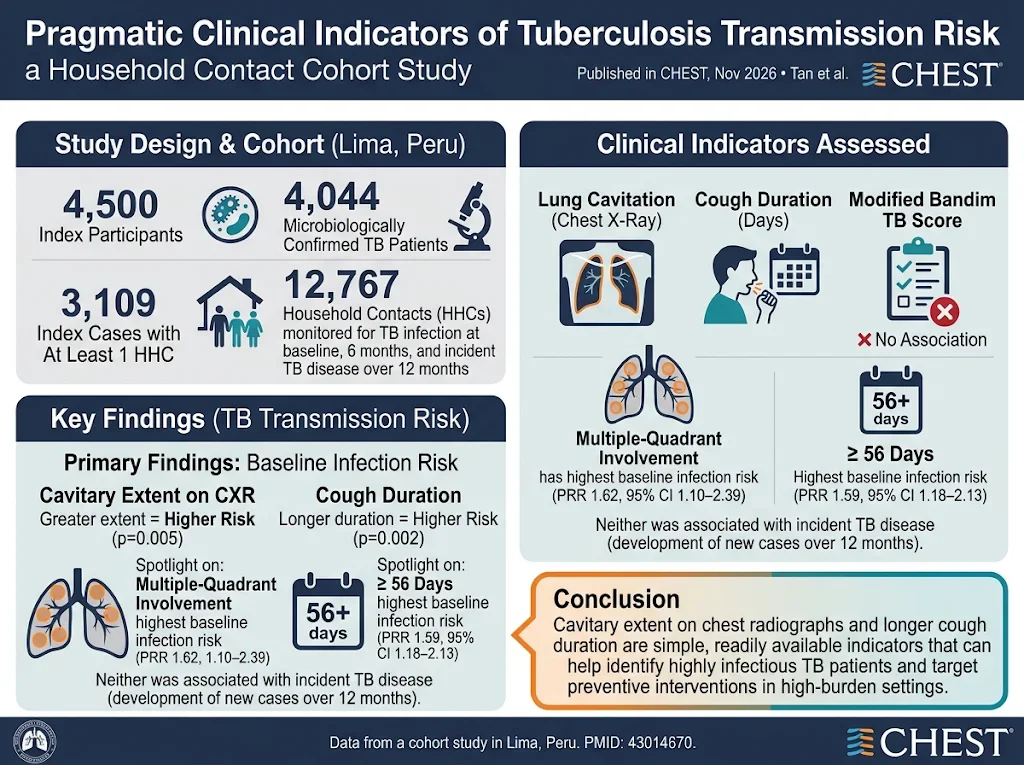
This observational cohort study enrolled 4,500 index participants diagnosed with TB in Lima, Peru. Among these, 4,044 had microbiologically confirmed TB, and 3,109 index participants had at least one HHC, culminating in 12,767 HHCs being followed. Index patients underwent chest radiography to assess cavitary lung disease extent and a clinic-based TB symptom assessment to calculate a modified Bandim TB score, incorporating symptom severity metrics. The primary outcomes measured in HHCs were baseline TB infection status, 6-month infection status, and incident active TB disease over 12 months of follow-up. Statistical analyses involved modified Poisson regression models with generalized estimating equations to adjust for clustering and relevant confounders. The study focused particularly on child HHCs, given their vulnerability to progressing from latent infection to active disease.
Key Findings
The study revealed a clear association between increased cavitary extent on chest X-ray and higher risk of prevalent TB infection among child household contacts. Specifically, multiple-quadrant cavitation conferred a significantly higher baseline infection risk compared with no or limited cavitation (adjusted prevalence risk ratio [PRR], 1.62; 95% confidence interval [CI], 1.10-2.39; trend P=0.005). Likewise, prolonged cough duration also correlated positively with increased TB infection risk, with those coughing ≥56 days exhibiting the highest baseline infection prevalence (adjusted PRR, 1.59; 95% CI, 1.18-2.13; trend P=0.002). Similar trends were observed for 6-month infection status, reinforcing the stability of these associations over time.
However, when considering incident active TB disease among HHCs over 12 months, these markers showed weaker and statistically non-significant associations. For cavitary extent, the adjusted cumulative risk ratio was 1.20 (95% CI, 0.56-2.60), and for prolonged cough duration, 1.30 (95% CI, 0.85-1.99). This suggests that while such clinical features can predict transmission-leading infection, progression from latent infection to active disease likely involves additional host and environmental factors.
Interestingly, the modified Bandim TB score, which synthesizes clinical symptom burden, was not associated with either TB infection or incident disease risk in contacts. This finding may reflect the limited discriminatory power of symptom scores alone in identifying infectiousness or transmission potential versus direct radiological and cough duration assessments.
Expert Commentary
This study by Tan et al. is significant for illustrating that simple clinical markers—lung cavitation extent and cough duration—can serve as proxies for infectiousness in patients with active TB in resource-limited, high-burden contexts. The dose-response relationships observed support biological plausibility where more extensive cavitary disease corresponds to higher bacterial loads shed during coughing. Prolonged cough likely reflects sustained bacillary dissemination. Notably, the lack of association between the modified Bandim score and transmission highlights a gap in symptom-based assessments, which could omit radiographic and duration factors influencing transmission dynamics.
These findings align with prior knowledge that cavitary pulmonary TB is more infectious, but empirically quantify this relationship in a large cohort under operational conditions. The focus on child contacts is relevant, as children have increased susceptibility to developing active TB after infection. However, the weaker correlations with incident TB disease underscore the complexity of progression beyond exposure.
Limitations include reliance on chest radiographs interpreted visually without volumetric quantitation, potential misclassification of infection using tuberculin skin test or interferon gamma release assays, and lack of evaluation of other transmission factors such as sputum bacillary load, ventilation, and behavioral interactions within households. The generalizability may be reduced outside of similar urban, high-burden settings.
Conclusion
This large household cohort study demonstrates that readily accessible clinical indicators—extent of lung cavitation visible on chest radiographs and the duration of cough—are positively associated with increased TB transmission risk, particularly evidenced by infection prevalence among child contacts. These findings provide evidence to support the use of such pragmatic markers for prioritizing contact investigations and preventive interventions such as isoniazid or rifapentine-based therapy in high-burden TB settings. Future studies should incorporate microbiological and environmental transmission assessments and explore factors influencing progression to active disease. Nevertheless, integrating simple clinical indicators into TB control programs may facilitate focused management and reduce ongoing transmission.
Funding
Funding information was not disclosed in the abstract. Further details can be accessed via the published article.
References
1. Tan Q, Huang CC, Becerra MC, Calderon R, Contreras C, Lecca L, Jimenez J, Yataco R, Galea JT, Zhang Z, Murray MB. Pragmatic Clinical indicators of Tuberculosis Transmission Risk: a Household Contact Cohort Study. Chest. 2026 Nov 11. PMID: 43014670.
2. World Health Organization. Global Tuberculosis Report 2023. WHO, 2023.
3. Menzies NA, Cohen T, Murray M, Salomon JA. Effect of duration and timing of tuberculosis transmission episodes: a modelling analysis. Eur Respir J. 2019;54(1):1801486.
Specialty calculators
For clinical reference; use professional judgment.