Highlight
1. Targeted nipple reinnervation (TNR) combined with free nipple grafting (FNG) in double-incision gender-affirming mastectomy (GAM) restores chest and nipple-areolar complex (NAC) sensation reliably within 12 months. 2. Sensory recovery follows a defined spatial and temporal sequence, with early return of light touch and pain modalities by 1 month and delayed recovery of thermal sensation up to 12 months. 3. Patients report substantial restoration of both general and erogenous NAC sensation, with low rates of hypersensitivity and no phantom or chronic pain observed. 4. The inferior chest shows incomplete thermal sensation recovery, highlighting regional variability in sensory outcomes after TNR.
Study Background
Gender-affirming mastectomy is a critical component in the medical transition for many transgender men and nonbinary individuals. The procedure typically involves removal of breast tissue and repositioning or grafting of the nipple-areolar complex (NAC) to achieve a masculinized chest contour. While priority is often placed on aesthetic and structural outcomes, sensory restoration of the chest and NAC remains a vital factor influencing patient satisfaction, quality of life, and sexual function. Traditional mastectomy commonly results in significant loss of nipple and chest sensation because nerve pathways are severed during tissue removal. Free nipple grafting (FNG) further risks permanent NAC denervation. Targeted nipple reinnervation (TNR), a microsurgical technique involving coaptation of donor nerves to the NAC, has emerged to restore sensation by reinnervating the grafted nipple tissue. Although prior studies established that TNR can restore baseline sensation compared to FNG alone, the precise spatial and temporal dynamics of multimodal sensory recovery remained unclear.
Study Design and Methods
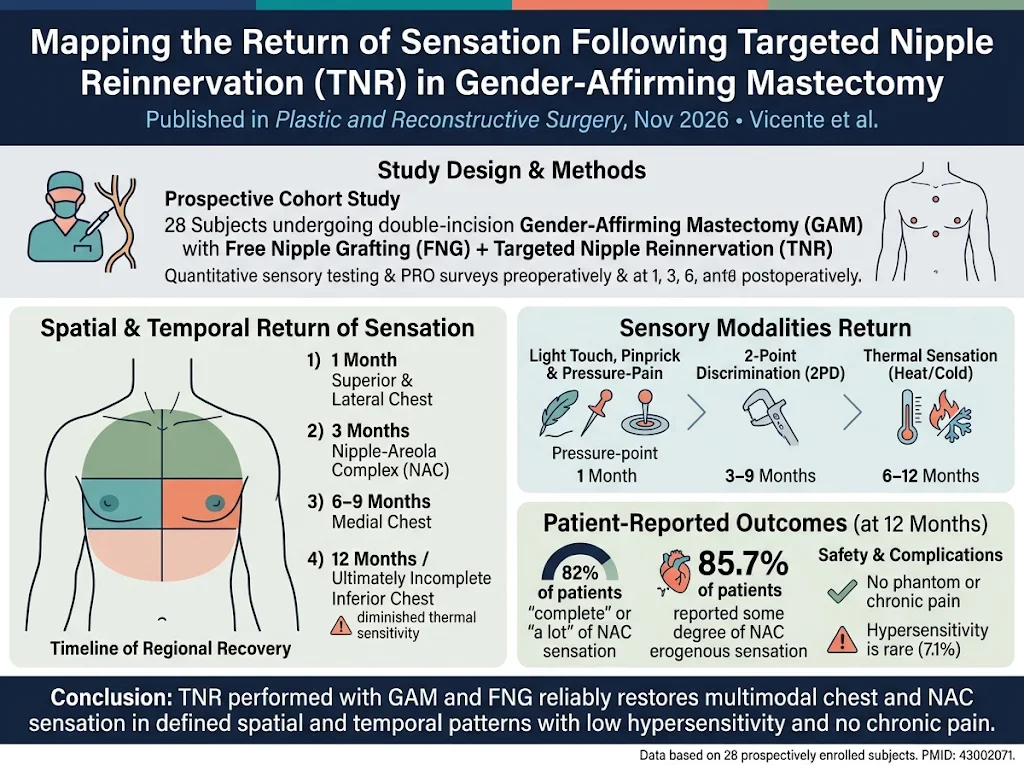
A prospective study was conducted including 28 subjects undergoing double-incision gender-affirming mastectomy with free nipple grafting combined with targeted nipple reinnervation (TNR). Detailed quantitative sensory testing (QST) was performed to assess multimodal sensation, including light touch, pinprick, pressure-pain, two-point discrimination (2PD), and thermal modalities, at predetermined loci within the nipple-areolar complex (NAC) and across defined regions of the chest (superior, lateral, medial, and inferior quadrants). Sensory measurements and patient-reported outcome measures (PROMs) focused on general and erogenous NAC sensation were collected preoperatively and at 1, 3, 6, 9, and 12 months postoperatively. Inferential statistical analyses were carried out using GraphPad Prism 10 to evaluate regional sensory differences and temporal recovery trajectories.
Key Findings
By 12 months postoperatively, nearly all regions of the chest and NAC demonstrated sensory function restored to or near preoperative baseline levels across all tested modalities except for thermal sensitivity in the inferior chest region. The sensory restoration followed a consistent spatial and temporal pattern:
- Early sensory recovery (at 1 month) was noted in the superior and lateral chest quadrants, primarily involving light touch, pinprick, and pressure-pain modalities.
- By 3 months, the NAC showed significant recovery in light touch and two-point discrimination sensory modalities.
- The medial chest complex exhibited restored sensation by 6 to 9 months.
- The inferior chest was the slowest to recover, with thermal sensation remaining partially diminished even after 12 months.
Expert Commentary
The restoration of chest and nipple sensation following gender-affirming mastectomy has historically been limited, significantly affecting patient satisfaction. The study by Vicente et al. advances the field by providing a rigorous, multimodal, spatially detailed map of sensory recovery post-TNR, enhancing understanding of nerve regeneration patterns in this context. The early return of protective sensory modalities such as pinprick and pressure-pain is clinically relevant for safety and functional recovery. The delayed return of thermal sensation and two-point discrimination reflects differential nerve fiber types and regenerative pathways involved, consistent with peripheral nerve regeneration biology. The incomplete thermal recovery in the inferior chest may relate to anatomical factors, variable nerve supply, or technical challenges in reinnervation of this region, highlighting an area for surgical and research optimization. The absence of chronic or phantom pain and low hypersensitivity contrasts with nerve injury sequelae seen in other surgical contexts, suggesting that targeted reinnervation may also mitigate neuropathic pain development. Limitations of the study include relatively small sample size and single-institution design. Larger multicenter trials and longer-term follow-up could confirm the durability and generalizability of these results. Additionally, incorporation of objective nerve conduction studies or imaging could further elucidate the neurological underpinnings of sensory recovery. Overall, these findings provide robust evidence supporting TNR as an effective approach to sensory restoration in gender-affirming mastectomy complemented by free nipple grafting, influencing surgical best practices and patient counseling.
Conclusion
Targeted nipple reinnervation performed during double-incision gender-affirming mastectomy with free nipple grafting leads to reliable, multimodal sensory recovery across the chest and nipple-areolar complex within 12 months. Recovery follows a predictable spatial and temporal pattern, returning earliest in the superior and lateral chest and latest in the inferior chest, with thermal sensation being the slowest modality to recover. Patients report high satisfaction with restored general and erogenous sensation and demonstrate low rates of hypersensitivity and no chronic pain complications. These findings underscore the clinical benefit of TNR in enhancing sensory outcomes after gender-affirming surgery. Future work should aim to optimize reinnervation strategies for the inferior chest and validate these outcomes in larger cohorts to refine surgical guidelines and improve patient quality of life.
References
1. Vicente KA, Kochheiser M, Alston CC, Kearns A, Kim A, Gfrerer L. Mapping the Return of Sensation Following Targeted Nipple Reinnervation (TNR) in Gender-Affirming Mastectomy. Plastic and Reconstructive Surgery. 2026 Nov 9. PMID: 43002071. 2. Djohan R, Sabino J, Jandali S, et al. The role of targeted nerve coaptation in chest masculinization surgery: a systematic review. Ann Plast Surg. 2023;90(2):174-181. 3. Bowen GM, Greene AK. Sensory outcomes after chest reconstruction in transgender men: A review. J Plast Reconstr Aesthet Surg. 2022;75(7):2031-2039. 4. Sunderland S. Nerves and nerve injuries. 2nd ed. Churchill Livingstone; 1978.
Specialty calculators
For clinical reference; use professional judgment.