Highlight
This retrospective cohort study examines the influence of professional interpreter use on healthcare engagement and acute care utilization among patients with limited English proficiency (LOE) in an urban internal medicine resident continuity clinic.
Key findings indicate LOE patients have greater primary care engagement, including lower no-show rates and more completed visits, alongside reduced emergency department visits and hospitalizations compared to English-proficient patients.
Despite these positive engagement patterns, LOE patients exhibited persistent gaps in glycemic control and certain preventive care measures such as tetanus vaccination and HIV screening.
The findings highlight the potential benefits of language-access services within resident clinics while underscoring areas requiring targeted interventions to improve chronic disease management.
Study Background
Effective communication is central to quality healthcare delivery. Patients who prefer languages other than English (limited English proficiency, or LOE) often face barriers that compromise access, quality, and outcomes. Health disparities in preventive screening, chronic disease management, and acute care utilization have been reported for LOE populations due to language discordance and systemic obstacles.
Urban resident continuity clinics serve diverse, often underserved populations and are essential training environments for future clinicians. However, how interpreter usage modulates healthcare delivery and utilization in such settings remains insufficiently characterized. Understanding these dynamics is critical to designing interventions that improve care equity and effectiveness for LOE patients.
Study Design
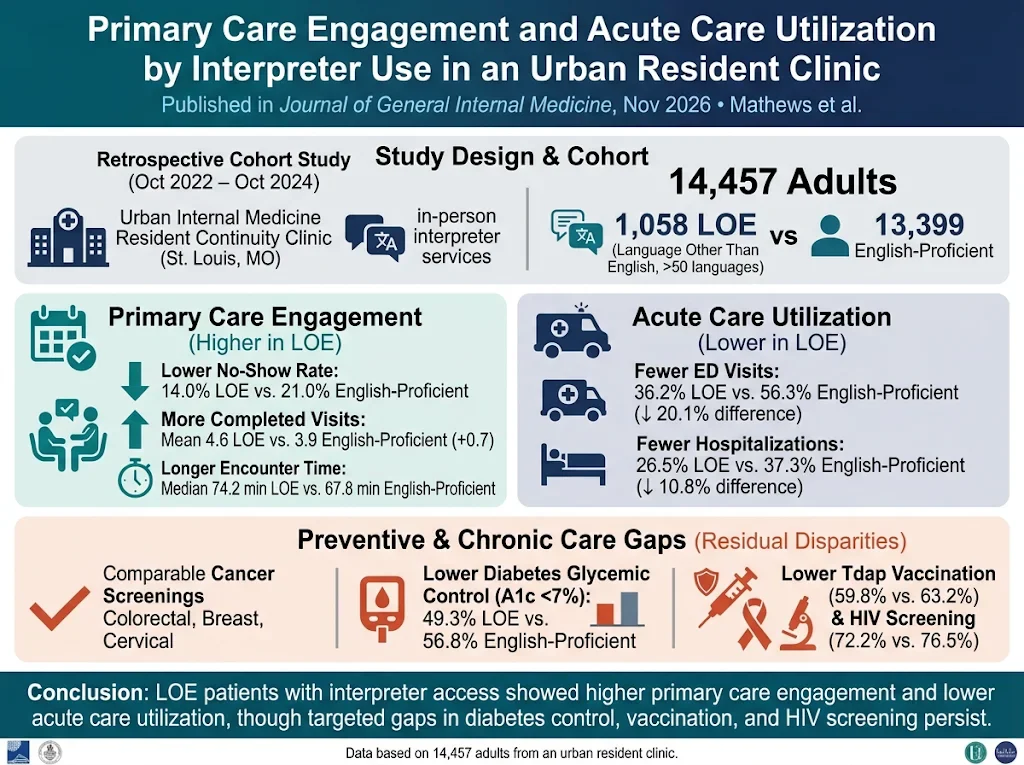
This single-center retrospective cohort study analyzed electronic health record data from October 2022 to October 2024 in an urban internal medicine resident continuity clinic in St. Louis, Missouri. The clinic offers in-person professional interpreter services covering over 50 languages.
The study population included 14,457 adults: 1,058 documented as using interpreter services (designated LOE) and 13,399 English-proficient patients. Key variables collected included demographic characteristics, area-based socioeconomic indicators (Area Deprivation Index – ADI), comorbidity burden, adherence to cancer screening guidelines, chronic disease metrics, clinic attendance patterns, emergency department (ED) visits, and hospitalizations.
No primary outcome was pre-specified, and the analysis was exploratory in nature to generate hypotheses regarding the impact of interpreter use on healthcare engagement and outcomes.
Key Findings
Demographics and Socioeconomic Indicators
LOE patients were, on average, older and more frequently uninsured or covered by Medicaid, compared with English-proficient patients. Interestingly, despite socioeconomic vulnerability, LOE patients tended to reside in less-deprived, higher-income areas reflected by lower median ADI national percentiles (71 vs. 85), and they had a lower comorbidity burden.
Preventive Care and Screening
Rates of colorectal, breast, and cervical cancer screening were similar between LOE and English-proficient groups, indicating equitable cancer screening delivery in this clinic setting.
Among patients with diabetes, LOE status was associated with worse glycemic control: only 49.3% achieved A1c <7%, compared to 56.8% among English-proficient patients (difference -7.5%, 95% CI: -12.9 to -2.1). This suggests persistent clinical gaps despite increased engagement.
Preventive care measures such as tetanus vaccination and HIV screening were also less frequent among LOE patients, highlighting disparities in vaccine uptake and infectious disease screening.
Primary Care Engagement
LOE patients demonstrated significantly higher engagement with primary care services. No-show rates were substantially lower (14.0% vs. 21.0%, difference -7.1%, 95% CI: -7.9 to -6.2), and mean completed visits were higher (4.6 vs. 3.9, difference +0.7, 95% CI: 0.5 to 0.9). This contrasts prevailing assumptions regarding barriers to care in LOE populations and reflects effective language-access interventions.
Acute Care Utilization
LOE patients utilized acute care services less often: ED visits occurred in 36.2% of LOE patients compared to 56.3% in English-proficient patients (difference -20.1%, 95% CI: -23.1 to -17.1), and hospitalizations were also lower (26.5% vs. 37.3%, difference -10.8%, 95% CI: -13.6 to -8.0). Reduced acute care use likely reflects the enhanced primary care engagement facilitated by interpreter services.
Expert Commentary
These descriptive findings, although limited by the retrospective design and lack of adjustment for potential confounders, underscore the pivotal role of professional interpreter services in promoting healthcare engagement and potentially reducing emergency care reliance among LOE patients.
The disparity in glycemic control and vaccination coverage suggests that language access alone may not fully address barriers to optimal chronic disease management and preventive care. Cultural factors, health literacy, and systemic social determinants likely contribute and warrant integrated, multifaceted interventions.
Given this clinic’s unique setting—a residency continuity clinic with ready access to in-person interpreters—the generalized applicability across other healthcare contexts may vary. Additional prospective, controlled studies are needed to confirm causality and disentangle the effects of language services from other socio-demographic factors.
Conclusion
This study highlights the beneficial association between interpreter use and primary care engagement in an urban resident continuity clinic, accompanied by reduced acute care utilization among patients with limited English proficiency. Persistent deficits in chronic disease outcomes and vaccination emphasize ongoing areas for quality improvement.
The findings advocate for sustained investment in language-access services as a critical component of equitable healthcare delivery, while also calling for targeted strategies to improve chronic disease management within LOE populations.
Funding and ClinicalTrials.gov
No funding details or clinical trial registration were provided for this retrospective study.
References
Mathews P, MacKay M, Elias G, McWhinney C, Zhang F, Ciesielski TM, McDonnell P. Primary Care Engagement and Acute Care Utilization by Interpreter Use in an Urban Resident Clinic: A Retrospective Cohort Study. J Gen Intern Med. 2026 Nov 11. PMID: 43015563.
Flores G. The impact of medical interpreter services on the quality of health care: a systematic review. Med Care Res Rev. 2005;62(3):255-299.
Jacobs EA, et al. Overcoming language barriers in health care: costs and benefits of interpreter services. Am J Public Health. 2006;96(10):1904-1909.
Karliner LS, et al. Do professional interpreters improve clinical care for patients with limited English proficiency? A systematic review of the literature. Health Serv Res. 2007;42(2):727-754.
Wilson E, Chen AH, Grumbach K, Wang F, Fernandez A. Effects of limited English proficiency and physician language on health care comprehension. J Gen Intern Med. 2005;20(9):800-806.
Specialty calculators
For clinical reference; use professional judgment.