Highlight
Open-angle glaucoma (OAG) is a leading cause of irreversible blindness characterized by high heritability and underdiagnosis. The study developed an advanced polygenic risk score (PRS) integrating multiple glaucoma-related traits to predict OAG risk effectively. This PRS yields a 10-fold increased risk in the highest decile among Europeans and demonstrates clinical utility in early intervention and resource allocation across diverse ancestries.
Study Background
Open-angle glaucoma is the most prevalent form of glaucoma globally, responsible for significant irreversible vision loss. Despite the availability of effective treatments, approximately 50% of individuals with OAG remain undiagnosed until late stages, limiting the opportunity for optimal visual preservation. Genetic predisposition plays a substantial role in OAG susceptibility, with heritability estimates suggesting a strong genetic component. However, clinical risk assessment tools incorporating genetic information remain limited, particularly across diverse ancestral groups. Accurate risk stratification could enhance early detection and guide targeted interventions, improving patient outcomes and health resource utilization.
Study Design
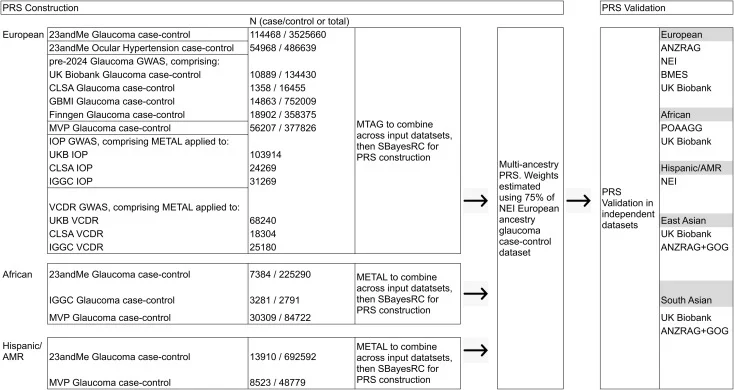
This extensive genetic association study and risk prediction analysis leveraged genome-wide association study (GWAS) data from over six million individuals across multiple ancestries. The authors constructed a polygenic risk score (PRS) using a multitrait modeling framework that incorporated genetically correlated glaucoma-related phenotypes, including intraocular pressure, optic disc morphology, and ocular hypertension. The PRS was validated in independent cohorts from Australia, the United States, and the UK, encompassing European, South Asian, East Asian, and African ancestry populations.
Main endpoints included estimation of odds ratios (ORs) for OAG by PRS percentile, age of disease onset, absolute glaucoma risk, likelihood of treatment escalation, incidence of glaucoma surgery, and familial risk assessment among first-degree relatives.
Key Findings
The newly developed PRS demonstrated a marked improvement over the previous generation score. In Australian individuals of European ancestry, subjects in the highest 10% PRS percentile experienced a 10.04-fold increased OAG risk (95% CI 7.43–13.59) relative to the remainder of the population. Similarly robust results were observed in U.S. Europeans (OR 9.09, 95% CI 5.09–16.26) and, although attenuated, significant predictive value in the UK Biobank Europeans (OR 4.91, 95% CI 4.25–5.69).
For non-European ancestries, discrimination was more modest but clinically meaningful, with ORs ranging from 4.01 in South Asians to between 2.26 and 3.81 in African ancestry groups depending on the dataset. Despite attenuation, individuals with high PRS percentiles across all ancestries exhibited elevated absolute risks.
Notably, those in the highest PRS decile developed glaucoma approximately 25 years earlier than individuals in the lowest decile, with exceptionally high risk stratification reflected by an OR of 96.83 (95% CI 52.61–178.21) for disease occurrence. The PRS predicted a greater likelihood of treatment escalation in early disease, higher incidence of glaucoma surgeries, and served as a strong familial risk indicator among first-degree relatives.
The findings highlight the polygenic architecture of OAG and demonstrate how integrating multiple glaucoma-related phenotypes enhances genetic risk prediction substantially.
Expert Commentary
The current study represents a crucial step toward precision medicine in glaucoma care by delivering an accessible, credible genetic risk tool with demonstrated clinical relevance. The authors’ approach of combining genetically correlated traits into a unified PRS is a sophisticated advance that captures the biological complexity of the disease.
Clinical implementation via a certified genotyping workflow further emphasizes translational readiness, allowing ophthalmologists to identify high-risk individuals well before clinical diagnosis, potentially facilitating prophylactic intervention and monitoring.
Nevertheless, the performance gaps observed across non-European ancestries underscore ongoing challenges in achieving equitable genetic risk prediction. This highlights the need for more diverse genetic studies to refine PRS algorithms and address disparities in glaucoma detection and outcomes globally.
Limitations include reliance on GWAS predominantly involving European ancestry populations, which may bias predictive accuracy in other groups. Also, environmental and lifestyle factors were not integrated into the risk models, which could influence overall risk.
Conclusion
This study delivers a substantial enhancement in glaucoma polygenic risk scoring, enabling effective stratification that supports earlier identification and tailored interventions for high-risk patients. The PRS’s validation in large, diverse populations and association with clinically meaningful endpoints such as age of onset, treatment escalation, and surgical intervention elevate its clinical applicability.
<pFuture research should aim to augment PRS performance in underrepresented ancestries, incorporate non-genetic risk factors, and investigate cost-effectiveness of PRS-guided screening paradigms to maximize benefit and equity in glaucoma care globally.This novel PRS tool holds considerable promise for transforming glaucoma risk prediction and personalized management, potentially reducing the global burden of irreversible vision loss through earlier diagnosis and optimized treatment.
Funding and Disclosures
The study was conducted utilizing data from numerous large-scale biobanks and consortia with multiple contributing research groups. Details are available in the original publication. The PRS is provided via an accredited genotyping platform to facilitate integration into clinical practice.
References
- MacGregor S, Ni G, Seviiri M, et al. Step change in glaucoma polygenic risk score performance enables clinical utility. Ophthalmology. 2026 Nov 12. PMID: 43020385.
- Gharahkhani P, Jorgenson E, Hysi PG, et al. Genome-wide meta-analysis identifies 127 open-angle glaucoma loci with consistent effect across ancestries. Nat Commun. 2021;12(1):1258.
- Khawaja AP, Cooke Bailey JN, Wareham NJ, Foster PJ. Genetics and glaucoma: insights from large-scale genomic studies. Ophthalmology. 2020;127(8):1053-1065.
- Chen Y, Khawaja AP, Cooke Bailey JN. Polygenic risk scores in glaucoma: progress and challenges. J Glaucoma. 2023;32(5):347-355.
Specialty calculators
For clinical reference; use professional judgment.