Introduction and Context
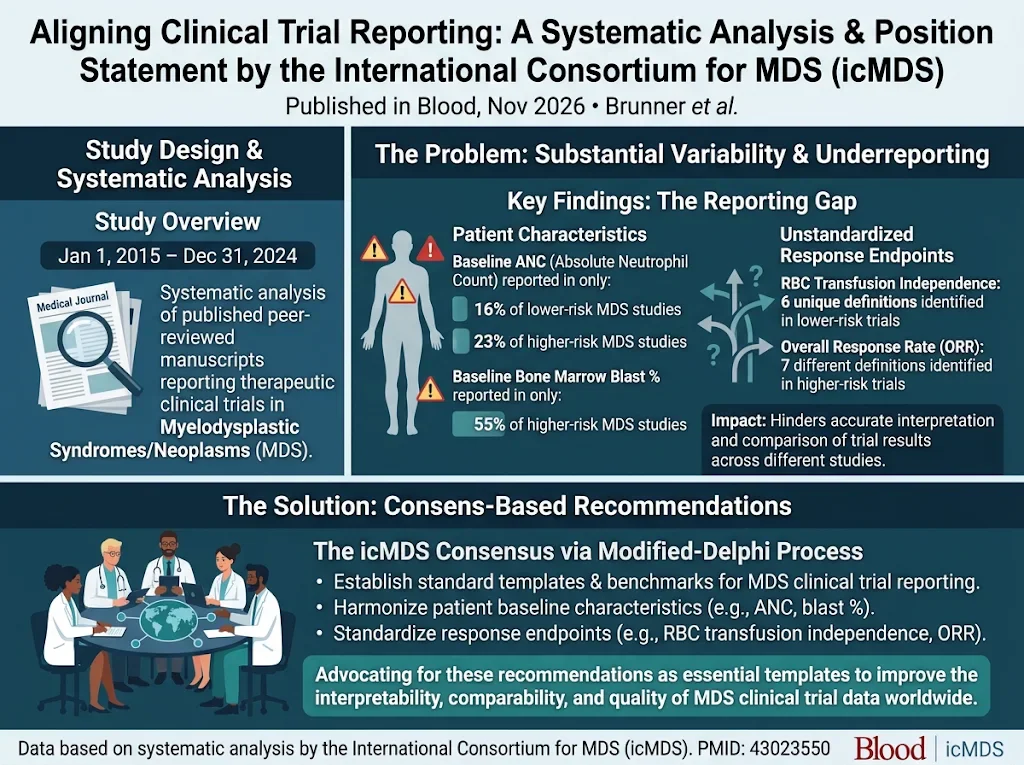
Myelodysplastic syndromes (MDS) are biologically and clinically heterogeneous bone marrow disorders with a spectrum of presentations, from lower-risk disease characterized mainly by cytopenias to higher-risk disease with progressive marrow failure and transformation to acute myeloid leukemia (AML). Over the past decade, therapeutic innovation (erythropoiesis-stimulating agents, lenalidomide, hypomethylating agents, luspatercept and a growing number of targeted agents) and improved molecular characterization have accelerated clinical research in MDS. At the same time, variability in how trial populations, response criteria and safety outcomes are reported has complicated interpretation, meta-analysis and regulatory review. Recognizing this problem, the International Consortium for MDS (icMDS) performed a systematic review of MDS therapeutic trial manuscripts published between 2015 and 2024 and used a modified-Delphi process to produce consensus recommendations for core trial reporting elements. Their full position statement (Brunner et al., Blood 2026) documents substantial heterogeneity—for example, baseline absolute neutrophil count (ANC) was present in only 16% of lower-risk and 23% of higher-risk trials; bone marrow blast percentage was reported in only 55% of higher-risk manuscripts. Multiple competing definitions of key endpoints were identified: six different definitions of red blood cell (RBC) transfusion independence (TI) and seven different overall response rate (ORR) definitions in higher-risk MDS trials. The icMDS recommendations aim to make trial reports more comparable, transparent and useful for clinicians, researchers and regulators. Why this consensus matters now – Rapid proliferation of novel agents and combination regimens means indirect comparisons and meta-analyses are increasingly used to inform practice. Heterogeneous reporting undermines these efforts. – Regulatory decisions and payer evaluations rely on clear, consistent endpoints and baseline descriptions. – Precision medicine in MDS (molecularly defined subgroups such as SF3B1-mutant or TP53-mutant disease) requires standardized molecular and outcome reporting to evaluate differential benefit.New Guideline Highlights
Major themes and takeaways from the icMDS position statement – Define a minimum required dataset for baseline characteristics that must be reported in every therapeutic MDS trial manuscript. – Harmonize endpoint definitions: adopt standard primary definitions for transfusion independence, overall response, and survival endpoints; report alternate time-windowed definitions as sensitivity analyses. – Standardize safety reporting (CTCAE v5.0), attribution, and dose-modification tables. – Require explicit reporting of diagnostic criteria used (WHO/ICC or other), risk stratification method (IPSS-R), prior therapies, and detailed molecular and cytogenetic data. – Promote publication of a trial-specific reporting template and inclusion of core data in supplementary files or trial registries to facilitate reuse and meta-analysis. Key immediate recommendations (summary) – Mandatory baseline elements: age, sex, performance status, hemoglobin, ANC, platelet count, bone marrow blast percentage, cytogenetics (per IPSS-R categories), prior transfusion requirement (units/8–12 weeks), prior therapies (including ESA exposure), ECOG/WHO performance status, and key somatic mutations (minimum panel: TP53, SF3B1, TET2, ASXL1, SRSF2, etc.). – Standard primary endpoint definitions: for lower-risk MDS trials with anemia-focused interventions — RBC transfusion independence defined as no RBC transfusion and sustained hemoglobin without ESA for a prespecified interval of >=8 weeks (primary) and >=16 weeks (secondary sensitivity). For higher-risk disease, ORR should be defined by modified IWG criteria with clear definitions of CR, PR, marrow CR (mCR) and hematologic improvement. – Report both investigator-assessed and (where available) central review–assessed responses, with methodology for adjudication described.Updated Recommendations and Key Changes
What the icMDS consensus adds or changes vs prior practice – From patchwork to minimum dataset: Previous practice left many baseline elements optional; the icMDS sets a required baseline dataset to be reported in all trial publications. – Harmonized transfusion endpoints: Historically, transfusion independence has been reported using differing time windows (8, 12, 16 weeks or variable definitions). The icMDS endorses 8 weeks as the primary definition (aligned with longstanding IWG practice) and 16 weeks as a meaningful durability benchmark. – ORR standardization in higher-risk trials: Instead of allowing variable composite endpoints, the consensus recommends explicit use of modified IWG criteria for response categories, with clear rules for counting mCR, CRi, CR, and PR in ORR. – Molecular data as core: Previously sporadic reporting of somatic mutations is now designated as required where testing is available, with the panel and assay sensitivity described. Side-by-side: notable shifts – Baseline cytopenias: from occasional reporting → mandatory (hemoglobin, ANC, platelets). – Bone marrow blasts: from inconsistent → mandatory in higher-risk disease reports. – Transfusion history: from descriptive text → quantitative reporting (units/8 weeks) required. – Safety: from narrative summaries → structured AE tables by grade, attribution, and consequence (dose reductions, discontinuation).Topic-by-Topic Recommendations
Diagnostic criteria and baseline reporting – State diagnostic classification used (WHO 2016/2022 or International Consensus Classification 2022 and specify version) and criteria applied. Cite reference classification. – Required baseline elements: age, sex, race/ethnicity (where available), ECOG/WHO performance status, comorbidities (cardiac, hepatic, renal), hemoglobin, ANC, platelet count, bone marrow blast percentage (morphology), karyotype and IPSS-R category, prior transfusion burden (units per 8 weeks prior to enrollment), prior therapies (agents, dates), and key somatic mutation status with assay sensitivity. – For trials restricted by risk group, report the distribution of IPSS-R risk subgroups and the reasoning for eligibility cutoffs. Risk stratification and staging – Use IPSS-R for baseline risk stratification for prognostic reporting; if alternative systems are used, supply a crosswalk to IPSS-R where possible. – Report both categorical IPSS-R and continuous component scores (cytogenetic score, marrow blasts, cytopenia scores). Primary and secondary endpoints – Recommended primary endpoints (examples): – Lower-risk anemia-directed trials: RBC transfusion independence (primary), defined as no RBC transfusion and no ESAs with sustained hemoglobin for >=8 consecutive weeks from first post-treatment assessment; duration and rates at >=16 weeks as secondary. – Cytopenia improvement trials: Hematologic improvement per IWG metrics with pre-specified thresholds and baseline measurement windows. – Higher-risk trials: ORR (CR + PR + CRi + mCR depending on prespecified definition) defined per modified IWG criteria; event-free survival (EFS), progression to AML, overall survival (OS) as key secondary endpoints. – Define censoring rules, handling of missing data, and if using composite endpoints, state each component explicitly and rules for counting. Response assessment and adjudication – Specify assessment schedule (hematologic labs, marrow assessments) and confirmatory assessments for CR/PR. – Where central morphology/cytogenetics review is feasible, report both local and central results and reconcile discordances. Transfusion endpoints and PROs – Use a quantitative baseline transfusion burden (units/8 weeks) and report duration and proportion achieving TI. – Capture patient-reported outcomes using validated instruments (EORTC QLQ-C30, FACT-An) and report timing, scale changes with minimally important difference thresholds. Safety and tolerability – Use CTCAE v5.0 for AE grading and report: incidence by grade, serious adverse events (SAEs), AEs leading to dose reduction or discontinuation, attributable causality, and AE onset relative to treatment initiation. – Report hematologic AEs and infection rates in context of baseline counts and growth factor use. Molecular and biomarker reporting – Report the mutation panel used (genes tested), variant allele frequency (VAF) thresholds, and assay platform. At minimum, report presence/absence of clinically recurrent mutations (TP53, SF3B1, TET2, ASXL1, SRSF2, DNMT3A) and report subgroup outcomes when relevant. – If MRD (measurable residual disease) assays are used, specify methodology, sensitivity (limit of detection), and thresholds for negativity. Statistical reporting and transparency – Specify sample size calculation assumptions and estimands (treatment policy vs hypothetical), prespecified subgroup analyses, and multiplicity control. – Deposit deidentified patient-level data tables or standardized trial datasets in appropriate repositories or include as supplementary materials when possible.Expert Commentary and Insights
Consensus panel perspectives – The icMDS panel emphasized that standardization is essential for cross-trial comparisons and meta-analyses but recognized trade-offs between ideal reporting and practical feasibility, particularly for older trials and resource-limited settings. – Experts argued for a pragmatic approach: a core mandatory dataset that all trials should include, plus an expanded dataset for trials with greater resources or regulatory intent. Controversies and open questions – Mandatory molecular testing: while the panel advocates for standardized reporting of mutation status, they acknowledge access and assay variability remain barriers globally. The recommendation is to report molecular data when available and to document testing limitations. – Fixed endpoint windows (8 vs 16 weeks) for transfusion independence: some clinicians prefer longer windows to demonstrate durability; the panel therefore recommended 8 weeks as the primary minimum and 16 weeks as a durability sensitivity analysis. – Adoption across sponsors and journals: the consensus calls for journals, trial registries and regulators to adopt these templates, but real-world uptake will require editorial policies and regulatory alignment. Future directions highlighted by experts – Harmonize clinical reporting with evolving molecular taxonomies (ICC/WHO 2022) and MRD assays. – Encourage prospective inclusion of core elements in trial protocols and registration (e.g., ClinicalTrials.gov fields). – Develop machine-readable reporting templates to enable automated pooling and meta-analytic efforts.Practical Implications for Clinicians, Investigators and Regulators
Implementing the recommendations – Trialists: include the icMDS core dataset in protocols and publications, pre-specify exact endpoint definitions, and submit supplementary case-level tables where possible. – Clinical journals: adopt reporting checklists for MDS trials analogous to CONSORT, requiring the minimum dataset and endpoint definitions in manuscripts. – Regulators and payers: encourage use of harmonized endpoints to simplify benefit-risk assessment and health-technology appraisals. A brief vignette (illustrative) John, a 72-year-old man with lower-risk MDS and baseline transfusion-dependence (6 RBC units in 8 weeks), enrolls in a trial of a novel erythroid maturation agent. The trial reports: baseline hemoglobin 8.2 g/dL, ANC 1.2 x10^9/L, platelets 90 x10^9/L, SF3B1-mutant, IPSS-R low risk. Primary endpoint: RBC transfusion independence >=8 weeks; secondary: TI >=16 weeks and change in FACT-An score. Outcomes were reported per the icMDS template, facilitating comparison with prior luspatercept trials and helping the treating clinician interpret how John’s response compares to published benchmarks.References
– Brunner AM, Getz TM, Pugh K, et al. Aligning Clinical Trial Reporting: A systematic analysis and position statement by the International Consortium for MDS. Blood. 2026 Nov 13. PMID: 43023550. – Schulz KF, Altman DG, Moher D; CONSORT Group. CONSORT 2010 Statement: updated guidelines for reporting parallel group randomized trials. BMJ. 2010;340:c332. – Chan AW, Tetzlaff JM, Gøtzsche PC, et al. SPIRIT 2013 Explanation and Elaboration: guidance for protocols of clinical trials. BMJ. 2013;346:e7586. – Greenberg PL, Tuechler H, Schanz J, et al. Revised International Prognostic Scoring System for Myelodysplastic Syndromes (IPSS-R). Blood. 2012;120(12):2454-2465. – Khoury JD, Solary E, Abla O, et al. The 2022 International Consensus Classification of Myeloid Neoplasms and Acute Leukemia. Blood. 2022;140(11):1200-1228. – National Cancer Institute. Common Terminology Criteria for Adverse Events (CTCAE) v5.0. 2017. – U.S. Food and Drug Administration. Guidance for Industry: Patient-Reported Outcome Measures: Use in Medical Product Development to Support Labeling Claims. 2009. Note: The icMDS position statement provides detailed templates and consensus tables (recommended core dataset, prioritized endpoint definitions, and illustrative reporting templates) intended for adoption by trialists and journals. Readers interested in implementation tools should consult the full Blood 2026 publication and its supplementary materials.Closing
The icMDS consensus represents an important step toward clarity and comparability in MDS clinical research. By defining a pragmatic core dataset and harmonized endpoints, the field can better synthesize evidence, accelerate learning across trials, and more confidently translate trial results into patient care. The success of these recommendations will depend on adoption by trialists, journals, regulators and funders—and on continued refinement as molecular diagnostics and MRD technologies evolve.Specialty calculators
For clinical reference; use professional judgment.