Highlight
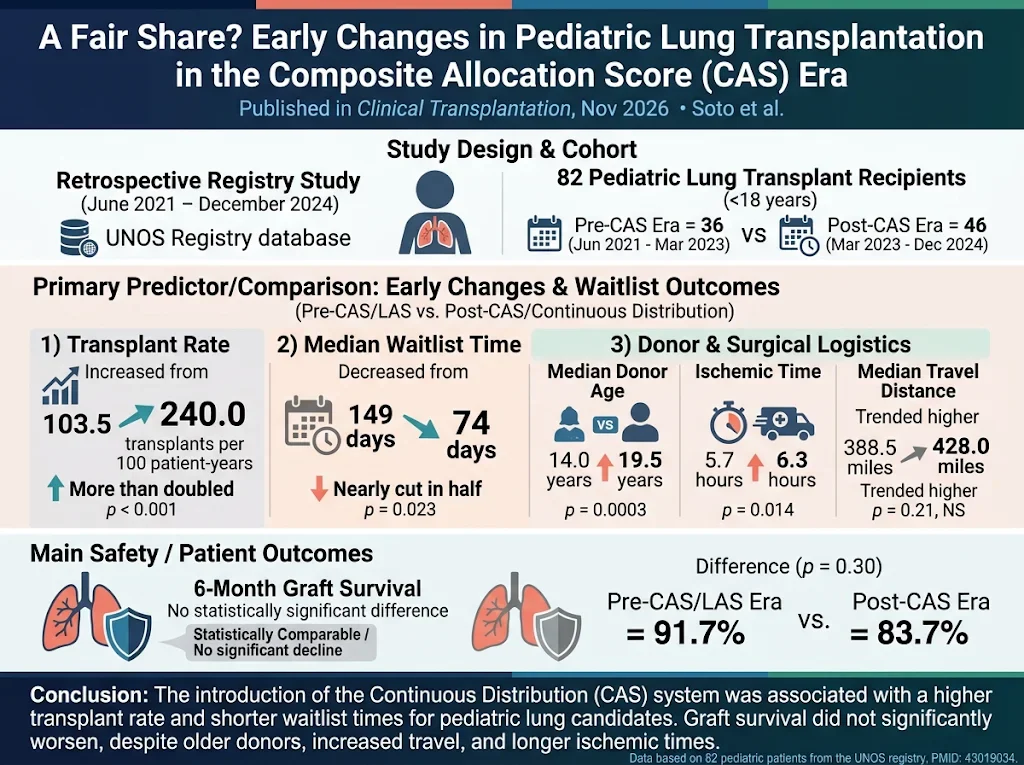
This article summarizes the early effects of the Composite Allocation Score (CAS) introduced in March 2023 on pediatric lung transplantation. Key findings include a significant increase in transplant rates and shorter waitlist times for children without detrimental effect on 6-month graft survival, despite longer donor travel distance and ischemic times.
Study Background
Lung transplantation is a critical, life-saving intervention for children with end-stage pulmonary diseases. Historically, allocation policies for donor lungs have struggled to balance equity and utility, with pediatric candidates often disadvantaged by adult-focused scoring systems such as the Lung Allocation Score (LAS). To promote fairer organ distribution across age groups and geographic regions, the United Network for Organ Sharing (UNOS) introduced the Composite Allocation Score (CAS) in early 2023, replacing prior categorical sharing rules. While adult lung transplant outcomes following this change have been reported, the impact on pediatric candidates—who have unique physiological and logistic considerations—remains underexplored. This knowledge gap is significant given the vulnerability of pediatric patients and the imperative to optimize access and outcomes in this population.
Study Design
This retrospective cohort study analyzed pediatric lung transplant recipients (under 18 years old) harnessing the UNOS registry between June 2021 and December 2024. Two eras were compared: pre-CAS (June 2021 to February 2023) and post-CAS (March 2023 to December 2024). Key variables included recipient characteristics, donor attributes, transplant logistics (travel distance, ischemic time), waitlist times, transplantation rates per 100 patient-years, and early graft survival. Statistical comparisons utilized parametric and nonparametric tests (Student’s t-test or Wilcoxon test for continuous variables; Fisher’s exact test for categorical variables). Survival outcomes were assessed by Kaplan-Meier analysis. This design enabled a robust comparison of changes attributable to the CAS policy shift while capturing early post-implementation outcomes in a national pediatric cohort.
Key Findings
The study identified 82 pediatric lung transplant recipients across the study period—36 before and 46 after CAS implementation. Results demonstrated a notable increase in pediatric transplant rates, from 103.5 per 100 patient-years pre-CAS to 240.0 post-CAS, indicating enhanced organ access (p<0.001). Median waitlist duration significantly decreased by nearly 50%, from 149 days to 74 days (p = 0.023), reflecting expedited allocation and transplantation.
Donor characteristics shifted slightly, with median donor age increasing from 14.0 to 19.5 years (p = 0.0003), potentially reflecting broader donor sharing or changes in prioritization criteria. The median travel distance for donor lungs rose marginally from 388.5 to 428.0 miles, though this was not statistically significant (p = 0.21). Ischemic times increased from 5.7 hours to 6.3 hours (p = 0.014), consistent with longer transport distances.
Importantly, six-month graft survival remained comparable—91.7% pre-CAS vs. 83.7% post-CAS (p = 0.30)—indicating that the increased ischemic time and travel distance did not translate into early detriment in graft function or recipient survival during this follow-up interval. These findings suggest a preservation of short-term outcomes despite logistical challenges inherent to the new allocation framework.
Expert Commentary
The introduction of the Composite Allocation Score represents a major paradigm shift aimed at equitable lung organ distribution. This early analytic evidence alleviates concerns that expanded sharing and longer donor transports could compromise pediatric graft outcomes. The increased transplant rates and decreased waitlist times address important disparities previously observed in the pediatric population. However, the rise in ischemic times prompts vigilance for potential long-term adverse effects that may not yet be apparent at six months. Prospective multicenter studies with longer follow-up are warranted to confirm sustained graft function and survival benefits.
Limitations include the observational study design and relatively small sample size, which could affect the power to detect subtle outcome differences, especially for rare complications. Furthermore, the relatively short post-CAS follow-up period limits assessments of chronic rejection or long-term survival trends. Given the complexity of pediatric lung transplantation—including size matching, immunologic factors, and growth considerations—the CAS’s adaptability should remain under review to optimize pediatric-specific allocation fairness. Clinicians and transplant teams should monitor evolving data and advocate for continued refinement of allocation algorithms that balance equitable access with outcomes.
Conclusion
The adoption of the Composite Allocation Score for pediatric lung transplantation in the United States has yielded encouraging early benefits: increased transplant rates and shortened waitlist times, without a significant decline in six-month graft survival despite increased ischemic times and donor travel. This suggests that continuous distribution allocation models can enhance equity for pediatric candidates while maintaining clinical outcomes. Ongoing evaluation with longer-term data and larger cohorts is essential to ensure the sustainability of these gains and to guide further policy optimization tailored to pediatric needs.
Funding and Clinicaltrials.gov
The original study did not report specific funding sources. Details regarding clinical trial registration were not provided, consistent with registry-based observational research.
References
1. Organ Procurement and Transplantation Network (OPTN). Lung Allocation Score and Pediatric Lung Transplantation. Available from: https://optn.transplant.hrsa.gov
2. Valapour M, Lehr CJ, Skeans MA, et al. OPTN/SRTR 2021 Annual Data Report: Lung. Am J Transplant. 2023;23 Suppl 1:401-480.
3. Chambers DC, Perch M, Zuckermann A, et al. The International Thoracic Organ Transplant Registry of the International Society for Heart and Lung Transplantation: Thirty-eighth adult lung and heart-lung transplantation report-2021; Focus on recipient characteristics. J Heart Lung Transplant. 2021;40(10):1060-1072.
4. Halpern SE, Alderete IS, Soto AL, et al. Early impact of the Composite Allocation Score on adult lung transplant outcomes: a UNOS registry analysis. Clin Transplant. 2025;39(5):e14708.
5. Organ Procurement and Transplantation Network. Continuous Distribution of Lungs Policy. Final Rule Implementation Update. 2023.
Specialty calculators
For clinical reference; use professional judgment.