Highlight
- Persistent hypoalbuminemia during continuous kidney replacement therapy (CKRT) is strongly associated with increased risk of progression to end-stage kidney disease and mortality within one year.
- Even patients without hypoalbuminemia at CKRT initiation who develop early declines in albumin levels have worse long-term outcomes.
- Early monitoring of albumin changes provides important prognostic information beyond baseline albumin levels in acute kidney injury (AKI) patients receiving CKRT.
Study Background
Acute kidney injury (AKI) requiring continuous kidney replacement therapy (CKRT) represents a critical condition frequently encountered in intensive care units, associated with substantial morbidity and mortality. Despite advances in supportive care, long-term kidney failure and death remain common in survivors of severe AKI. Serum albumin, a key plasma protein with multiple physiological roles including maintaining oncotic pressure and modulating inflammatory responses, is often decreased in critically ill patients and has been linked to adverse outcomes. However, the prognostic significance of early changes in albumin levels during CKRT and their relation to long-term renal and survival outcomes have been inadequately characterized.
This study aimed to investigate how changes in serum albumin within the first week of CKRT initiation impact outcomes in a large, multicenter Korean cohort of AKI patients who survived at least 90 days, addressing an important gap in risk stratification and personalized care for this vulnerable population.
Study Design
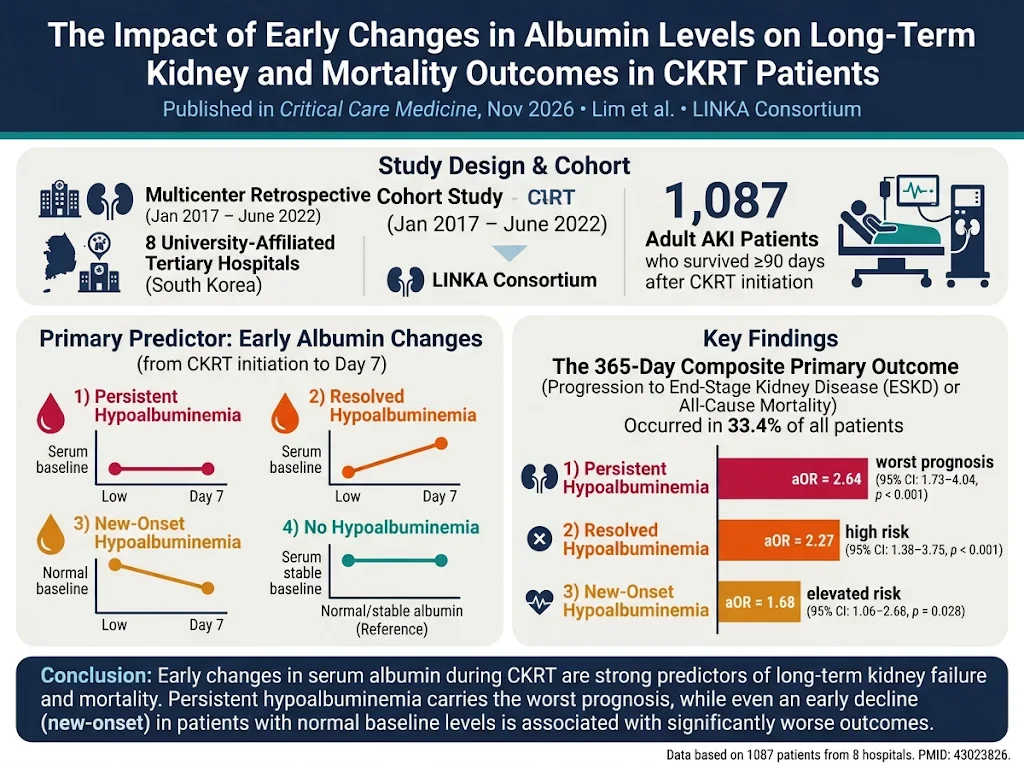
This investigation was conducted as a multicenter retrospective cohort study utilizing data from eight university-affiliated tertiary hospitals in South Korea linked through the LINking health medical records, biospecimens, and biosignals in Korean patients with Acute kidney injury consortium (LINKA) cohort. The study population consisted of 1,087 adult patients with AKI who underwent CKRT between January 2017 and June 2022 and survived at least 90 days post-initiation.
No interventional procedures were applied as part of this observational design. Patients were stratified according to serum albumin status measured at CKRT initiation and day 7 into four groups: persistent hypoalbuminemia (low albumin at both time points), resolved hypoalbuminemia (low at initiation, normalized by day 7), new-onset hypoalbuminemia (normal at initiation, low by day 7), and no hypoalbuminemia (normal at both time points).
The primary composite outcome was progression to end-stage kidney disease requiring dialysis or all-cause mortality within 365 days after CKRT initiation.
Key Findings
The composite outcome occurred in 33.4% of patients (363 out of 1,087) over the follow-up period. In multivariable adjusted logistic regression models accounting for key confounders, all hypoalbuminemia groups had significantly increased odds of adverse outcomes compared with patients without hypoalbuminemia:
- Persistent hypoalbuminemia: adjusted odds ratio (aOR), 2.64; 95% confidence interval (CI), 1.73–4.04; p < 0.001
- Resolved hypoalbuminemia: aOR, 2.27; 95% CI, 1.38–3.75; p < 0.001
- New-onset hypoalbuminemia: aOR, 1.68; 95% CI, 1.06–2.68; p = 0.028
The no hypoalbuminemia group demonstrated the most favorable prognosis, underscoring the detrimental prognostic impact of albumin depletion irrespective of baseline status. Notably, patients who developed new hypoalbuminemia during the first week also exhibited significantly increased risk, highlighting the dynamic nature of albumin as a prognostic biomarker during critical illness and CKRT.
These findings establish early changes in serum albumin as clinically relevant markers that can inform risk stratification for long-term kidney failure and mortality among survivors of severe AKI treated with CKRT.
Expert Commentary
The study by Lim et al. provides robust evidence that monitoring albumin dynamics during CKRT yields valuable prognostic insights beyond static baseline measurements. Albumin’s multiple physiological functions—including regulation of vascular permeability, transport of endogenous and exogenous substances, antioxidant properties, and modulation of inflammatory cascades—likely underpin its association with outcomes. Persistent hypoalbuminemia may reflect ongoing systemic inflammation, malnutrition, or capillary leak syndrome, all contributing to adverse organ recovery and survival.
One strength of this study is its large multicenter design with rigorous adjustment for confounders, enhancing generalizability within similar healthcare settings. However, causality cannot be definitively established due to observational design. Potential confounders like nutrition support, fluid balance, or albumin replacement therapy were not detailed, and these factors could modify albumin levels and outcomes. Future prospective trials could clarify whether therapeutic interventions to correct early hypoalbuminemia might improve prognosis.
The findings harmonize with prior literature highlighting hypoalbuminemia as a mortality predictor in critically ill populations but extend understanding by emphasizing the prognostic importance of early albumin changes specifically during CKRT. Clinicians should consider serial serum albumin assessments as an accessible, inexpensive biomarker to guide prognosis and potentially inform individualized therapeutic strategies in AKI.
Conclusion
In patients with AKI undergoing CKRT who survive beyond 90 days, early changes in serum albumin levels significantly associate with long-term risk of dialysis dependence and mortality. Persistent hypoalbuminemia confers the worst outcomes, while even new-onset hypoalbuminemia portends increased risk compared to stable normal albumin levels. Incorporating early albumin monitoring into clinical care pathways may enhance risk stratification and inform tailored interventions in this high-risk population.
Further research is needed to explore causative mechanisms and the potential benefit of albumin-targeted therapies to improve outcomes in severe AKI undergoing CKRT.
Funding and ClinicalTrials.gov
The study was supported by the LINKA consortium. Specific funding sources were not detailed in the abstract. No interventional clinical trials were reported.
References
1. Lim JH, Seo YJ, Park J, et al. The Impact of Early Changes in Albumin Levels on Long-Term Kidney and Mortality Outcomes in Patients With Acute Kidney Injury Undergoing Continuous Kidney Replacement Therapy. Crit Care Med. 2026 Nov 13. PMID: 43023826.
2. Wiedermann CJ, Wiedermann W, Joannidis M. Hypoalbuminemia and Acute Kidney Injury: An Important Relationship. Nephrol Dial Transplant. 2010;25(6):1809-1815.
3. Bellomo R, Kellum JA, Ronco C. Acute kidney injury. Lancet. 2012;380(9843):756-766.
4. Wiedermann CJ. Albumin and the Compromised Circulation in Critical Illness. Intensive Care Med. 2014;40(5):684-695.
Specialty calculators
For clinical reference; use professional judgment.