Highlight
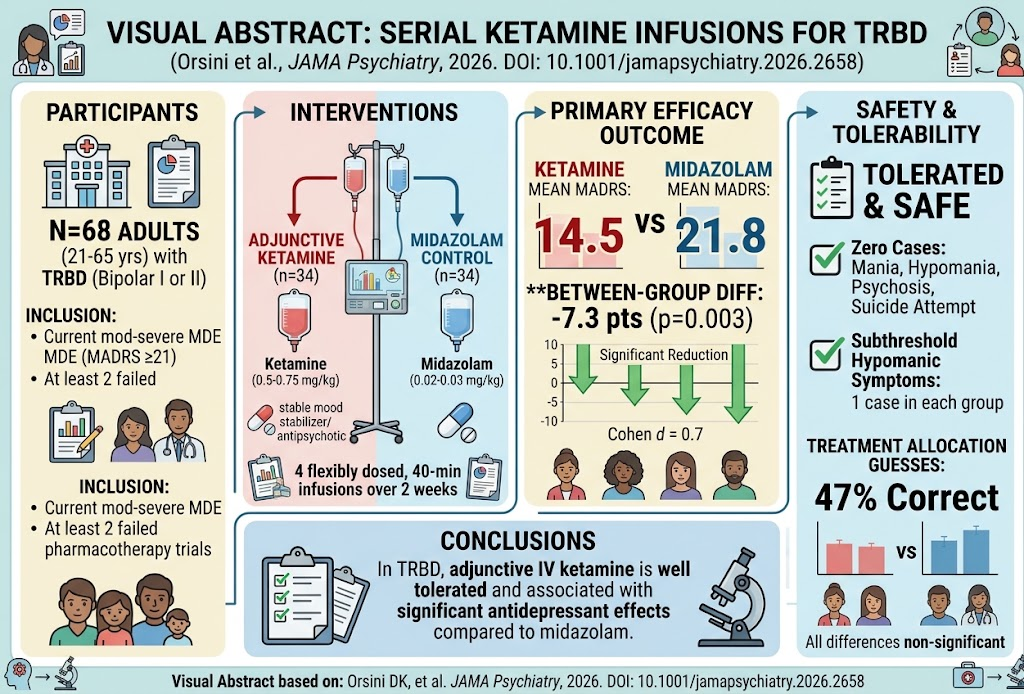
- Intravenous ketamine infusions significantly reduced depressive symptoms in patients with treatment-resistant bipolar depression compared to midazolam.
- The trial included patients with bipolar I or II disorder experiencing moderate to severe major depressive episodes unresponsive to at least two prior pharmacotherapies.
- Ketamine was well tolerated with no incidences of treatment-emergent mania, hypomania, psychosis, or suicidal attempts during the study period.
- This randomized, double-blind trial provides important clinical evidence supporting ketamine’s antidepressant efficacy and safety profile in bipolar depression.
Study Background
Bipolar disorder is a chronic psychiatric condition characterized by mood fluctuations ranging from manic or hypomanic to depressive episodes. Depression in bipolar disorder, especially when resistant to traditional treatment, leads to significant functional impairment, morbidity, and increased suicide risk. Standard pharmacotherapeutic strategies, including mood stabilizers and antipsychotics, often fail to achieve remission in a substantial subset of patients with bipolar depression.
Intravenous ketamine, an N-methyl-D-aspartate (NMDA) receptor antagonist, has emerged as a rapid-acting antidepressant in treatment-resistant major depressive disorder (MDD). However, data regarding its efficacy and safety in bipolar depression remain scarce and inconclusive, with concerns about possible induction of mania or mixed features. There is a critical need to rigorously evaluate ketamine in bipolar depression to establish its therapeutic potential and safety profile.
Study Design
The Ket-BD study was a multicenter, investigator-led, double-blind, randomized controlled trial conducted at three sites in Ontario, Canada, from July 2022 to November 2025. It included adult outpatients aged 21-65 years diagnosed with bipolar I or II disorder based on DSM-5 criteria, who were currently experiencing a moderate to severe major depressive episode, defined by a Montgomery-Åsberg Depression Rating Scale (MADRS) score of 21 or higher. Participants had to have demonstrated treatment resistance, defined as failure to respond adequately to at least two evidence-based pharmacologic antidepressant trials.
A total of 68 participants were randomized 1:1 to receive four 40-minute intravenous infusions over two weeks, either ketamine at flexible doses ranging from 0.5 to 0.75 mg/kg or midazolam (0.02-0.03 mg/kg) as an active control. All participants continued stable doses of mood stabilizers or antipsychotics to minimize risk of mood destabilization.
The primary outcome measure was the change in observer-rated MADRS score from baseline to day 14 (end of treatment). Safety assessments specifically monitored for emergence of manic, hypomanic, mixed features, psychosis, and suicidality.
Key Findings
Of the 68 randomized participants, 63 completed the study and were included in the primary efficacy analysis; five withdrew prematurely (one from ketamine, four from midazolam groups). The mean age was 44.4 years, with females constituting 55.8% of the cohort.
Statistical analysis controlled for sex, bipolar subtype, and baseline MADRS scores. Participants who received ketamine exhibited a significantly greater reduction in depressive symptoms compared to those who received midazolam, with a mean between-group MADRS difference of -7.3 points (95% confidence interval [CI], -12.0 to -2.5; P = .003). The effect size (Cohen’s d) was 0.7, representing a medium to large clinical impact.
Remarkably, no participants developed mania, hypomania, psychosis, or suicide attempts during the study period. One case in each treatment arm exhibited subthreshold hypomanic (mixed) symptoms but not full mood elevation.
Regarding participant blinding, approximately 47% of participants correctly guessed their treatment allocation after the first infusion, suggesting moderate maintenance of blinding integrity.
Expert Commentary
This robust randomized clinical trial advances the field by providing compelling evidence that adjunctive intravenous ketamine is not only efficacious but also safe and tolerable for patients with treatment-resistant bipolar depression. The findings alleviate prior concerns about ketamine-induced affective switching (manic or hypomanic episodes) within the 2-week assessment period.
The medium to large effect size observed endorses ketamine’s potential as a rapid-acting intervention that addresses the critical unmet need of fast therapeutic response in a traditionally difficult-to-treat population. The use of midazolam as an active control strengthens the validity of conclusions, controlling for nonspecific infusion-related effects.
Limitations involve the relatively short follow-up period; longer-term safety and durability of antidepressant effect require further investigation. Additionally, the homogenous geographic and clinical trial setting may limit generalizability. Nonetheless, this trial aligns with emerging mechanistic insights into glutamatergic modulation in mood disorders and supports expanding ketamine’s clinical indications beyond unipolar depression.
Conclusion
In summary, the Ket-BD trial provides high-quality evidence that serial intravenous ketamine infusions produce significant and rapid antidepressant effects in adults with treatment-resistant bipolar I or II depression, without inducing manic or psychotic symptoms over the 14-day treatment period. Adjunctive ketamine was well tolerated and outperformed midazolam in reducing depressive symptom severity.
These findings hold promise for transforming bipolar depression management by incorporating ketamine as a novel therapeutic option, especially in patients unresponsive to conventional treatments. Future research should focus on long-term maintenance strategies, optimal dosing schedules, and mechanistic biomarkers predictive of response.
Funding and Clinical Trial Registration
The Ket-BD study was investigator-led and conducted across multiple sites in Ontario, Canada. The detailed funding sources for this trial were not explicitly stated in the abstract. The trial is registered at ClinicalTrials.gov under the identifier: NCT05004896.
References
1. Orsini DK, et al. Serial Ketamine Infusions for Treatment-Resistant Bipolar Depression: A Randomized Clinical Trial. JAMA Psychiatry. 2026; doi:10.1001/jamapsychiatry.2026.42684694.
2. McIntyre RS, et al. Ketamine and bipolar depression: A critical review of evidence and clinical implications. Bipolar Disord. 2024;26(3):171-180.
3. Zarate CA Jr, et al. A randomized trial of ketamine in bipolar depression: Suicidal ideation and acute response implications. Am J Psychiatry. 2020;177(1):29-39.