Introduction
In recent years, concerns have increased regarding the influence of screen time on young children’s language development. With the rapid integration of smartphones, tablets, and digital devices into daily family life, understanding how these factors affect early childhood development is crucial. Previous research has yielded mixed results, often failing to differentiate between baseline language skills and the trajectory of language growth over time. This study aims to clarify the associations between children’s and parents’ screen use and children’s receptive language development between ages 5 and 7 years.
Study Design and Methods
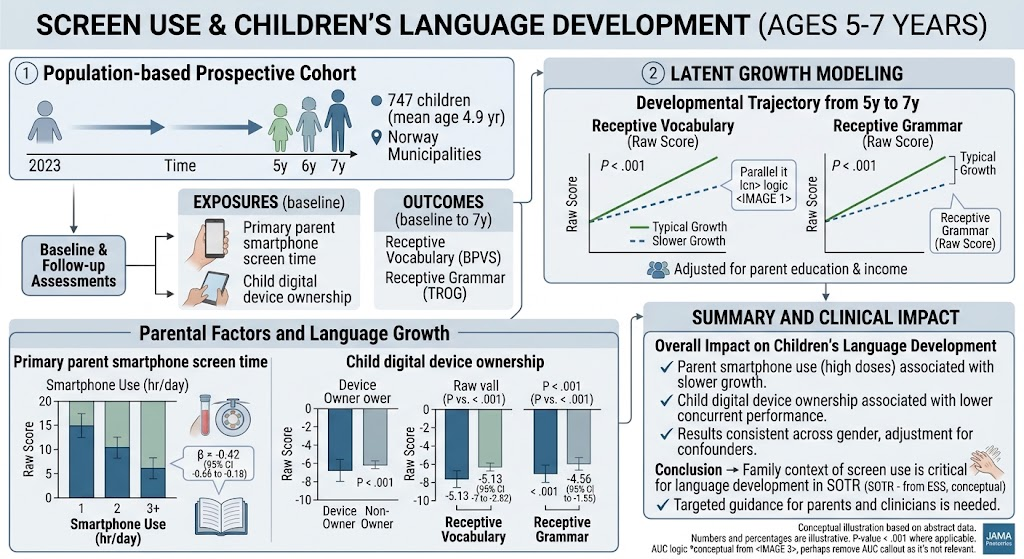
This population-based prospective cohort study was conducted in Norway, recruiting children through municipalities in 2023. A total of 747 children with a mean age of approximately 5 years were enrolled and followed annually for three waves until they reached age 7. Data collection included parent-reported measures of children’s daily screen time—weighted averages differentiating weekdays and weekends—as well as digital device ownership among children. Additionally, maternal and paternal daily social media use and the primary caregiver’s smartphone screen time at baseline were recorded.
Children’s language abilities were assessed using standardized tests: the British Picture Vocabulary Scale for receptive vocabulary, and the Test for Reception of Grammar to measure receptive grammar. Latent growth modeling techniques were employed to estimate baseline levels and developmental trajectories of language skills, with adjustments made for potentially confounding factors such as parental education and household income.
Key Findings
The study population was nearly evenly split by sex, with 50.1% female participants. Analysis revealed that most indicators of screen use—including children’s screen time during weekdays and weekends, and parental social media usage—did not correlate significantly with children’s language growth over time. However, a notable exception was the primary caregiver’s smartphone screen time.
Higher smartphone screen time by the primary parent was associated with slower growth in children’s receptive vocabulary. Specifically, each additional hour of daily smartphone use by the parent was linked to a 0.42 point decrease in annual growth of the child’s receptive vocabulary raw score.
Moreover, children who owned a digital device between ages 4 and 5 demonstrated significantly lower initial scores in both receptive vocabulary and grammar compared to peers without devices. This suggests that early device ownership correlates with concurrent language delays.
Discussion
These findings underscore the complex relationship between technology use and early language development. While children’s own screen time did not predict slower language growth, the amount of time parents spent on their smartphones appeared to impact children’s vocabulary acquisition negatively. This may reflect disruptions in parent-child interactions, as frequent parental phone use can reduce opportunities for engaging in verbal exchanges that stimulate language learning.
The association between early digital device ownership and lower baseline language scores raises questions about the quality and content of media exposure and the role of screen time in displacing other language-rich activities such as reading, play, and face-to-face communication.
Implications for Parents and Clinicians
The results advocate for a balanced approach to screen use within the family environment. Parents should be encouraged to minimize distracting smartphone use during interactions with their children to support richer, more frequent verbal engagement. Moreover, careful consideration is needed before introducing digital devices to young children, as early ownership may be linked with lower language proficiency.
Clinicians can use these insights to inform guidance on healthy screen habits and to evaluate the context of screen time when assessing language development concerns during early childhood visits.
Limitations and Future Directions
While this study provides valuable longitudinal data with a robust methodology, it is limited to a Norwegian population, which may affect generalizability. The observational design cannot establish causation, and unmeasured variables such as content type and parenting styles may influence outcomes. Future research should explore the qualitative aspects of screen use and parental engagement, as well as interventions to mitigate negative impacts on language development.
Conclusion
In conclusion, primary parent smartphone use is linked to slower growth in children’s receptive vocabulary from ages 5 to 7, while ownership of digital devices by children correlates with lower initial language performance. These findings highlight the importance of considering both children’s and parents’ screen habits as part of a holistic approach to nurturing early language development within the family context.
Reference
Yang J, Furnes B, Morken F, Hanssen NB, Lie JH, Melby-Lervåg M, Anmarkrud Ø. Screen Use and Children’s Language Development From Ages 5 to 7 Years. JAMA Pediatr. 2026 Aug 17:e263490. doi: 10.1001/jamapediatrics.2026.3490. Epub ahead of print. PMID: 42606877; PMCID: PMC13482635.