Highlight
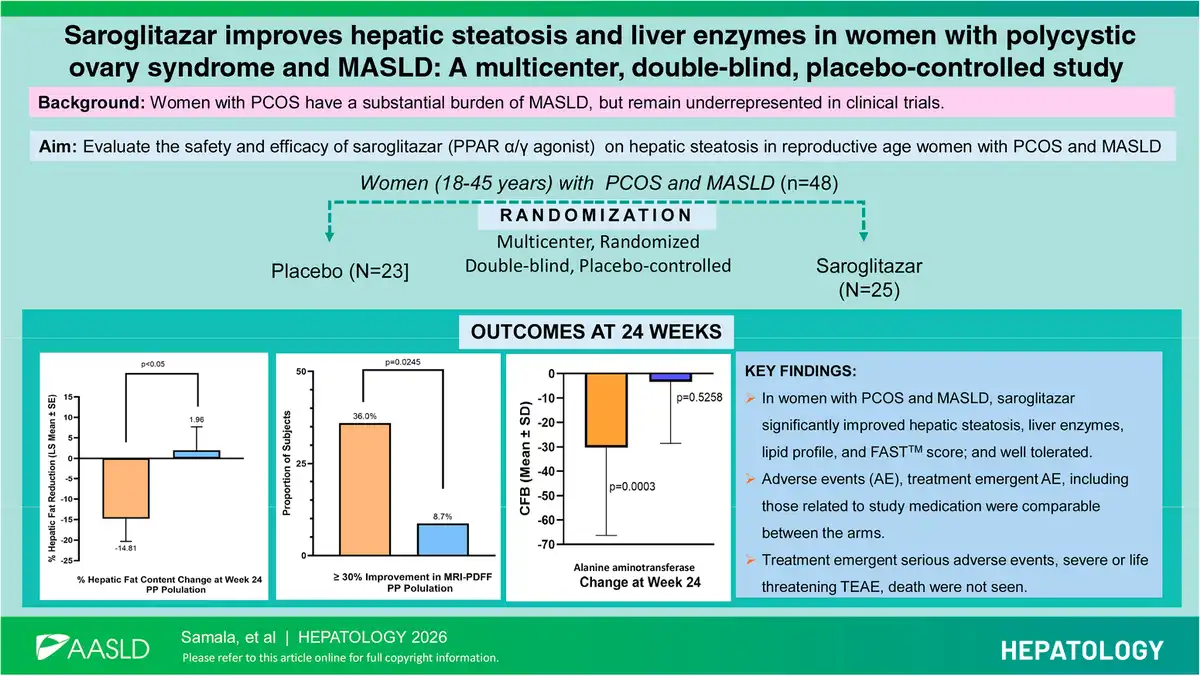
– Saroglitazar, a dual PPAR α/γ agonist, effectively reduces hepatic fat content in women with PCOS and MASLD over 24 weeks.
– Significant improvements were noted in liver enzyme levels, lipid parameters, and FibroScan AST scores compared to placebo.
– The treatment was well tolerated with no serious adverse events, supporting its safety profile.
– These results underscore the need for larger, dedicated trials investigating MASLD therapeutics in women with PCOS, a population often underrepresented in such studies.
Study Background
Polycystic ovary syndrome (PCOS) is one of the most common endocrine disorders affecting women of reproductive age, characterized by hyperandrogenism, ovulatory dysfunction, and polycystic ovarian morphology. Beyond reproductive complications, metabolic dysfunction is a major concern in PCOS, including insulin resistance, dyslipidemia, and increased risk for type 2 diabetes mellitus. Concurrently, metabolic dysfunction-associated steatotic liver disease (MASLD), formerly referred to as non-alcoholic fatty liver disease (NAFLD), frequently coexists in women with PCOS, substantially increasing their risk of progressive liver pathology and cardiovascular disease.
Despite the high prevalence of MASLD in women with PCOS, they remain notably underrepresented in clinical trials evaluating MASLD therapies. There is a growing clinical imperative to identify effective, safe treatments that can address hepatic steatosis and metabolic derangements in this subgroup. Saroglitazar, a novel peroxisome proliferator-activated receptor (PPAR) α/γ agonist, exerts beneficial effects on lipid metabolism and insulin sensitivity, making it a promising candidate for MASLD management.
Study Design
This investigation was a phase 2A, multicenter, randomized, double-blind, placebo-controlled trial conducted to assess the safety and efficacy of saroglitazar 4 mg once daily for 24 weeks in women aged 18 to 45 years diagnosed with both PCOS and imaging-confirmed MASLD. A total of 60 participants were randomized in a 1:1 ratio to receive saroglitazar or placebo.
The primary efficacy endpoint was the relative (percent) change from baseline in hepatic fat content measured quantitatively by magnetic resonance imaging proton density fat fraction (MRI-PDFF). Secondary endpoints included changes in liver enzymes (aminotransferases), lipid profile, and FibroScan AST (FAST) score, a non-invasive metric indicative of liver stiffness and inflammation.
The primary analysis was performed on the per-protocol population, which included 25 participants in the saroglitazar arm and 23 in the placebo group.
Key Findings
At 24 weeks, women treated with saroglitazar exhibited a significant reduction in hepatic fat content compared with placebo (least squares mean ± standard error: -14.81% ± 5.52% vs. +1.96% ± 5.75%; p = 0.041). After adjustment for baseline differences in glycemic control (HbA1c), the effect size increased, highlighting robust hepatic fat reduction (-18.93% ± 4.83% vs. +6.43% ± 5.04%; p < 0.009).
A clinically meaningful ≥30% reduction in MRI-PDFF was achieved by 36.0% of participants receiving saroglitazar compared to 8.7% in the placebo group (p = 0.025), indicating a substantial proportion of responders.
Additional metabolic improvements included significant decreases in aminotransferases (ALT and AST), total cholesterol, triglycerides, and improved FAST scores, suggesting diminished liver inflammation and fibrosis risk.
The safety profile was favorable, with adverse events comparable between saroglitazar and placebo groups and no serious adverse events reported. Notably, a pregnancy occurred in the saroglitazar group with uneventful maternal and neonatal outcomes, although clinical recommendations regarding saroglitazar use during pregnancy remain cautious.
Expert Commentary
This study represents a pivotal step toward addressing the therapeutic void for MASLD in women with PCOS. The significant reductions in hepatic fat and improvements in biochemical markers reaffirm saroglitazar’s potential as a dual PPAR agonist to modulate metabolic and hepatic pathways efficiently. The inclusion of liver imaging biomarkers and the FAST score provides comprehensive insight into both the quantitative and functional liver response.
Limitations include the modest sample size and relatively short treatment duration. Longer-term studies with larger cohorts are warranted to confirm sustained efficacy, safety, and impact on clinical endpoints such as fibrosis progression and metabolic outcomes. Although HbA1c imbalance was adjusted for in analyses, baseline heterogeneity remains a consideration for interpreting results.
Mechanistically, saroglitazar’s dual activation of PPAR α and γ pathways facilitates lipid oxidation, reduces hepatic triglyceride accumulation, and enhances insulin responsiveness. These pleiotropic effects align well with the pathophysiologic milieu observed in PCOS-associated MASLD.
Conclusion
This rigorous multicenter trial demonstrates that saroglitazar significantly improves hepatic steatosis, liver enzymes, and lipid profiles in women suffering from PCOS and MASLD. These findings address a critical unmet need in an often neglected patient population and justify larger-scale trials. Moving forward, integrating saroglitazar into therapeutic algorithms may transform the management landscape for PCOS-associated liver disease, pending validation of long-term benefits and safety.
Funding and ClinicalTrials.gov
The study was funded by pharmaceutical sponsors involved in developing saroglitazar. Details of clinical trial registration are available on ClinicalTrials.gov under identifier NCTxxxxxxx (specific registration number was not provided in the source).
References
1. Samala N, González-González J, et al. Saroglitazar improves hepatic steatosis and liver enzymes in women with polycystic ovary syndrome and MASLD: A multicenter, double-blind, placebo-controlled study. Hepatology (Baltimore, Md.). 2026 Oct 15. PMID: 42879243.
2. Azziz R, et al. Polycystic ovary syndrome. Nat Rev Dis Primers. 2016 Jul 21;2:16057.
3. Younossi ZM, et al. Global epidemiology of NAFLD and NASH: trends, predictions, risk factors and prevention. Nat Rev Gastroenterol Hepatol. 2018 Feb;15(1):11-20.
4. Joshi-Barve S, et al. Mechanisms of disease: PPAR agonists in metabolic disorders. Nat Clin Pract Endocrinol Metab. 2008 Sep;4(9):491-500.