Introduction and Clinical Background
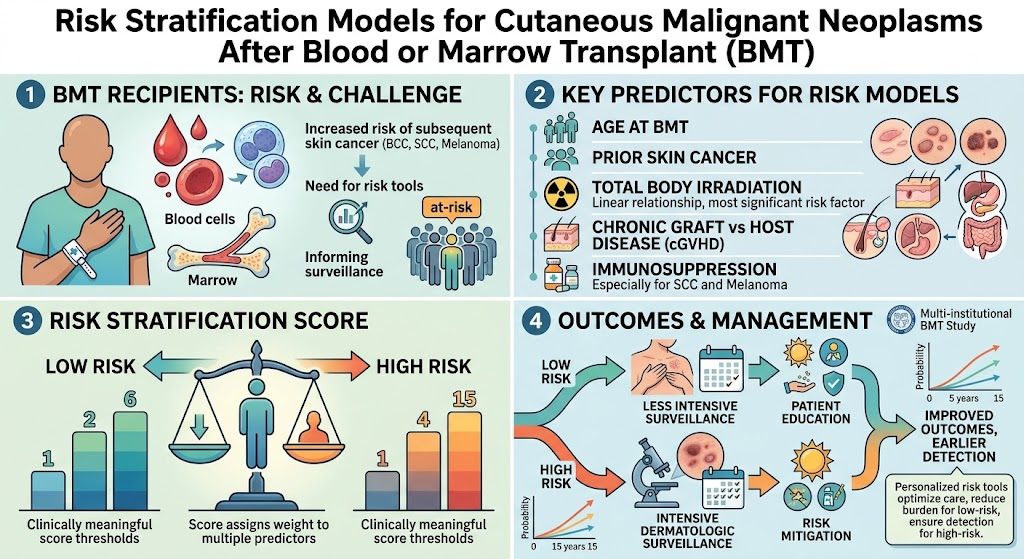
Recipients of blood or marrow transplants (BMT), encompassing both autologous and allogeneic procedures, are at a recognized increased risk of developing subsequent cutaneous malignant neoplasms (CMNs), including basal cell carcinoma (BCC), squamous cell carcinoma (SCC), and melanoma. This elevated risk derives from multiple factors such as prior cancer therapies including total body irradiation, immunosuppressive regimens post-transplant, chronic graft versus host disease (GVHD), and the underlying immunocompromised state associated with transplantation. Given the considerable morbidity and mortality burden posed by skin cancers, identifying transplant survivors at greatest risk for CMNs is critically important for guiding dermatologic surveillance, counseling, and potentially implementing tailored preventive measures.
Previous efforts to characterize risk among BMT survivors have lacked comprehensive, validated tools that integrate patient-specific and treatment-related factors. This gap undermines the ability to efficiently target high-risk individuals for early detection and risk mitigation strategies, which could improve long-term outcomes.
Study Design and Methodology
The referenced prognostic study utilized data from the multi-institutional Blood or Marrow Transplant Survivor Study (BMTSS), which included participants treated between 1974 and 2014 at three U.S. transplant centers located in California, Minnesota, and Alabama. Eligible participants comprised individuals who underwent a single BMT procedure and survived at least two years post-transplant, with at least one completed BMTSS survey providing follow-up data. This cohort included 3448 survivors with a mean age of 41.9 years at transplant, and 55.6% male distribution.
The investigators aimed to develop risk stratification models using commonly available clinical variables: age at transplant, sex, race, ethnicity, history of prior cutaneous malignant neoplasm, pretransplant exposure to monoclonal antibodies, total body irradiation, presence of chronic GVHD, and posttransplant immunosuppression. Outcomes comprised incident cases of BCC, SCC, and melanoma diagnosed after BMT, documented via participant self-report and confirmed by medical record review when feasible.
The models employed time-dependent receiver operating characteristic (ROC) curve analyses with area under the curve (AUC) metrics for discrimination assessment. Validation was performed through repeated random partitioning into training and testing datasets, averaging the results to ensure robust model performance. Based on risk score thresholds, participants were categorized into low- or high-risk groups for CMNs.
Key Findings and Results
Among the 3448 BMT survivors analyzed, 8.2% (n=282) developed basal cell carcinoma, 5.3% (n=183) squamous cell carcinoma, and 2.1% (n=73) melanoma after surviving two years post-BMT.
The predictive performance of the models at 15 years post-transplant was excellent, with time-dependent AUCs of 0.81 for BCC, 0.90 for SCC, and 0.83 for melanoma, indicating strong discriminative ability. This suggests that the selected clinical and treatment variables capture key determinants of skin cancer risk among this population.
Cumulative incidence estimates for the low-risk group were 2.4% for BCC, 3.2% for SCC, and 0.8% for melanoma at 15 years, contrasting markedly with 13.3%, 13.6%, and 4.4%, respectively, in the high-risk group. These substantial risk differentials support the clinical utility of stratifying patients to direct surveillance intensity.
Clinical Implications and Expert Commentary
The construction and validation of accurate risk stratification models for CMNs in BMT survivors is a significant advance enabling precision medicine. For clinicians managing transplant survivors, these models facilitate identification of individuals requiring more vigilant dermatologic evaluation and potentially preventive interventions.
Understanding that older age at transplant, prior skin cancer history, radiation exposure, chronic GVHD, and immunosuppression contribute to augmented risk aligns with current knowledge about skin carcinogenesis in immunocompromised hosts. Model incorporation of accessible clinical data ensures applicability in routine post-transplant care settings.
While the study presents robust discrimination, limitations include reliance on self-reported cancer diagnoses supplemented by medical record confirmation, which may miss asymptomatic or unreported cases. The cohort’s demographic and treatment era characteristics may affect the generalizability to contemporary transplant recipients receiving newer therapies. Further external validation in diverse populations and integration with biomarker or genetic data could enhance model precision.
Conclusions and Future Directions
This prognostic study highlights the utility of risk stratification models in predicting subsequent cutaneous malignant neoplasms among blood or marrow transplant recipients. The models demonstrated excellent performance metrics, paving the way for implementation into clinical practice to guide personalized dermatologic surveillance and risk mitigation strategies.
Future research should focus on prospective validation, integration with molecular risk markers, and evaluation of cost-effectiveness of risk-guided screening approaches. Ultimately, such advances will improve the long-term skin cancer outcomes and quality of life for the growing population of BMT survivors.
Funding and Trial Registration
Details regarding funding sources and specific clinical trial registrations were not provided in the study abstract.
References
1. Broman KK, Meng Q, Richman J, et al. Risk Stratification Models for Cutaneous Malignant Neoplasms After Blood or Marrow Transplant. JAMA Dermatol. 2026; Published August 12, 2026. doi:10.1001/jamadermatol.2026.42584914
2. Curtis RE, Rowlings PA, Deeg HJ, et al. Solid cancers after bone marrow transplantation. N Engl J Med. 1997;336(13):897-904.
3. Bhatia S, Francisco L, Carter A, et al. Risk factors for subsequent neoplasms after allogeneic hematopoietic cell transplantation in childhood. Bone Marrow Transplant. 2016;51(1):90-95.
4. Dalle S, Poulalhon N, Balme B, et al. Nonmelanoma skin cancers in immunosuppressed patients. Int J Dermatol. 2015;54(4):436-445.