Intravenous Nicorandil in STEMI Patients Undergoing Primary PCI: Insights from the CLEAN Randomized Clinical Trial and Broader Evidence

Highlights

  • The CLEAN trial, a large multicenter RCT, found no significant reduction in 12-month major adverse cardiovascular events (MACE) with adjunctive intravenous nicorandil in STEMI patients undergoing primary PCI.
  • Secondary analyses suggested nominal reductions in cardiovascular death and target-vessel revascularization, but no significant effects on myocardial infarction or heart failure hospitalization.
  • Smaller, exploratory studies show intracoronary or oral nicorandil improves microvascular function and reduces no-reflow, infarct size, and reperfusion arrhythmias.
  • Despite mechanistic promise and improvements in surrogate endpoints, consistent long-term clinical benefits remain unproven, cautioning against routine nicorandil use in all STEMI patients.

Background

ST-segment elevation myocardial infarction (STEMI) represents a critical cardiovascular emergency where rapid reperfusion via primary percutaneous coronary intervention (PCI) has improved survival. However, reperfusion injury and microvascular obstruction remain important contributors to myocardial damage, affecting outcomes. Nicorandil, an adenosine triphosphate-sensitive potassium (KATP) channel opener with nitrate-like vasodilatory properties, has been studied as a cardioprotective adjunct to mitigate reperfusion injury by improving microvascular perfusion, reducing no-reflow phenomenon, infarct size, and arrhythmias. Despite promising preclinical data and smaller clinical trials, robust evidence for long-term clinical benefit has been inconsistent.

Key Content

The CLEAN Randomized Clinical Trial: Design and Main Findings

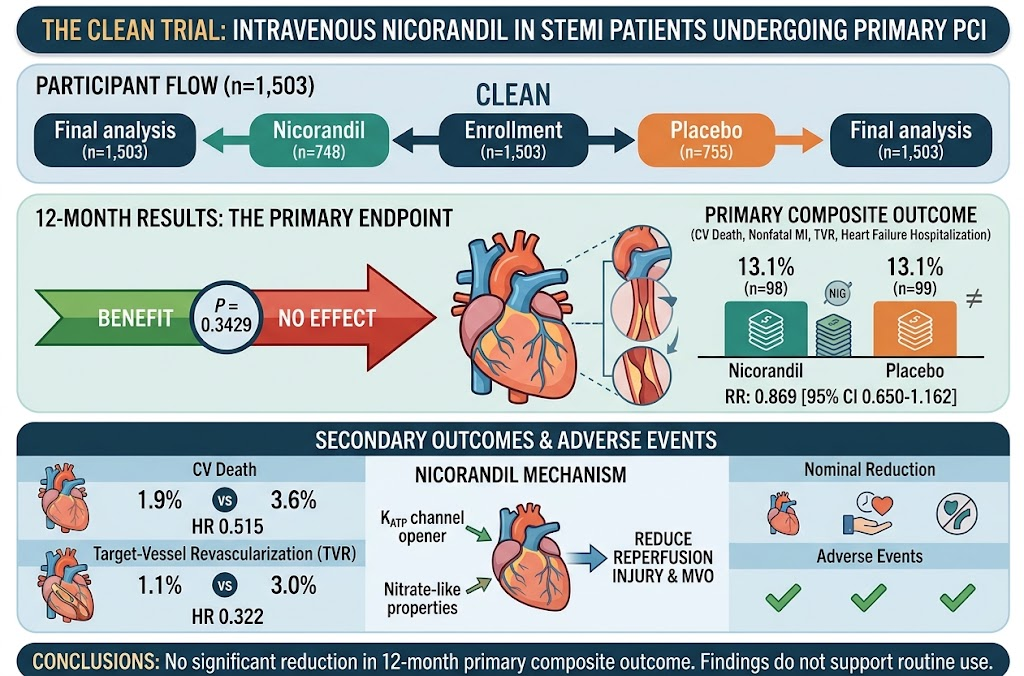
The CLinical Efficacy and sAfety of intravenous Nicorandil (CLEAN) trial enrolled 1,503 patients with STEMI undergoing primary PCI within 12 hours of symptom onset across 49 Chinese hospitals. Patients were randomized 1:1 to intravenous nicorandil (6 mg bolus before reperfusion followed by 6 mg/h infusion for 48 hours) or placebo, with prohibition of oral nicorandil during follow-up. The primary composite outcome was cardiovascular death, nonfatal myocardial infarction, target vessel revascularization, or unplanned hospitalization for heart failure at 12 months.

Results showed the primary outcome incidence was identical (13.1%) in both groups, with no statistically significant difference (rate ratio 0.869; 95% CI 0.650-1.162; p=0.343). Secondary endpoints revealed nominally lower cardiovascular death (1.9% vs 3.6%, HR 0.515) and target vessel revascularization (1.1% vs 3.0%, HR 0.322) in the nicorandil group, but nonfatal MI and unplanned heart failure admissions were similar. Safety profiles were comparable without significant adverse events.

Supporting Evidence on Nicorandil’s Microvascular and Clinical Effects

Smaller randomized trials and mechanistic studies complement these findings:

– Intracoronary nicorandil during PCI improved coronary microcirculatory function measured by angiographic microcirculatory resistance (AMR) and quantitative flow ratio (QFR), with higher TIMI 3 flow and lower AMR, suggesting enhanced microvascular reperfusion.[42099789]

– Oral nicorandil administered prior to PCI reduced rates of no-reflow, improved myocardial blush grade, enhanced ST-segment resolution, and decreased 3-month MACE rates including improved left ventricular ejection fraction (LVEF).[40839018]

– The CHANGE trial demonstrated that intravenous nicorandil given before PCI significantly reduced infarct size measured by cardiac MRI at early and six-month follow-up compared to placebo, with better left ventricular function and reduced no-reflow incidence.[36073634]

– Other studies have documented that nicorandil reduces reperfusion-related ventricular arrhythmias, improves myocardial perfusion indexes, and lowers biomarkers of myocardial injury without significant hemodynamic compromise.[29743901,29891250,28851188]

However, a randomized trial with 83 patients showed no difference in infarct size or long-term cardiac function with nicorandil continued for 6 months post-PCI.[36942830]

Reconciling Divergent Outcomes

The discrepancy between surrogate endpoint improvements and final clinical outcomes highlights complexities:

– Nicorandil effectively ameliorates microvascular dysfunction, reduces no-reflow phenomenon, and limits infarct size in several smaller or mechanistic trials.
– These physiological benefits do not consistently translate into reductions in broad clinical endpoints such as long-term mortality, reinfarction, or heart failure hospitalization in large-scale trials like CLEAN.
– Variability in administration routes (intravenous vs intracoronary vs oral), timing, dosage, patient selection, and follow-up durations may contribute to inconsistent findings.
– Potential benefits in select subgroups, such as elderly or patients with high risk of no-reflow, could be masked in unselected populations.

Mechanistic Insights and Translational Perspectives

Nicorandil’s dual mechanism combining nitrate-mediated vasodilation and KATP channel opening attenuates ischemia-reperfusion injury by improving coronary microcirculatory flow, reducing calcium overload and oxidative stress, and stabilizing myocardial mitochondria during reperfusion. The reduction of ventricular arrhythmias with nicorandil may result from modulation of cardiac electrophysiology via KATP channels.

Animal models reinforce nicorandil’s efficacy in improving coronary microcirculation, limiting infarct size, and preserving left ventricular function following STEMI. Translating these findings to clinical practice requires overcoming heterogeneity in STEMI pathology and reperfusion injury severity.

Expert Commentary

Current guidelines on STEMI management emphasize rapid primary PCI to restore epicardial perfusion but acknowledge the challenge of microvascular obstruction contributing to adverse remodeling and outcomes. Adjunctive therapies targeting microcirculation, such as nicorandil, have theoretical appeal but clinical adoption demands consistent evidence of meaningful clinical benefit.

The CLEAN trial, the largest of its kind, did not demonstrate a statistically significant reduction in the composite of hard clinical endpoints at 12 months with intravenous nicorandil. This finding suggests routine intravenous nicorandil in unselected STEMI patients may not be warranted.

Nonetheless, the improvements in secondary endpoint trends (cardiovascular death, revascularization) and surrogate markers of microvascular function observed in ancillary studies warrant further investigation. Stratification of patients based on microvascular injury risk or incorporation of nicorandil into multimodal reperfusion injury mitigation strategies could clarify its niche.

Limitations of available data include relatively short follow-up in some trials, underpowered subgroup analyses, and heterogeneity in study protocols. Larger, multicenter trials with mechanistic substudy components and biomarker-guided patient selection are essential.

Conclusion

Nicorandil possesses favorable mechanistic properties that improve coronary microcirculation and reduce reperfusion injury in STEMI patients undergoing PCI. Multiple smaller trials have shown benefits in infarct size limitation, no-reflow reduction, and arrhythmia mitigation.

However, the CLEAN trial’s robust, large-scale data demonstrate that adjunctive intravenous nicorandil does not significantly reduce 12-month major adverse cardiovascular events. Thus, current evidence does not support its routine intravenous use in all STEMI patients undergoing primary PCI.

Future research should focus on identifying patient subgroups most likely to benefit, optimizing dosing strategies and routes of administration, and combining nicorandil with other cardioprotective interventions to enhance microvascular recovery and long-term outcomes.

References

  • Huang D et al. Intravenous Nicorandil in Patients With ST-Segment Elevation Myocardial Infarction Undergoing Primary PCI: The CLEAN Randomized Clinical Trial. J Am Coll Cardiol. 2026 Jul 30; S0735-1097(26)07071-3. PMID: 42584383
  • Liu J et al. Intracoronary nicorandil improves coronary microcirculatory function after primary PCI in first-episode STEMI: an angiography-derived evaluation using AMR and QFR. Front Cardiovasc Med. 2026 Apr 22;13:1786130. PMID: 42099789
  • Wang Y et al. Impact of oral nicorandil administration prior to primary PCI on no-reflow: a randomized controlled trial. Clin Res Cardiol. 2025 Aug 21. PMID: 40839018
  • Wang Q et al. Effects of Nicorandil Administration on Infarct Size in Patients With STEMI Undergoing Primary PCI: The CHANGE Trial. J Am Heart Assoc. 2022 Sep 20;11(18):e026232. PMID: 36073634
  • Chen J et al. Effects of Early Intracoronary Administration of Nicorandil During PCI in Patients With Acute MI. Heart Lung Circ. 2019 Jun;28(6):858-865. PMID: 29891250
  • Zhang Q et al. Intracoronary Nicorandil and the Prevention of No-Reflow Phenomenon During Primary PCI in Patients with Acute STEMI. Med Sci Monit. 2018 May 4;24:2767-2776. PMID: 29726480
  • Yu B et al. Effect of nicorandil administration on myocardial microcirculation during primary PCI in patients with AMI. Postepy Kardiol Interwencyjnej. 2018;14(1):26-31. PMID: 29743901

Comments

No comments yet. Why don’t you start the discussion?

Leave a Reply