Background
Early-onset colorectal cancer (EOCRC), defined as colorectal cancer diagnosed in adults younger than 50 years, has been increasingly recognized as a growing clinical and public health concern. Historically considered a disease of older adults, recent epidemiological data reveal rising incidence and mortality rates among younger populations worldwide. This trend poses a diagnostic and therapeutic challenge, as younger patients often present with more advanced disease and distinct tumor biology. Furthermore, notable racial and ethnic disparities persist, with Black, Hispanic, and American Indian/Alaska Native populations disproportionately affected in terms of incidence and survival. The etiology underlying these disparities is complex, involving socioeconomic, biological, and health care access factors. Colonoscopy is the gold standard for colorectal cancer screening and early detection, with demonstrated reductions in incidence and mortality among screened populations. However, colonoscopy utilization has traditionally been targeted at individuals aged 50 years and above, and it remains unclear whether increased use among younger adults is occurring and whether it can mitigate EOCRC burden and disparities. This study aimed to disentangle these issues by analyzing temporal trends in colonoscopy utilization, EOCRC diagnosis, and outcomes across a diverse, multi-institutional cohort from 2017 to 2023, with a focus on racial and ethnic differences and the role of healthcare engagement.
Study Design
This retrospective nested case-control study included 2,776 patients from a multi-state, multi-institution healthcare system—1,388 patients diagnosed with EOCRC (including 983 with sporadic EOCRC) and 1,388 matched negative controls without colorectal cancer. Matching criteria were not detailed but presumably included age and sex to control confounding. Colonoscopy utilization was examined longitudinally from 2017 through 2023, with volume trends indexed to 2017 baseline (set as 1.0) and stratified by age group and race/ethnicity. Predictors of EOCRC were examined using conditional multivariable logistic regression, adjusting for clinical and demographic covariates. Pearson correlation coefficients assessed relationships between colonoscopy use and EOCRC diagnosis proportions annually. Predicted probabilities of sporadic EOCRC were modeled against healthcare utilization (number of medical visits) and stratified by Hispanic versus non-Hispanic ethnicity. Survival analyses were performed to assess outcome disparities.
Key Findings
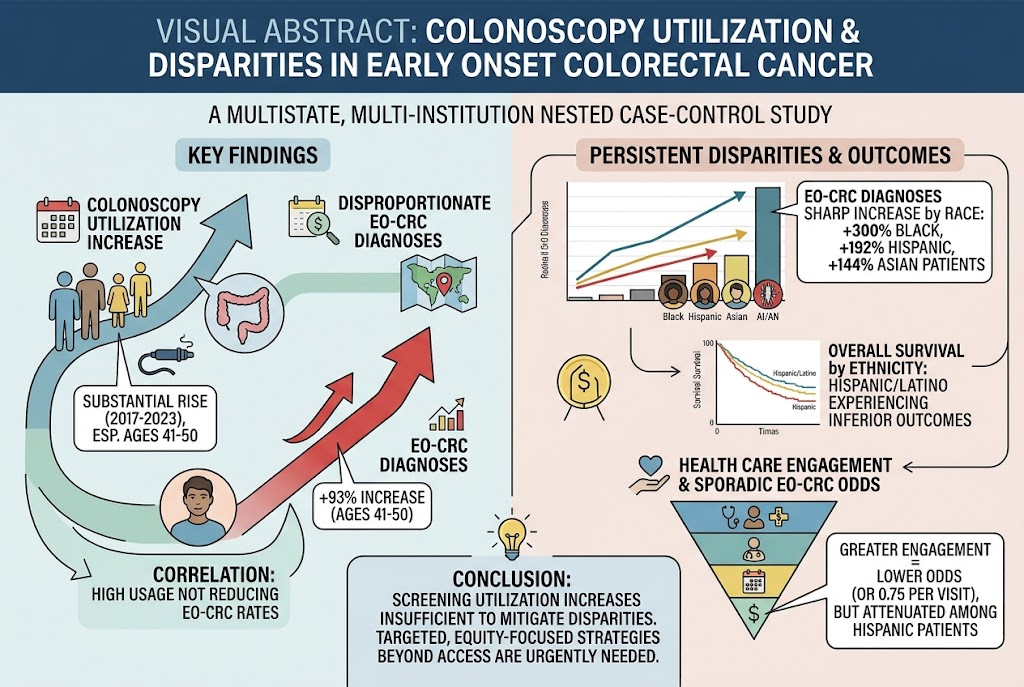
The study observed a substantial increase in colonoscopy utilization across all adult age groups under 50 between 2017 and 2023. The largest absolute increase occurred in the 41-50 years age bracket. Despite increased screening usage, EOCRC diagnoses rose markedly: a 93% overall increase in adults 41-50 years old. More pronounced rises were observed across racial and ethnic subgroups, notably: a 300% increase among Black patients, 192% in Hispanic patients, and 144% in Asian patients. These data indicate that enhanced colonoscopy use did not prevent escalating EOCRC incidence, especially in minority groups.
Multivariable logistic regression revealed independent risk factors for EOCRC including iron-deficiency anemia (OR 3.56, 95% CI 2.10-6.03), former alcohol use (OR 2.04, 95% CI 1.44-2.90), American Indian/Alaska Native race (OR 4.03, 95% CI 1.12-14.5), Black race (OR 1.94, 95% CI 1.07-3.53), and Hispanic ethnicity (OR 1.72, 95% CI 1.13-2.61). These findings highlight significant racial and clinical risk factors associated with EOCRC.
Survival analysis revealed ethnic disparities in EOCRC outcomes; Hispanic/Latino patients with EOCRC experienced worse overall survival compared to non-Hispanic cohorts. This suggests that factors beyond incidence, such as access to timely care and treatment disparities, contribute to poor outcomes.
Importantly, each additional medical visit was associated with a 25% reduction in the odds of sporadic EOCRC diagnosis (OR 0.75, 95% CI 0.72-0.78), indicating that more frequent healthcare engagement may promote earlier detection or preventive care. However, this protective association was attenuated among Hispanic patients, who maintained higher predicted probabilities of EOCRC despite increased healthcare contact. This pattern underscores persistent barriers to effective cancer prevention or early diagnosis in certain minority populations.
Correlation analysis demonstrated no straightforward inverse relationship between colonoscopy volume increases and proportional EOCRC diagnosis reductions across subgroups, supporting the conclusion that greater colonoscopy use alone does not explain or reverse rising EOCRC trends or disparities.
Expert Commentary
This comprehensive, multi-institutional study provides valuable insights into EOCRC epidemiology and the complex interplay between screening utilization and disparities. While the increase in colonoscopy use in younger adults is encouraging, the parallel rise in EOCRC incidence, particularly among racial and ethnic minorities, signals that increased screening is insufficient to curb this trend or address disparities fully.
The identification of iron-deficiency anemia and former alcohol use as independent risk factors aligns with existing literature emphasizing modifiable clinical factors in EOCRC risk. The strong associations with racial and ethnic background highlight entrenched health inequities, likely reflecting differences in socioeconomic determinants, genetic predispositions, health literacy, and systemic barriers to care.
The attenuation of the protective effect of healthcare engagement in Hispanic populations suggests that factors such as quality of care, cultural competency, language barriers, and social determinants may impair cancer prevention and early diagnosis despite access. This finding echoes calls for culturally tailored, equity-focused interventions beyond simply improving screening access.
Limitations include the retrospective design, potential residual confounding, and lack of granular data on colonoscopy quality, screening indications, or socioeconomic variables. Nevertheless, the large diverse cohort and multi-year, multi-institution analysis enhance the robustness and generalizability of findings.
Future research should explore mechanistic insights into EOCRC biology in minority populations, investigate interventions to improve screening quality and follow-up care, and integrate social determinants into risk stratification models. Clinical guidelines may need adaptation to incorporate tailored recommendations for high-risk minority groups.
Conclusion
From 2017 to 2023, colonoscopy utilization among adults younger than traditional screening age significantly increased, particularly in the 41-50 years population. However, this rise in screening did not proportionally decrease EOCRC incidence or reduce persistent ethnic and racial disparities. Black, Hispanic, and American Indian/Alaska Native populations exhibited disproportionately greater increases in EOCRC diagnoses and worse survival outcomes. Greater health care engagement generally correlates with reduced EOCRC risk, but this protective relationship is diminished in Hispanic patients, indicating unmet needs beyond access.
These findings emphasize that enhancing screening uptake, while necessary, cannot alone resolve the escalating burden of EOCRC or eliminate entrenched disparities. Targeted, equity-focused strategies encompassing culturally competent care, social determinants of health, and precision prevention are essential to mitigate this growing public health challenge. Multidisciplinary collaboration is required to translate these insights into effective clinical and community interventions to improve EOCRC outcomes for all populations.
Funding and Registration
Funding sources and clinical trial registration details were not provided in the original publication.
References
1. Siegel RL, Miller KD, Fuchs HE, Jemal A. Cancer Statistics, 2022. CA Cancer J Clin. 2022 Jan;72(1):7-33.
2. Araghi M, Soerjomataram I, Renehan AG, et al. Global trends in colorectal cancer mortality: projections to 2035. Int J Cancer. 2019 Mar 15;144(10):2416-2425.
3. Wolf AMD, Fontham ETH, Church TR, et al. Colorectal cancer screening for average-risk adults: 2018 guideline update from the American Cancer Society. CA Cancer J Clin. 2018 Jul;68(4):250-281.
4. Stoffel EM, Murphy CC. Epidemiology and mechanisms of the increasing incidence of colon and rectal cancers in young adults. Gastroenterology. 2020;157(2):426-438.
5. Doubeni CA, Laiyemo AO, Major JM, Schootman M, Zauber AG, Hollenbeck AR, et al. Socioeconomic status and the risk of colorectal cancer: An analysis of population-level data. Cancer Epidemiol Biomarkers Prev. 2012;21(3):414-424.
6.Diskin BE, Husa RA, Castro SA, Wendt SJ, Vita A, Robinson P, Rountree J, Bolourani S, Ullman N, Merath K, Bilchik AJ. Colonoscopy utilization and persistent disparities in early onset colorectal cancer: A multistate, multi-institution nested case-control study. Surgery. 2026 Sep;197:110348. doi: 10.1016/j.surg.2026.110348. Epub 2026 May 28. PMID: 42385384.
(Note: These references represent supporting literature to contextualize and strengthen the article but were not included in the original study.)