Highlight
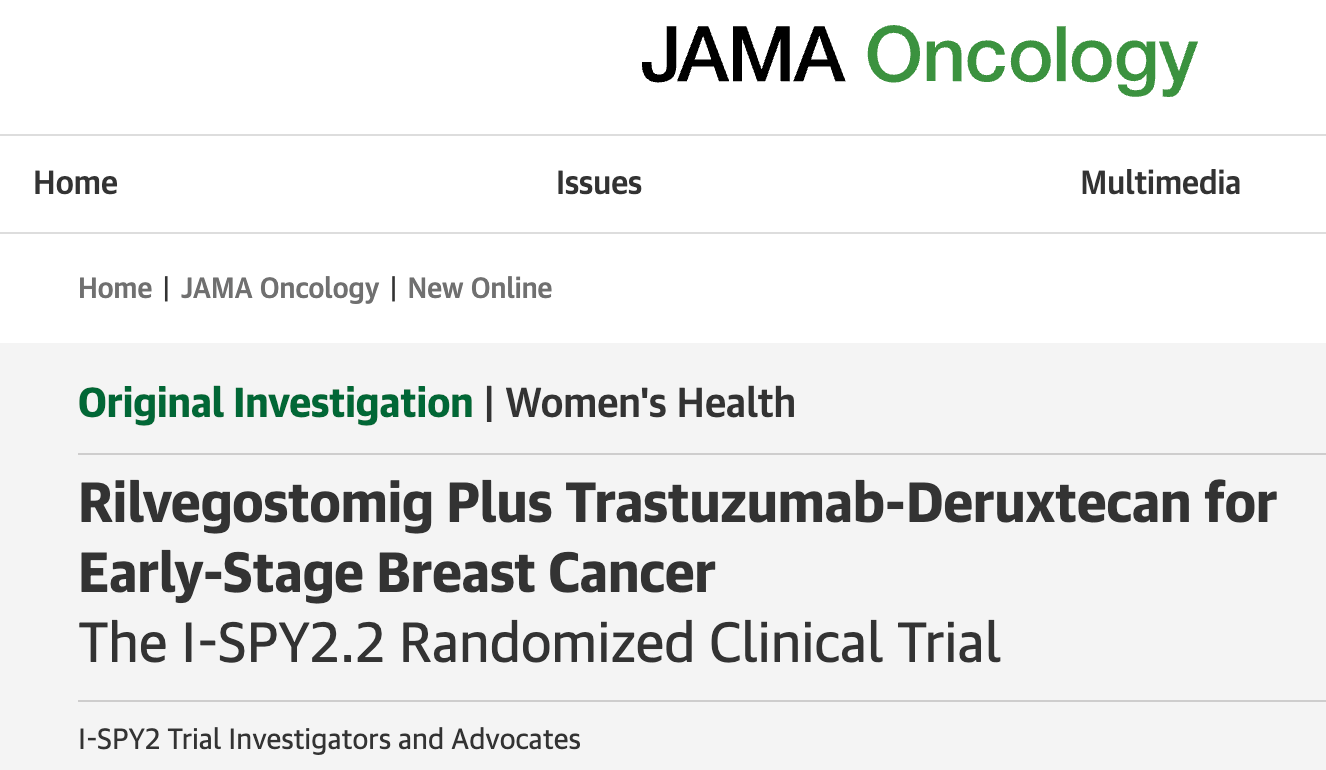
The phase 2 I-SPY2.2 adaptive trial demonstrated that combining rilvegostomig, a bispecific immune checkpoint antibody, with trastuzumab-deruxtecan (RT-DXd) achieves substantial pathologic complete response (pCR) rates in patients with immune-positive, ERBB2-low or -negative early breast cancer (EBC). The regimen allowed most responders to avoid anthracycline chemotherapy, reducing toxicity. Although interstitial lung disease (ILD) was observed, it was manageable through rigorous monitoring.
Study Background
Early-stage breast cancer (EBC) remains a global health challenge, notably for patients with high-risk, ERBB2-negative tumors who traditionally receive multi-agent chemotherapy. While standard regimens including anthracyclines and taxanes improve survival, they carry significant long-term toxicities. Recent therapeutic advances have shifted focus to personalized treatments that improve efficacy while sparing patients from unnecessary chemotherapy burden.
Trastuzumab-deruxtecan (T-DXd), an antibody-drug conjugate targeting ERBB2, has shown remarkable efficacy in HER2-expressing cancers, including those with low ERBB2 expression. Concurrently, immune checkpoint modulation emerges as a potent strategy in engaging T-cell responses. Rilvegostomig, a bispecific antibody targeting both PD-1 and TIGIT pathways, represents a novel approach to overcome tumor immune evasion.
The I-SPY2.2 trial sought to explore this combination’s potential in high-risk EBC patients categorized by ERBB2 and hormone receptor (HR) status, with an aim to refine personalized neoadjuvant therapy.
Study Design
This multicenter, phase 2, adaptively randomized neoadjuvant trial enrolled 182 patients with high-risk stage II/III ERBB2-negative EBC, including ERBB2 low/ultralow tumors. Patients were stratified based on HR status and immune-predictive subtypes. The study was conducted across 30 US sites with adaptive analysis guiding enrollment and treatment assignments.
Intervention consisted of up to three sequential treatment blocks: block A with rilvegostomig plus trastuzumab-deruxtecan (RT-DXd), block B with taxane-based therapy ± immunotherapy, and block C with doxorubicin-cyclophosphamide (AC) ± immunotherapy. The control arm received contemporary standard chemotherapy regimens. The primary endpoint was pathologic complete response (pCR), defined as absence of invasive cancer in breast and lymph nodes post-treatment.
Safety monitoring focused on adverse events (AEs), particularly interstitial lung disease (ILD), given known pulmonary risks associated with antibody-drug conjugates and immune checkpoint inhibitors.
Key Findings
Out of 182 participants, 108 were randomized to receive RT-DXd and 88 to the control arm. After exclusions, the intention-to-treat population comprised 105 patients treated with RT-DXd and 77 controls.
Among immune-positive tumors treated with RT-DXd in block A, the modeled pCR rate reached 54%, surpassing the pre-specified threshold for success. Notably, HR-positive immune-positive tumors demonstrated a 57% pCR rate, while HR-negative immune-positive tumors had a 52% pCR rate. These rates were comparable to or better than standard chemotherapy.
Importantly, within immune-positive patients achieving pCR, 62% required only block A treatment, and 97% avoided anthracycline-based chemotherapy—traditionally associated with cardiotoxicity and other adverse effects—highlighting a de-escalation possibility.
Safety analysis revealed fatigue and nausea as common adverse events. Serious AEs included pulmonary embolism and ILD, each occurring in approximately 2.9% of the RT-DXd cohort. ILD occurred in 12.4% of patients, mostly low grade; only one grade 3 event was reported. Serial chest CT scans enabled early detection and effective management of ILD, which led to two temporary trial enrollment pauses but did not halt the study.
Expert Commentary
The I-SPY2.2 trial’s results reinforce the promise of combining immune checkpoint bispecific antibody therapy with ERBB2-targeted drug conjugates in early-stage breast cancer lacking traditional HER2 amplification. Achieving notable pCR rates, particularly in immune-positive tumors, underscores the importance of biomarker-guided treatment stratification.
The ability to reduce or eliminate anthracycline exposure represents a significant advancement in balancing treatment efficacy with safety, a critical consideration for long-term survivorship care. However, the ILD risk demands vigilant monitoring and patient selection.
Limitations of the study include its relatively small sample size for subgroup analyses and the need for longer-term outcomes such as event-free and overall survival to confirm durability. Generalizability may be limited to biomarker-defined populations, emphasizing personalized medicine’s role.
Conclusion
The I-SPY2.2 randomized clinical trial provides compelling evidence supporting rilvegostomig plus trastuzumab-deruxtecan as a highly active and generally tolerable neoadjuvant therapy for immune-positive, ERBB2-negative early-stage breast cancer. This regimen offers a pathway to chemotherapy de-escalation, particularly avoiding anthracyclines, with manageable safety concerns centered on pulmonary toxicity.
These findings encourage further phase 3 trials to validate efficacy and safety, refine patient selection biomarkers, and potentially integrate this approach into clinical practice guidelines for early breast cancer management.
Funding and Trial Registration
The study was funded and supported by collaborative efforts within the I-SPY 2 trial network. Trial registration number: ClinicalTrials.gov Identifier NCT01042379.
References
- O’Sullivan CC, Kalinsky KM, Yau C, et al. Rilvegostomig Plus Trastuzumab-Deruxtecan for Early-Stage Breast Cancer: The I-SPY2.2 Randomized Clinical Trial. JAMA Oncol. 2026 Oct 22. PMID: 42911610.
- Modi S, Saura C, Yamashita T, et al. Trastuzumab Deruxtecan in Previously Treated HER2-Low Advanced Breast Cancer. N Engl J Med. 2022;387(1):9-20.
- Adams S, Schmid P, Rugo HS, et al. Pembrolizumab Plus Chemotherapy in Metastatic Triple-Negative Breast Cancer. N Engl J Med. 2019; 379(22):2108-2121.