Highlight
– Preoperative apnea-hypopnea index (AHI) inversely predicts surgical success after tonsillectomy in children with obstructive sleep apnea (OSA).
– Inverse probability weighting (IPW) corrects bias due to selective postoperative polysomnography (PSG) follow-up.
– Obesity’s effect on surgical success is uncertain after adjustment for selection bias.
– Children with very severe OSA (AHI >30) have low rates of cure with tonsillectomy alone.
Study Background
Obstructive sleep apnea (OSA) in children is a prevalent condition characterized by recurrent upper airway obstruction during sleep, leading to intermittent hypoxia, sleep fragmentation, and adverse neurocognitive, cardiovascular, and growth consequences. Tonsillectomy, often combined with adenoidectomy, remains the first-line surgical treatment for pediatric OSA, particularly for those with adenotonsillar hypertrophy. Despite its widespread use, success rates vary widely, and identifying reliable predictors of surgical cure is clinically essential to guide perioperative counseling and optimize patient management.
Prior studies assessing tonsillectomy outcomes in pediatric OSA face limitations, including selection bias due to non-random postoperative polysomnography (PSG), which can distort estimates of surgical success and its predictors. This study by Zhang et al. aimed to clarify predictors of surgical success using inverse probability weighting (IPW) to adjust for potential biases arising from selective PSG follow-up.
Study Design
The investigation was a retrospective nested cohort study conducted at a quaternary pediatric center from 2016 to 2024. The study cohort comprised 940 children who underwent tonsillectomy primarily for OSA. Among these, 389 underwent preoperative PSG, and 174 had both preoperative and postoperative PSG, forming the outcome cohort for the analysis.
Surgical success was stringently defined as a postoperative apnea-hypopnea index (AHI) of less than 5 events per hour, a threshold consistent with standard clinical criteria for resolution of OSA. The authors used inverse probability weighting to statistically adjust for selective follow-up PSG, which was influenced by preoperative severity and medical complexity, thereby aiming to mitigate bias in associations between patient characteristics and surgical outcomes.
Key Findings
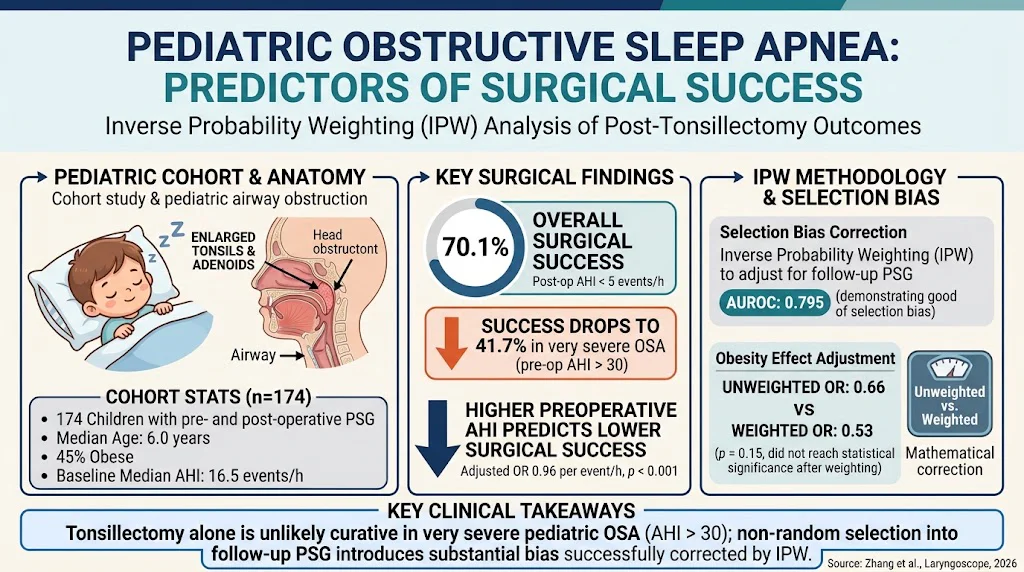
The 174 children in the outcome cohort had a median age of 6.0 years, 62% were male, and 45% were obese. Their median preoperative AHI was 16.5 events/hour, indicating moderate to severe OSA at baseline.
Overall, surgical success (postoperative AHI <5) was achieved in 70.1% of cases, a substantial but not universal rate.
The analysis elucidated several important associations:
- Selection bias in PSG follow-up: Children undergoing postoperative PSG were more likely to have had higher severity OSA preoperatively (each additional AHI event/hour increased odds of PSG by 6%), medical complexity (OR 2.22), and multiple comorbidities (OR 1.86), which substantiated the need for IPW adjustment.
- Preoperative AHI and surgical success: After IPW adjustment, each additional event/hour of preoperative AHI was associated with a 4% reduction in the odds of surgical success (OR 0.96, p < 0.001), underscoring that baseline severity is a strong inverse predictor of cure.
- Obesity: The effect size of obesity on decreased surgical success strengthened after weighting (OR from 0.66 to 0.53), though the association did not reach statistical significance (p = 0.15). This may reflect limited power or confounding by OSA severity, which obesity often exacerbates.
- Severe OSA subgroup: Among children with very severe OSA (preoperative AHI >30), only 41.7% achieved surgical cure, highlighting limited efficacy of tonsillectomy alone in this subgroup.
These data advocate for nuanced interpretation of tonsillectomy outcomes and point to preoperative AHI as a robust predictor that should be factored into clinical decision-making.
Expert Commentary
The study presents a methodologically rigorous approach to address a common challenge in sleep surgery outcomes research—non-random postoperative evaluation. By applying inverse probability weighting, the authors reduce bias and provide more generalizable estimates of surgery effectiveness.
Biologically, the inverse relationship between baseline AHI and surgical success aligns with the understanding that more severe upper airway obstruction may involve multifactorial mechanisms beyond adenotonsillar hypertrophy, such as obesity-related airway collapsibility or neuromuscular factors, which are less amenable to tonsillectomy alone.
The absence of a statistically significant obesity effect after weighting does not necessarily exclude a clinically meaningful role; rather, it may be due to intertwined influence of obesity on OSA severity or insufficient sample size. Clinicians should remain vigilant for residual OSA in obese children postoperatively.
Limitations include the retrospective design and a relatively small subset with postoperative PSG, though IPW partially addresses this. Prospective studies with standardized follow-up could further validate these findings.
Conclusion
Tonsillectomy yields surgical success in approximately 70% of pediatric OSA cases, with higher preoperative AHI strongly predicting poorer outcomes. The data underscore the importance of comprehensive preoperative evaluation and counseling, especially for children with very severe OSA or obesity, for whom adjunctive or alternative therapies may be necessary.
Incorporation of methods to adjust for follow-up selection bias strengthens the reliability of predictors identified and should be considered in future surgical outcome research.
Overall, the study advances understanding of pediatric OSA management and informs personalized treatment strategies to improve long-term airway health and quality of life.
Funding and Disclosures
The original study does not specify funding sources or clinical trial registration details; no conflicts of interest are reported in the cited article.
References
- Marcus CL, Brooks LJ, Draper KA, et al. Diagnosis and management of childhood obstructive sleep apnea syndrome. Pediatrics. 2012;130(3):576-584. doi:10.1542/peds.2012-1671
- Mitchell RB. Adenotonsillectomy for obstructive sleep apnea in children: Outcome evaluated by pre- and postoperative polysomnography. Laryngoscope. 2007;117(10):1844-1854. doi:10.1097/MLG.0b013e31812fadc7
- Paruthi S, Brooks LJ, D’Ambrosio C, et al. Consensus statement on the use of postoperative polysomnography after adenotonsillectomy for pediatric obstructive sleep apnea. J Clin Sleep Med. 2021;17(3):731-735. doi:10.5664/jcsm.9410
- Zhang Z, Bridges A, Pasapula V, Mitchell RB, Ulualp S, Johnson RF. Pediatric Obstructive Sleep Apnea: Predictors of Surgical Success via Weighted Analysis. The Laryngoscope. 2026 Oct 23. PMID: 42924857.