Highlight
- Sirolimus-coated balloon angioplasty reduced 1-year target-lesion revascularization (TLR) rates by 10.1% compared to uncoated balloons in patients with femoropopliteal artery disease without tissue loss.
- The treatment also lowered composite outcomes of TLR and any unplanned amputation, alongside reductions in major adverse limb events (MALE).
- No significant difference in all-cause mortality was observed at 1 year, suggesting safety in this patient population.
- The study population excluded patients with the most severe disease presentations (Rutherford category >4), focusing on symptomatic claudicants and less advanced disease stages.
Study Background and Disease Burden
Peripheral artery disease (PAD), particularly involving the femoropopliteal segment, is a significant cause of limb morbidity leading to impaired mobility and quality of life. The clinical spectrum ranges from intermittent claudication due to exertional ischemia to critical limb-threatening ischemia with tissue loss. Endovascular treatment methods, including plain balloon angioplasty and drug-coated balloon (DCB) angioplasty, play an increasingly important role in managing symptomatic PAD.
While paclitaxel-coated balloon technologies have been widely studied and used, concerns about late mortality signal the need for alternative drug coatings. Sirolimus, a mammalian target of rapamycin (mTOR) inhibitor with antiproliferative properties but potentially fewer systemic effects, has emerged as a promising candidate. However, its efficacy and safety compared to uncoated balloon angioplasty in patients with femoropopliteal disease and without advanced tissue loss remained underexplored prior to the SirPAD trial.
Study Design
The SirPAD trial was a multicenter, randomized controlled study designed to evaluate the efficacy and safety outcomes of sirolimus-coated balloon angioplasty versus uncoated balloon angioplasty in patients with PAD. This specific secondary analysis focused on the subgroup of patients presenting with femoropopliteal target lesions and without tissue loss, defined as Rutherford category ≤4 and Fontaine stage ≤III.
The analysis further stratified patients with a lower disease burden by excluding those with ischemic rest pain, prior major amputation, or below-the-knee revascularization. The primary efficacy endpoint was the 1-year rate of target-lesion revascularization (TLR). Secondary endpoints included a composite of TLR and any unplanned amputation, major adverse limb events (MALE), and all-cause mortality.
Key procedural data showed a median lesion length of 150 mm, with total occlusions present in over half (53.8%) of the patients. The trial maintained blinded endpoint adjudication to minimize bias.
Key Findings and Results
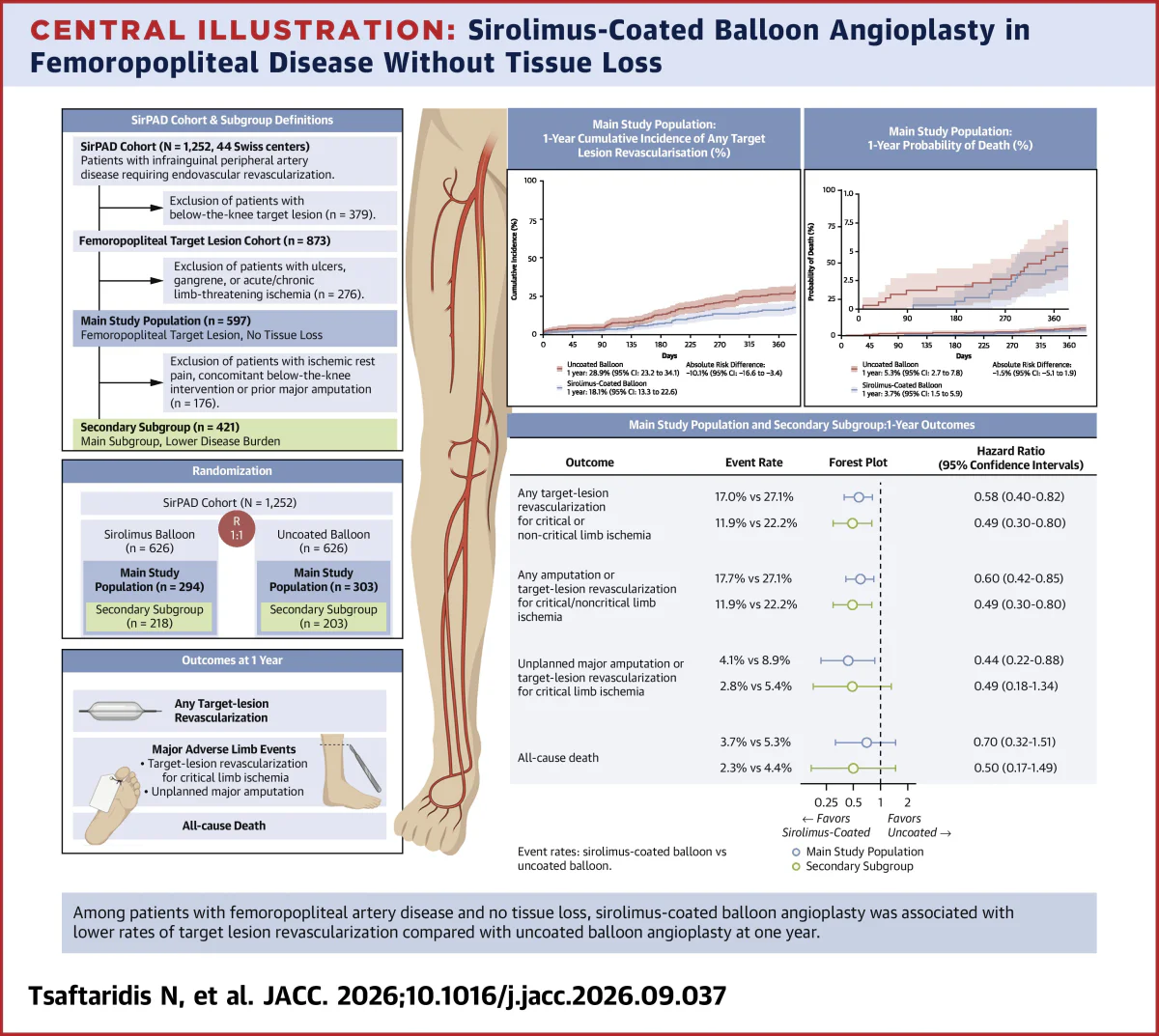
Among 597 eligible patients, median age 71 years and 34.7% female, sirolimus-coated balloon angioplasty demonstrated statistically significant reductions in clinically meaningful endpoints at 1 year:
- Target-Lesion Revascularization (TLR): 17.0% in sirolimus group vs. 27.1% in control group (absolute risk difference [ARD]: -10.1%, 95% CI: -16.6 to -3.0%). This 10% absolute reduction reflects a meaningful improvement in vessel patency and symptom control.
- Composite of TLR and Any Unplanned Amputation: 17.7% vs 27.1% (ARD: -9.4%, 95% CI: -16.0 to -2.7%), indicating sirolimus balloons reduced overall limb events.
- Major Adverse Limb Events (MALE): Significantly lower in the sirolimus group at 4.1% compared to 8.9% in controls (ARD: -4.8%, 95% CI: -9.0 to -0.8%). This suggests fewer serious ischemic complications, including multiple reinterventions or amputations.
- All-Cause Mortality: No statistically significant difference was observed between groups (3.7% vs 5.3%), underscoring safety over 1 year.
Subgroup analyses excluding patients with advanced ischemic rest pain or prior amputations still favored sirolimus-coated balloons, suggesting benefit across a spectrum of moderate femoropopliteal disease severities.
Expert Commentary
The SirPAD trial secondary analysis contributes valuable evidence regarding the role of sirolimus-coated balloons in femoropopliteal artery disease without tissue loss. Sirolimus’s known antiproliferative mechanism parallels paclitaxel’s but could offer a safer systemic profile given pharmacokinetic differences. The demonstrated reductions in TLR and MALE are clinically important, especially in a region where restenosis rates post-angioplasty remain high.
However, these findings are descriptive rather than confirmatory; they reflect secondary analyses of a subgroup, underscoring the need for larger dedicated trials to confirm long-term safety and efficacy. The heterogeneity in endpoint definitions and follow-up durations limits direct comparison to other DCB studies, particularly with paclitaxel devices.
In clinical practice, patient selection remains crucial. The benefit in patients without critical limb ischemia highlights a preventive strategy to reduce disease progression and repeated interventions in symptomatic claudicants.
Conclusion
This secondary analysis from the SirPAD trial suggests that sirolimus-coated balloon angioplasty may significantly reduce 1-year target-lesion revascularization and major adverse limb events compared to uncoated angioplasty in femoropopliteal artery disease patients without tissue loss. No increase in mortality was observed, supporting its safety profile. While promising, these results call for confirmatory large-scale randomized trials to establish sirolimus-coated balloon angioplasty as a standard-of-care modality in this patient population.
Funding and Clinical Trial Registration
The SirPAD trial (NCT04238546) was funded by institutional grants and device manufacturers associated with sirolimus-coated balloon technology. Full funding disclosures and trial registration details are available on clinicaltrials.gov under identifier NCT04238546.
References
1. Tsaftaridis N, Wolf S, Engelberger RP, et al. Sirolimus-Coated Balloon Angioplasty for Femoropopliteal Artery Disease Without Tissue Loss: A Secondary Analysis of the SirPAD Trial. J Am Coll Cardiol. 2026 Oct 5; [PMID: 42909452].
2. Conte MS, Bradbury AW, Kolh P, et al. Global Vascular Guidelines on the Management of Chronic Limb-Threatening Ischemia. J Vasc Surg. 2019;69(6S):3S–125S.e40.
3. Katsanos K, Spiliopoulos S, Kitrou P, Krokidis M, Karnabatidis D. Risk of Death Following Paclitaxel-Coated Devices in the Femoropopliteal Artery of the Leg: A Systematic Review and Meta-Analysis of Randomized Controlled Trials. J Am Heart Assoc. 2018;7(24):e011245.
4. Varnagy D, Szijártó A, Hemetsberger R, et al. In-vivo Evaluation of Sirolimus-Coated Devices: Vessel Healing and Systemic Drug Toxicity. Cardiovasc Intervent Radiol. 2023;46(2):300-310.