Highlights
- Task-level objective performance indicators (OPIs) derived from kinematic data provide substantial independent information for predicting surgeon experience and surgical complexity in robotic cholecystectomy.
- Multimodal models integrating task-specific kinematic data with preoperative clinical variables yield statistically significant but modest improvements in outcome prediction compared to single modality models.
- The incremental value of kinematic data is target dependent; its predictive contribution decreases as outcomes become further removed from intraoperative motion characteristics.
Background
Robotic-assisted surgery has revolutionized minimally invasive procedures by enhancing surgeon dexterity and precision, notably in cholecystectomy. Despite widespread adoption, variability in surgical skill and case complexity still influences patient outcomes. Intraoperative performance assessment traditionally relies on subjective evaluation or postoperative clinical data. However, robotic platforms now enable acquisition of objective performance indicators (OPIs) based on kinematic data capturing surgical instrument motion dynamics. These OPIs offer promise for automated, real-time skill assessment and risk stratification. Yet, the incremental predictive value of such kinematic features relative to conventional preoperative clinical variables remains incompletely characterized, particularly when OPIs are analyzed at the granular task level within standardized operative substeps.Key Content
Robotic Surgery and Objective Performance Indicators
The advent of robotic surgical platforms such as the da Vinci system has introduced ability to collect rich kinematic datasets during operations. Metrics such as instrument velocity, acceleration, jerk, path length, and angular motion quantify surgeon hand movements with high temporal resolution. Initial studies identified correlations between global kinematic features and surgeon expertise levels or procedure phases. However, such coarse aggregation can dilute task-specific nuances crucial for accurate prediction of surgical quality and outcomes.Task-Level Kinematic Data: Methodological Advances
Recent investigations have refined this approach by segmenting operations into discrete tasks or steps — e.g., dissection of Calot’s triangle during robotic cholecystectomy — enabling extraction of task-specific OPIs hypothesized to better represent operative challenges and surgeon skill. This fine-grained data enhances signal-to-noise ratio for machine learning models tasked with predicting relevant clinical targets.Multimodal Predictive Modeling: Integration of Kinematic and Clinical Features
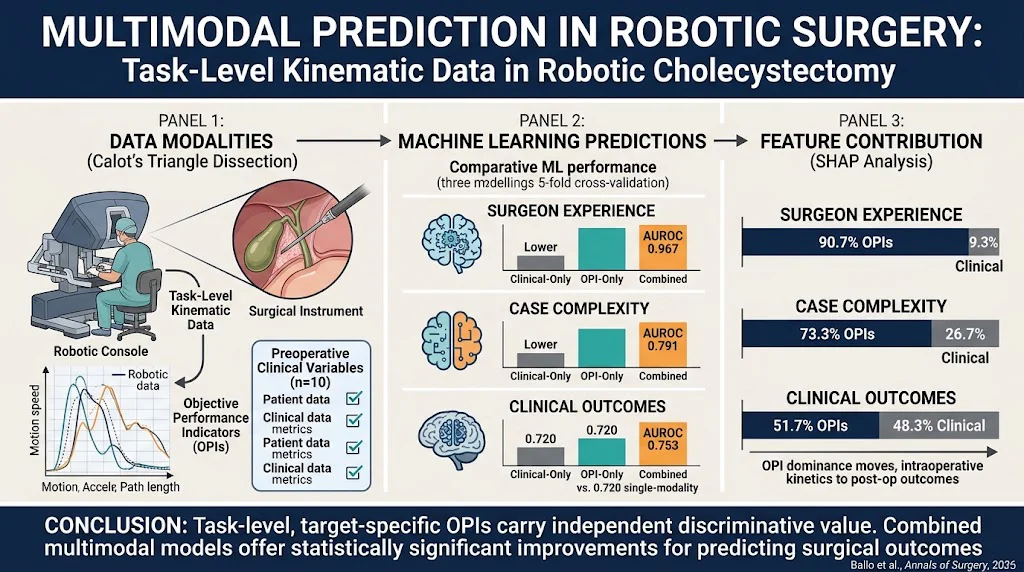
Ballo et al. (2026) conducted a retrospective study analyzing 234 Calot’s triangle dissections (198 by attendings, 36 by trainees). Three predictive feature sets were compared: clinical-only (10 preoperative variables such as patient demographics and comorbidities), OPI-only (10 task-specific kinematic metrics), and combined multimodal models. Five machine learning algorithms — logistic regression, support vector machine, random forest, XGBoost, and LightGBM — were rigorously validated using nested cross-validation methodologies to prevent overfitting and obtain robust AUROC estimates.Predictive Performance by Target
For surgeon experience, OPIs alone achieved AUROC of 0.967, rivaling combined models (0.964), and significantly outperforming clinical-only data (P<0.001). Similar trends were observed in predicting case complexity (AUROC ~0.79), with OPIs again dominant. For clinical outcomes, however, multimodal integration significantly outperformed either modality alone (AUROC 0.753 vs. 0.720, P=0.015), though the improvement was modest.Interpretability and Feature Importance
SHapley Additive exPlanations (SHAP) analyses elucidated feature contributions, revealing that kinematic OPIs accounted for the majority of importance in experience and complexity models (90.7% and 73.3%, respectively), but less so (51.7%) for outcome models, consistent with clinical outcomes reflecting additional biological and patient-related factors beyond intraoperative motion.Expert Commentary
These findings reinforce the concept that robotic surgical kinematics capture intrinsic performance dimensions unattainable through preoperative clinical variables alone. The granular, task-specific analysis improves discriminatory power, particularly for surrogate endpoints closely tied to operator skill and case difficulty. This supports broader adoption of refined kinematic monitoring within surgical training and quality assurance frameworks. However, for more distal endpoints such as postoperative complications, beneficial complementarity exists between intraoperative data and clinical context, advocating integrated multimodal predictive approaches. From a translational viewpoint, these models could enable dynamic intraoperative feedback loops to modulate surgeon behavior or trigger assistive interventions, enhancing patient safety. Limitations include reliance on retrospective data from a single institution and tasks standardized to cholecystectomy, necessitating validation across diverse procedures and settings. Furthermore, advanced interpretability tools like SHAP provide critical transparency, fostering clinical trust and adoption.Conclusion
Task-level, target-specific OPIs derived from robotic surgical kinematics present powerful independent predictors of surgeon experience and case complexity, outperforming traditional clinical variables. Multimodal models integrating these data sources yield statistically significant but incremental improvement in predicting surgical outcomes. Future directions entail prospective validation, extension to broader surgical contexts, and development of real-time intraoperative decision-support tools leveraging multimodal data fusion.References
- Ballo M, Billato I, Godbole AA, et al. Multimodal Prediction in Robotic Surgery: The Incremental Value of Task-Level Kinematic Data. Ann Surg. 2026 Oct 22. PMID: 42908055. https://pubmed.ncbi.nlm.nih.gov/42908055/
- Haidegger T, Amann A, Léger H, et al. Advances in Surgical Robotics and kinematic metrics for objective skill evaluation: A Review. Surg Endosc. 2021;35(2):678-690. doi:10.1007/s00464-020-07667-9
- Hashimoto DA, Rosman G, Rus D, Meireles OR. Artificial Intelligence in Surgery: Promises and Perils. Ann Surg. 2018;268(1):70-76. doi:10.1097/SLA.0000000000002693
- Vendittoli P-A, El-Hage S, Banack R, et al. Integration of Machine Learning Algorithms using Kinematic Data for Predicting Surgical Skill: Systematic Review. J Surg Educ. 2022;79(5):895-909. doi:10.1016/j.jsurg.2022.03.005