Highlight
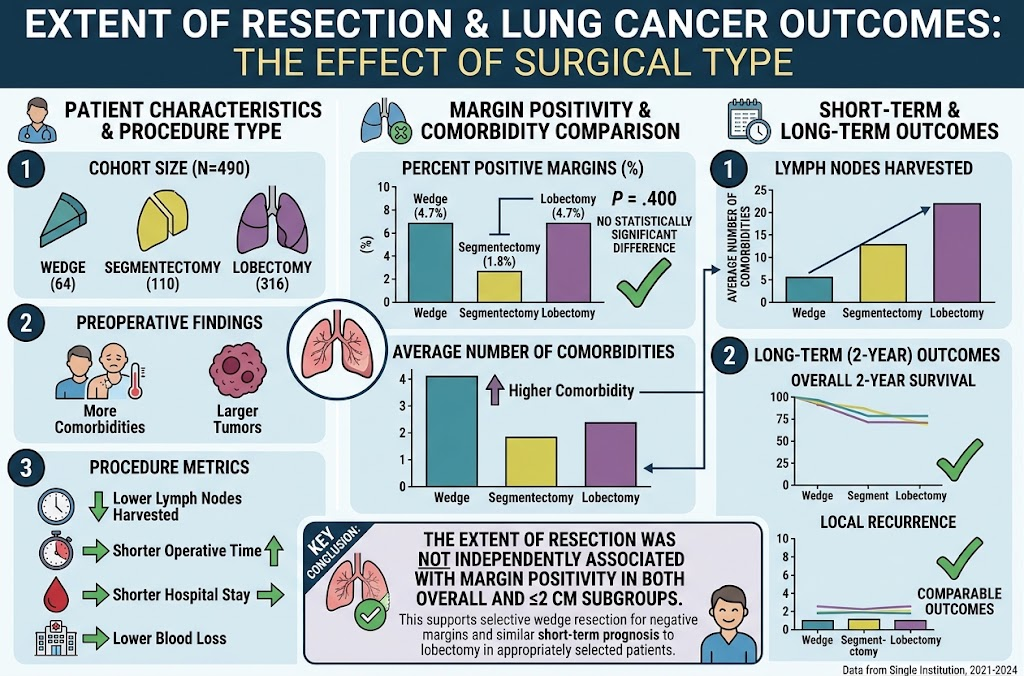
This study examined margin positivity rates in patients undergoing wedge resection, segmentectomy, or lobectomy for non-small cell lung cancer (NSCLC) and found no significant difference among types. Despite fewer lymph nodes harvested in wedge resections, two-year survival and recurrence rates were comparable to anatomic resections. These findings suggest wedge resection may be an oncologically safe option in selected patients.
Study Background
Non-small cell lung cancer remains a leading cause of cancer mortality worldwide. Surgical resection is a cornerstone of curative treatment for early-stage disease. Historically, lobectomy has been considered the standard surgical approach due to concerns about oncologic adequacy with lesser resections such as wedge resection and segmentectomy. However, as minimally invasive surgical techniques and patient selection improve, there is increasing interest in sublobar resections that potentially preserve more lung parenchyma and reduce perioperative morbidity. A critical concern with sublobar resections is the risk of positive surgical margins, which could compromise long-term outcomes. This study addresses whether margin positivity is associated with the extent of resection in NSCLC.
Study Design
This retrospective single-institution analysis included 490 NSCLC patients treated from 2021 to 2024 who underwent wedge resection (n=64), segmentectomy (n=110), or lobectomy (n=316). Patient demographics, comorbidities, tumor characteristics, operative details, lymph node harvest, margin status, perioperative outcomes, and two-year survival and recurrence data were collected and compared across groups. The primary endpoint was the rate of positive resection margins, analyzed with multivariable logistic regression to adjust for confounding factors. Subgroup analysis was performed for tumors ≤2 cm to evaluate margin status in smaller tumors.
Key Findings
The three groups differed significantly in patient and tumor characteristics: wedge resection patients had more comorbidities whereas lobectomy patients had larger tumors. Margin positivity rates were low and statistically similar across groups: wedge 4.7%, segmentectomy 1.8%, lobectomy 4.7% (P=0.400). Notably, wedge resections yielded fewer lymph nodes (reflecting less extensive nodal sampling) but had shorter operative times, less blood loss, and shorter hospital stays. Overall morbidity was comparable. Importantly, two-year survival and recurrence rates did not significantly differ among resection types. Multivariable analysis confirmed that extent of resection was not an independent predictor of margin positivity, including in the subset of tumors ≤2 cm.
Expert Commentary
This study adds important evidence to the evolving discussion about the oncologic safety of sublobar resections in NSCLC. The findings argue that wedge resection can achieve equivalent negative margin rates and short-term oncologic outcomes compared to more extensive resections in properly selected patients. This supports recent shifts in guidelines that endorse tissue-sparing approaches in small, peripheral tumors or patients with limited pulmonary reserve. However, the smaller lymph node harvest in wedge resections highlights the importance of adequate nodal staging and surveillance. Limitations include the retrospective single-center design and relatively short follow-up, thus longer-term outcomes remain to be established. The study underscores the need for careful patient selection and comprehensive multidisciplinary assessment when considering lesser resection approaches.
Conclusion
Positive surgical margins in NSCLC are infrequent and do not correlate with the extent of resection, supporting the selective use of wedge resection in suitable patients. Despite lower lymph node sampling, wedge resection demonstrated comparable two-year survival and recurrence to anatomic resections, suggesting that lobectomy or segmentectomy may not be mandatory solely to ensure margin negativity. Future prospective trials with longer follow-up are needed to confirm oncologic equivalency and define optimal patient selection criteria to maximize the benefits of lung parenchyma preservation without compromising cancer control.
Funding and ClinicalTrials.gov
The authors did not report specific funding sources. No ClinicalTrials.gov registration was indicated for this retrospective analysis.
References
Booth DH, Savitch SL, Chang AC, Ekeke CN, Lin J, Odell DD, Reddy RM, Lagisetty KH. Margin positivity is not associated with the extent of resection for non-small cell lung cancer. Surgery. 2026 May 22;196:110322. PMID: 42269208.
Altorki NK, Wang X, Wigle D, et al. Perioperative mortality and morbidity after sublobar versus lobar resection for early-stage non-small cell lung cancer: A randomized trial. Ann Thorac Surg. 2021;112(5):1709-1715.
National Comprehensive Cancer Network (NCCN). Non-Small Cell Lung Cancer (Version 8.2025). Available at: https://www.nccn.org/professionals/physician_gls/pdf/nscl.pdf