Highlight
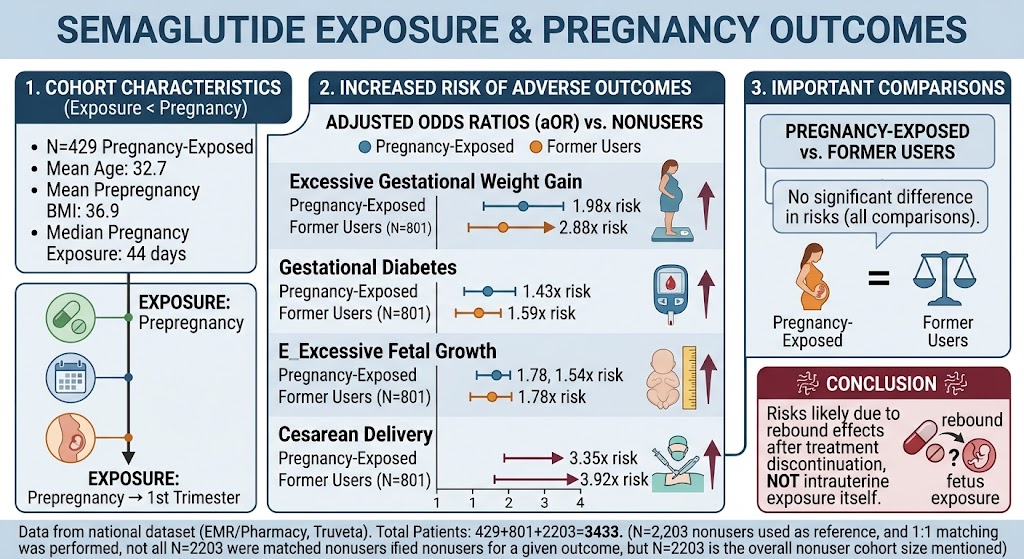
This retrospective cohort study reveals that semaglutide exposure before and during pregnancy among women with overweight or obesity is associated with increased risks of excessive gestational weight gain, gestational diabetes, excessive fetal growth, and cesarean delivery. Importantly, similar risks were observed in women who discontinued semaglutide prior to pregnancy, suggesting that adverse effects may relate more to rebound weight gain after treatment cessation rather than direct intrauterine exposure.
Study Background
Obesity and overweight are prevalent conditions that significantly complicate pregnancy by increasing the risks of adverse maternal and fetal outcomes, such as gestational diabetes, hypertensive disorders, and delivery complications. Managing weight in reproductive-age women is a public health priority to optimize pregnancy outcomes. Semaglutide, a glucagon-like peptide-1 receptor agonist (GLP-1 RA), has shown efficacy in weight reduction and glycemic control; however, its safety profile during pregnancy remains inadequately characterized due to limited clinical data on maternal and fetal effects. As semaglutide use increases in women of childbearing age, understanding its impact on gestational weight gain and pregnancy outcomes is crucial for clinical decision-making and counseling.
Study Design
This investigation utilized a retrospective cohort design analyzing a national-level dataset (Truveta) linking electronic medical record and pharmacy dispensing data, representing women delivering from January 2022 to January 2026. Eligible participants were women with prepregnancy overweight or obesity, categorized into three groups based on semaglutide exposure history:
- Pregnancy-exposed users: Semaglutide use before and continued into pregnancy
- Former users: Semaglutide use prior to pregnancy only
- Nonusers: No semaglutide exposure
Gestational diabetes, preterm birth (delivery between 24 and 37 weeks gestation), pregnancy-related hypertension, intrauterine growth restriction, excessive fetal growth, and cesarean delivery were identified using ICD-10 coding. To mitigate confounding, 1:1 propensity score matching was performed controlling for maternal age, race and ethnicity, prepregnancy BMI, diabetes, and hypertension. Adjusted logistic and linear regression models evaluated associations between semaglutide exposure and outcomes.
Key Findings
The study included 429 pregnancy-exposed users (mean age 32.7 years, mean BMI 36.9), 801 former users, and 2,203 nonusers after matching. Median semaglutide exposure during pregnancy was approximately 44 days.
Risks Associated with Semaglutide Exposure
- Excessive Gestational Weight Gain: Pregnancy-exposed users had nearly threefold increased odds (aOR 2.88; 95% CI, 2.04-4.05) compared to nonusers; former users also showed elevated risk (aOR 1.98; 95% CI, 1.56-2.51).
- Gestational Diabetes: Both pregnancy-exposed and former users exhibited statistically significant increases in gestational diabetes risk (aOR 1.59 and 1.43, respectively).
- Excessive Fetal Growth: Higher odds were observed in pregnancy-exposed (aOR 1.78; 95% CI, 1.03-3.08) and former users (aOR 1.54; 95% CI, 1.01-2.36) relative to nonusers.
- Cesarean Delivery: Markedly increased odds for cesarean delivery were found in both groups, with pregnancy-exposed users showing aOR of 3.35 (95% CI, 2.15-5.22) and former users aOR of 3.92 (95% CI, 2.81-5.47).
No significant differences in gestational weight gain or pregnancy outcomes were detected when comparing pregnancy-exposed users directly to former users, suggesting that continuation into pregnancy did not independently affect these risks.
Interpretation
The findings imply that adverse pregnancy outcomes linked with semaglutide use may be more attributable to rebound phenomena — such as rapid weight gain following drug cessation — than to direct teratogenic or intrauterine toxic effects of the drug. This is clinically relevant given that semaglutide is contraindicated during pregnancy, and women who discontinue therapy might experience metabolic and weight fluctuations impacting gestational health.
Expert Commentary
This large retrospective analysis contributes valuable observational data on the ramifications of semaglutide exposure among pregnant women with overweight or obesity, a population at high baseline risk for pregnancy complications. The use of a national electronic health record database enhances generalizability, and propensity score matching strengthens internal validity by minimizing confounding bias. Nonetheless, residual confounding cannot be fully excluded.
Limitations include the retrospective design, potential misclassification of outcomes relying on ICD codes, and inability to capture unmeasured confounders such as lifestyle factors, exact adherence, or gestational age at semaglutide discontinuation among former users. The median exposure duration in pregnancy approximated six weeks, reflecting likely discontinuation after pregnancy recognition, which may have influenced the lack of difference between groups.
Mechanistically, GLP-1 receptor agonists influence appetite and weight regulation centrally but lack established direct fetal toxicity. The observed associations underscore the need for preconception counseling regarding potential risks of discontinuation-related weight rebound and metabolic changes affecting pregnancy.
Conclusion
In summary, semaglutide exposure before and during pregnancy in women with overweight or obesity is associated with heightened risks for excessive gestational weight gain, gestational diabetes, excessive fetal growth, and cesarean delivery. Similar outcomes in those who discontinued treatment prior to pregnancy suggest these risks may predominantly relate to rebound effects after stopping semaglutide rather than direct intrauterine exposure. Clinicians should carefully counsel reproductive-age women about timing of semaglutide therapy relative to pregnancy and monitor for adverse metabolic changes post-discontinuation.
Further prospective studies and mechanistic research are warranted to better inform guidelines for semaglutide use in women planning pregnancy, optimizing maternal and fetal outcomes while balancing obesity management.
Funding and Clinical Trials
The article does not specify funding sources or clinical trial registration. Future research should consider prospective controlled studies to corroborate these retrospective findings.
References
Yu Y, Li X, Groth SW, et al. Gestational Weight Gain and Pregnancy Outcomes After Semaglutide Exposure. Obstet Gynecol. 2026 May 28;148(2):229-237. PMID: 42208070.
Khera R, et al. Effect of Semaglutide on Weight Loss in Patients with Obesity. N Engl J Med. 2021.
ACOG Practice Bulletin No. 190: Gestational Diabetes Mellitus. Obstet Gynecol. 2018.