Introduction and Context
Participation in organised physical activity (PA) — community classes, gym-based sessions, walking groups or sport clubs — is a proven route to improved health, function and quality of life for people living with long-term conditions (LTCs). International guidance from bodies such as the World Health Organization and national public health agencies has long emphasized that most people can safely begin or increase routine physical activity without medical clearance. Yet in many settings, industry and programme providers still require medical clearance or route people through screening tools that disproportionately direct them to clinicians. The result: unnecessary delay, confusion, and lower participation rates among people who could benefit most from activity.
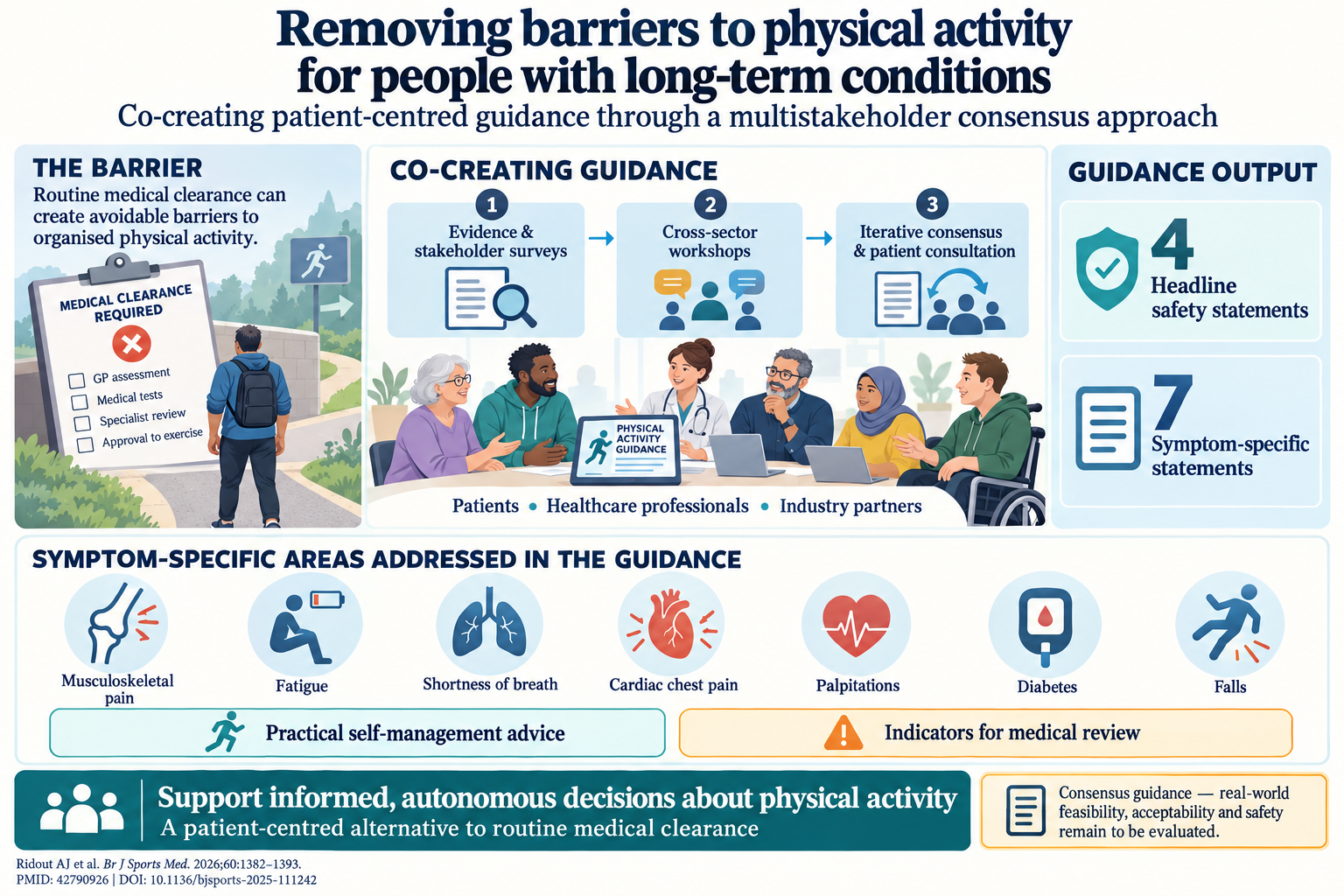
Ridout et al. (Ridout AJ, Reid H, Kelly P, Williamson C, Jones N. Br J Sports Med. 2026) used a multistakeholder consensus approach to co-create patient-facing digital guidance designed to support informed, autonomous decision-making about participation in organised PA without routine medical clearance. The project sought to remove avoidable barriers while preserving safety for people with LTCs. This article summarizes the consensus process, the core recommendations and practical statements developed, and implications for clinicians, programme providers and patients.
References that informed the broader context include the WHO Guidelines on Physical Activity and Sedentary Behaviour (2020) and U.S. Physical Activity Guidelines for Americans, 2nd Edition (2018), both of which emphasize population-level promotion of PA and that most adults can safely be active without physician screening.
Why this consensus was needed
Key problems identified by the authors across literature, industry audits and stakeholder surveys were:
– Routine medical clearance requirements persist despite guidance saying they are usually unnecessary, creating systemic barriers to participation.
– Existing preparticipation tools frequently funnel people toward clinician review even when risk is low.
– Clinicians report low confidence in providing “medical clearance” for organised activity, citing uncertainty about boundaries of responsibility and lack of pragmatic guidance.
– Industry providers (gyms, community programmes) face governance and liability concerns and lack clear, accepted patient-facing guidance they can use in enrolment and risk-assessment workflows.
– Patients with LTCs worry that activity will worsen symptoms, lack clear self-management and escalation guidance, and often defer participation because of unclear requirements.
These gaps motivated a co-creation process to produce clear, patient-centred statements that can be used digitally or in paper form to guide people with LTCs into organised PA without routine clinician review, while identifying clear red flags and indicators for medical review.
Consensus process and quality assurance
The group used the Knowledge-to-Action framework across three phases: literature review and audits; cross-sector workshops with patients, clinicians and industry; and iterative consensus development including patient focus groups and multidisciplinary clinician panels. Reporting and development followed ACcurate COnsensus Reporting Document (ACCORD) principles and AGREE II criteria to ensure methodological transparency, stakeholder involvement and applicability. The final outputs were a set of four headline safety statements and seven symptom-specific statements with plain-language self-management advice and clear indicators for seeking medical review.
New guideline highlights — major recommendations
Major consensus conclusions:
– Routine, blanket medical clearance is not required for most people with stable LTCs to participate in organised PA. Instead, use patient-centred decision guidance focused on symptoms and function.
– A short, digital patient-facing tool (decision aid) with four general safety statements and seven symptom-specific modules is an acceptable alternative, supported by patients, clinicians and industry stakeholders.
– The guidance prioritizes informed autonomy: clear language, practical self-management tips, graded activity advice, and explicit red flags that prompt medical review.
– Implementation should include education for clinicians and programme providers on the scope of the statements and clear local pathways for when medical review is appropriate.
Key takeaways for clinicians and providers:
– Stop automatic referral for medical clearance when no red flags are present.
– Use the symptom-specific statements to triage: treat most presentations (e.g., stable musculoskeletal pain, well-controlled diabetes) with practical PA advice rather than medical gatekeeping.
– Ensure mechanisms exist to support people who need clinical review, and communicate these clearly to participants.
Headline safety statements (consensus)
The consensus produced four headline safety statements (plain language paraphrase):
1. If you feel well and your long-term condition is stable, you can usually start or join organised PA without a doctor’s clearance.
2. If you have new, severe, or worsening symptoms (chest pain, fainting, new shortness of breath, uncontrolled blood sugar), seek medical review before joining.
3. Use graded or adapted activity if you are recovering from flare-ups or deconditioning; start low and progress slowly with support.
4. Programme providers should accept this patient-facing guidance and provide reasonable adaptations; clinicians should be available for consult when indicated, but routine clearance is unnecessary.
Consensus strength: strong multidisciplinary agreement, with patient endorsement; guidance framed as pragmatic, not prescriptive.
Seven symptom-specific statements (summary)
The panel created seven modules addressing common concerns. Each module contains: brief plain-language explanation, practical self-management tips, suggested activity adaptations, and clear indicators for urgent or routine medical review.
– Musculoskeletal pain: Emphasize movement as part of recovery, use pain-monitoring rules (e.g., acceptable transient increase in pain up to moderate level that settles within 24–48 hours), avoid sudden heavy loading if acute injury suspected. Seek review for suspected fracture, severe loss of function, or progressive neurologic symptoms.
– Fatigue: Recommend graded activity and pacing, energy conservation techniques, sleep hygiene, and monitoring for changes. Seek review if there is marked new fatigue, post-exertional symptom exacerbation suggestive of myalgic encephalomyelitis/chronic fatigue syndrome, or new red flags (fevers, weight loss).
– Shortness of breath (dyspnea): Differentiate exertional breathlessness that improves with conditioning from new or worsening breathlessness at rest. Urgent review recommended for sudden severe breathlessness, new hypoxia, or associated chest pain or syncope.
– Cardiac chest pain: Any new or typical angina-type chest pain requires urgent clinical evaluation. Stable, known non-cardiac chest discomfort may be managed with activity modifications pending clinician advice.
– Palpitations: Reassure for brief benign palpitations without other symptoms; advise review for sustained palpitations, syncope, chest pain, or associated breathlessness.
– Diabetes: Encourage activity with basic blood-glucose self-monitoring advice: check levels as per usual self-management, be aware of hypoglycaemia signs, adjust carbohydrate or insulin timing for higher-intensity sessions. Seek review if glucose control is unstable, recurrent hypoglycaemia or hyperglycaemic emergencies.
– Falls and balance concerns: Suggest supervised or adapted classes focusing on balance, strength and environmental safety; urgent review for recent fractures, progressive neurologic decline, or frequent unexplained falls.
For each module the consensus provides concrete indicators for seeking medical review (urgent vs routine) and suggested self-management steps to enable safe participation.
Updates and differences from prior practice
How this consensus differs from common practice and earlier guidance:
– Moves from clinician-led “medical clearance” to patient-centred, symptom-led decision-making: rather than defaulting to GP clearance, the guidance empowers patients and programme leaders to assess suitability using standardized statements.
– Clarifies practical self-management actions tied to specific symptoms, rather than vague “see your doctor” instructions often generated by screening tools.
– Emphasizes graded activity and adaptation as first-line responses to many symptom presentations, aligning with WHO and national activity guidance that prioritize safe progression.
Evidence driving the change: The consensus drew on international guidance (WHO 2020; US DHHS 2018) and stakeholder data showing the harms of unnecessary medicalization (reduced access, delayed participation). While direct randomized trials of “no-clearance” pathways are limited, the balance of risks — low incidence of adverse events during low-to-moderate intensity activity, and high benefit of participation — supports a less restrictive approach.
Expert commentary and controversies
Panel reflections and stakeholder concerns included:
– Clinician discomfort: Many clinicians felt uncertain about medicolegal responsibility when providing “clearance.” The consensus explicitly reframes the interaction as shared decision-making and provides referral guidance when medical review is required.
– Industry liability fears: Programme providers wanted a credible, evidence-based patient-facing tool they could adopt. The consensus provides standard wording and escalation criteria to reduce variability.
– Patients’ priorities: People with LTCs emphasized clear, empathetic language, practical tips for managing symptoms, and easy routes to clinical support if needed.
Areas of active debate: The panel debated thresholds for urgent review (e.g., degree of palpitations or breathlessness that mandates immediate evaluation) given differences in patient baseline risk. The consensus therefore uses conservative red-flag criteria to prioritize safety.
Practical implications for clinicians and programme providers
– Clinicians: Move from routine “sign-off” requests toward supporting patients with brief advice, clarifying when referral is needed, and documenting collaborative plans when requested.
– Programme providers: Adopt the patient-facing digital tool or statements as part of enrolment processes; provide reasonable adaptations; ensure pathways for contacting a clinician if a participant meets red-flag criteria.
– Patients: Empower people to self-assess using clear symptom guidance, start with graded activity, and seek medical review only when indicators are present.
Implementation tips:
– Integrate the statements into digital registration forms for classes and gym induction.
– Educate front-line staff about the guidance so they can explain it calmly to participants.
– Make local clinical pathways visible — who to contact and how — when medical review is indicated.
Next steps and research priorities
The authors recommend pragmatic evaluation of the guidance in real-world settings:
– Feasibility and acceptability studies in diverse communities and provider settings.
– Safety surveillance to monitor adverse events and healthcare use after adoption.
– Implementation studies assessing whether the guidance increases participation among people with LTCs and reduces inequities.
Illustrative vignette
Mary is 68, has osteoarthritis and well-controlled type 2 diabetes, and wants to join a local walking group that requires “medical clearance.” Using the consensus statements, Mary reads the musculoskeletal and diabetes modules in plain language, learns pacing and warming-up strategies, and checks her usual blood glucose habits. She has no new chest pain, breathlessness, or recent falls. Under the consensus approach, Mary can join the group with graded activity suggestions and an agreed plan to contact her GP if she notices new worrying symptoms — avoiding an unnecessary clinic visit and starting beneficial activity sooner.
References
– Ridout AJ, Reid H, Kelly P, Williamson C, Jones N. Removing barriers to physical activity for people with long-term conditions: co-creating patient-centred guidance through a multistakeholder consensus approach. Br J Sports Med. 2026 Sep 24;60(18):1382-1393. PMID: 42790926. https://pubmed.ncbi.nlm.nih.gov/42790926/
– World Health Organization. WHO Guidelines on Physical Activity and Sedentary Behaviour. Geneva: WHO; 2020. https://www.who.int/publications/i/item/9789240015128
– U.S. Department of Health and Human Services. Physical Activity Guidelines for Americans, 2nd edition. Washington, DC: HHS; 2018. https://health.gov/paguidelines/second-edition/
– American College of Sports Medicine. ACSM’s Guidelines for Exercise Testing and Prescription. 11th ed. Philadelphia: Wolters Kluwer; 2021.
– AGREE Next Steps Consortium. The AGREE II Instrument. 2009. https://www.agreetrust.org/resource-centre/agree-ii/
Bottom line
This 2026 multistakeholder consensus offers a pragmatic, patient-centred alternative to routine medical clearance for people with long-term conditions. By replacing default gatekeeping with clear symptom-based safety statements and practical self-management advice, the guidance aims to reduce barriers, support informed autonomy and safely increase participation in organised physical activity. Local implementation and prospective evaluation will be critical to ensure the approach is effective, acceptable and safe across diverse settings.