Introduction and Context
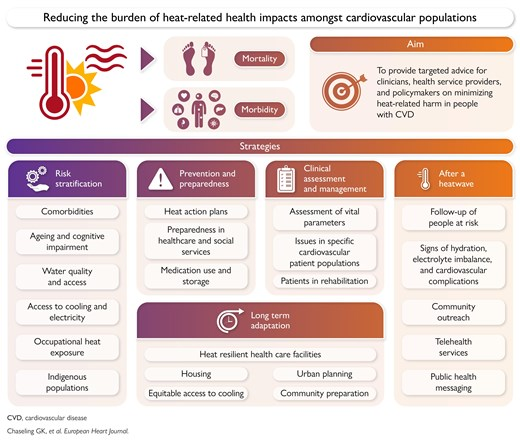
Extreme heat is increasingly a cardiology challenge. The European Heart Journal consensus statement “Reducing the burden of heat-related impacts on cardiovascular health” (Chaseling et al., 2026) was issued in response to accelerating climate-driven heat extremes and mounting evidence that people with cardiovascular disease (CVD) — especially older adults and those with heart failure, ischemic heart disease, arrhythmias, and hypertension — face disproportionate risks of illness and death during heatwaves [1]. The year 2024 was reported as the warmest on record and the first to cross the 1.5°C threshold above pre-industrial levels; clinicians are now expected to incorporate heat-risk management into routine cardiovascular care as heat exposure becomes a chronic, predictable hazard [1,2].
This consensus builds on earlier epidemiological and physiological literature demonstrating temperature-related mortality and the cardiovascular system’s vulnerability to heat stress [3]. It translates evidence and expert opinion in thermal physiology and cardiology into practical, actionable recommendations for clinicians, health services, and policy-makers.
New Guideline Highlights
Major themes and practical takeaways from the 2026 consensus statement:
– Proactive risk identification: screen cardiovascular patients for individual heat vulnerability before the warm season and during routine visits.
– Medication review is essential: identify drugs that raise heat or dehydration risk (notably high-dose diuretics, some antihypertensives) and plan individualized adjustments rather than blanket cessation.
– Hydration and cooling strategies: clear, stage-based guidance on hydration targets, ambient cooling, and safe physical activity during heat events.
– Systems-level preparedness: integration of heat-health action plans with cardiovascular care pathways, including remote monitoring, outreach to high-risk patients, and coordination with public health heat alerts.
– Follow-up after heat exposure: structured post-heat event assessment for decompensation and acute cardiac events.
Key takeaway for clinicians: treat heat exposure as a modifiable risk factor for cardiometabolic decompensation and adopt a coordinated pre-season, in-season, and post-event management plan grounded in patient-centred risk stratification and system readiness [1].
Updated Recommendations and Key Changes from Prior Guidance
The 2026 statement updates and expands on earlier cardiovascular and public health advice in several ways:
– Scope broadened from population-level warnings to individualized clinical guidance. Where previous documents emphasized public health alerts, this consensus gives concrete clinical actions for outpatient, inpatient, and community care teams [1].
– Medication guidance is more nuanced. Instead of recommending routine suspension of agents (e.g., RAAS inhibitors or beta-blockers), the statement advocates individualized review, with clear guidance on when temporary dose adjustment or closer monitoring is appropriate.
– Explicit integration of telemedicine and remote physiologic monitoring during heatwaves to detect early signs of decompensation (weight changes in heart failure, symptomatic hypotension, arrhythmia symptoms).
– Formal recommendation to embed heat-health planning into cardiology service pathways — including pre-season risk lists and proactive outreach — rather than treating heat as an ad hoc public health event.
The consensus relies on a synthesis of observational epidemiology, physiology studies, and expert thermal physiology input; where randomized trial evidence is lacking, the authors use graded expert consensus statements to offer practical guidance [1,3].
Topic-by-Topic Recommendations
Below are the core clinical recommendations distilled by topic. Where the consensus authors did not apply a formal GRADE label, recommendations are described as “expert consensus” or “evidence-informed”.
Risk stratification and screening (pre-season)
– Who to screen: all patients with established CVD, especially those with heart failure (HFrEF and HFpEF), recent myocardial infarction, advanced coronary disease, symptomatic arrhythmias, advanced age (>75 years), chronic kidney disease, diabetes, mobility limitations, social isolation, or lack of access to cool spaces. (Expert consensus) [1].
– How to screen: ask about living conditions (air conditioning, ability to access cool spaces), medication list, prior heat-related symptoms, and capacity for hydration and independent activities.
– Risk scoring: the statement recommends a pragmatic three-tier risk stratification (Low / Moderate / High) to guide frequency of contacts and monitoring during heatwaves: High risk = heart failure with recent hospitalization, advanced age with frailty plus diuretics, or severe CKD; Moderate = stable chronic CVD on diuretics or polypharmacy; Low = stable CVD with good adaptive capacity.
Medication management
– Do not routinely stop essential cardiovascular medications. Instead, adopt individualised reviews before heat season and again during prolonged heat events. (Expert consensus) [1].
– Diuretics: for patients on loop or thiazide diuretics, consider reviewing dose and instruct patients on signs of volume depletion. For high-risk patients (e.g., recent HF hospitalization), consider temporary dose reduction only under close monitoring or if symptomatic hypotension or acute kidney injury is suspected. (Evidence-informed; physiology-based) [1].
– Antihypertensives (ACE inhibitors, ARBs, calcium channel blockers, beta-blockers): continue usual therapy in most patients; be alert to symptomatic hypotension during heat exposure, particularly early in treatment or after dose escalation. If orthostatic or heat-related syncope occurs, re-evaluate and consider dose adjustment. (Expert consensus) [1].
– Antiarrhythmics and rate-control agents: monitor for heat-related electrolyte disturbances which can precipitate arrhythmias; correct electrolyte imbalances promptly.
– Antiplatelets/anticoagulants: maintain therapy; counsel patients regarding bleeding risk during falls or syncope from heat-related fainting.
Hydration, behavioral, and cooling advice (patient-centred)
– Hydration: individualized advice; avoid overhydration in patients with fluid-restricted heart failure — instead use symptom-guided approaches (monitor weight, peripheral edema), and seek rapid review if >1–2 kg weight gain or increasing dyspnea. For non-volume-restricted patients, advise regular fluid intake and small frequent amounts to avoid gastric upset. (Expert consensus) [1].
– Environmental measures: encourage access to air-conditioned environments during peak heat hours (typically mid-afternoon), use of fans as adjuncts when temperatures are not extreme, cool showers, damp cloths, and light clothing.
– Physical activity: limit strenuous exertion during heat alerts; schedule rehabilitation or exercise sessions in cool periods and advise gradual acclimatization.
Monitoring and early warning (in-season)
– Remote monitoring: for high-risk heart-failure patients, use home weight scales, symptom diaries, and where available, remote telemetry; proactive contact during heatwaves is recommended. (Evidence-informed) [1].
– Clinic and ED thresholds: lower threshold for evaluating dyspnea, syncope, chest pain, new or worsening edema, dizziness, or acute kidney injury symptoms during heat events.
Acute care and hospital management during heat events
– Recognize heat as a precipitant of decompensated heart failure, acute coronary syndromes, arrhythmias, and thrombotic events. Early assessment of volume status, electrolytes, renal function, and ECG is advised.
– Cooling: treat patients with heat-related illness per standard protocols (e.g., evaporative cooling for heatstroke) while concurrently managing cardiovascular status.
Follow-up after heat exposure
– Post-heat event review within 7–14 days for high-risk patients who were exposed or had symptoms; check weight, renal function, electrolytes, medication effects, and reassess home cooling and hydration plans. (Expert consensus) [1].
Special populations
– Older adults and frail patients: lower activity thresholds, earlier outreach, and assisted access to cooled environments are advised.
– Heart failure patients: individualized fluid plans, more frequent monitoring, and cautious diuretic adjustments.
– People in poverty or with limited cooling access: prioritize social prescribing, links with community cooling centres, and coordination with public health and social services.
Recommendation Summary Table (Practical Checklist)
– Pre-season (spring): perform heat-risk screen for all CVD patients; create high-risk registries for outreach. (Consensus)
– Medication review: reconcile medications and plan individualized adjustments; educate patients on signs of dehydration/syncope. (Consensus)
– Patient education: provide written and verbal advice on hydration, cooling, and activity modification. (Consensus)
– During heatwaves: proactive contacts for high-risk patients; enable remote monitoring; advise immediate evaluation for cardiopulmonary symptoms. (Evidence-informed)
– Post-heat event: structured clinical review for those with symptoms or hospitalization; update care plans. (Consensus)
Expert Commentary and Insights
The consensus committee — composed of cardiologists, thermal physiologists, emergency physicians, and public health experts — emphasizes several points:
– Heat is a clinical risk factor, not only a public health problem: cardiology teams should adopt anticipatory strategies similar to seasonal influenza planning.
– Medication management must be individualized: the committee warns against reflexive cessation of ACE inhibitors or beta-blockers during heat events because abrupt discontinuation can destabilize cardiovascular conditions. Instead, they recommend targeted monitoring and, if needed, temporary dose reduction for volume-depleting agents under clinical supervision [1].
– Equity is central: clinicians should advocate for patients lacking access to cooling or social supports. Heat amplifies existing health disparities.
– Implementation challenges: limited resources, competing demands in clinics, and uneven access to remote monitoring are barriers. The authors call for integration with public health heat warnings and local cooling resources.
Controversies and research gaps highlighted by the panel:
– Optimal protocols for diuretic adjustment during heat remain uncertain; randomized controlled data are lacking.
– Best models for scaling remote monitoring in resource-limited settings need study.
– Heat-adapted thresholds for blood pressure and heart rate management in acute care require further evidence.
Practical Implications for Clinical Practice
How clinicians can act now:
– Add a simple heat-risk screening question set to routine CVD visits in spring.
– Create a high-risk patient list in your practice and plan pre-emptive phone outreach when heat alerts are issued.
– Educate patients with clear, individualized messages: what to drink, when to seek help, how to modify medications if instructed, and how to keep living spaces cooler.
– Coordinate with primary care, home health, and community services to secure cooling access for vulnerable patients.
– Document heat-related teaching and any medication adjustments in the medical record and include expected triggers for re-evaluation.
System-level changes recommended:
– Embed heat-health action triggers into electronic health records (alerts for when local heat warnings activate) and link with care pathways for outreach.
– Advocate for community-level investments in cooling centres and public messaging targeted to people with CVD.
Patient vignette: John Smith
John Smith, 78, has ischemic cardiomyopathy (LVEF 35%) and takes a loop diuretic, ACE inhibitor, beta-blocker, and low-dose aspirin. In spring, his cardiology team identifies him as high-risk due to prior HF hospitalization and limited air conditioning at home. They provide tailored advice: weigh daily, call for >2 kg weight gain, maintain usual medications but instruct him to report dizziness or decreased urine output, and arrange a community cooling centre card and a pre-scheduled phone check during forecasted heatwaves. During a summer heatwave, John reports mild dizziness; his nurse performs a telephonic review, advises fluid intake, and schedules an urgent clinic visit where orthostatic hypotension is confirmed and his loop diuretic dose is temporarily reduced with close follow-up. John avoids hospitalization and recovers uneventfully. This vignette illustrates early identification, individualized medication decisions, and coordinated outreach as recommended by the consensus [1].
Future Directions and Research Priorities
The consensus lists several priorities:
– Trials to test diuretic and antihypertensive management strategies during heat exposure.
– Implementation science research to optimize remote monitoring and outreach models during heatwaves.
– Health equity research to evaluate interventions that improve cooling access among disadvantaged populations.
– Mechanistic work linking heat-induced thermoregulatory strain to specific cardiovascular events, to refine prognostic markers and early warning signals.
References
1. Chaseling GK, Jay O, Uchmanovicz I, Miró Ò, Tokmakova M, Ljungman P, Laukkanen J, Bruno RM, Ntaios G, Rocca B, Moons P. Reducing the burden of heat-related impacts on cardiovascular health. European Heart Journal. 2026 Oct 07. PMID: 42843319. https://pubmed.ncbi.nlm.nih.gov/42843319/
2. Intergovernmental Panel on Climate Change (IPCC). AR6 Synthesis Report: Climate Change 2023 — Synthesis Report. 2023. https://www.ipcc.ch/report/ar6/syr/
3. Gasparrini A, Guo Y, Hashizume M, Lavigne E, Zanobetti A, Schwartz J, et al. Mortality risk attributable to high and low ambient temperature: a multicountry observational study. Lancet. 2015;386(9991):369-375. doi:10.1016/S0140-6736(14)62114-0
4. World Health Organization. Heat and health. WHO fact sheets and technical guidance. https://www.who.int/news-room/fact-sheets/detail/heat-and-health
5. Centers for Disease Control and Prevention. Extreme Heat and Your Health. https://www.cdc.gov/disasters/extremeheat/index.html
Note: The consensus statement synthesizes epidemiologic evidence showing heat-related excess morbidity and mortality [3] with clinical and physiological expertise to form practicable care recommendations for clinicians and health systems. Where high-level trial evidence is absent, most operational recommendations are expert consensus and evidence-informed.
Final note
Heat exposure is an increasingly common and predictable threat to people with cardiovascular disease. The 2026 European Heart Journal consensus offers clinicians a practical, patient-focused road map to reduce heat-related harm: screen early, review medications thoughtfully, enable cooling and hydration strategies, use remote monitoring and proactive outreach, and treat heat exposure as an integral part of cardiovascular risk management.