Highlight
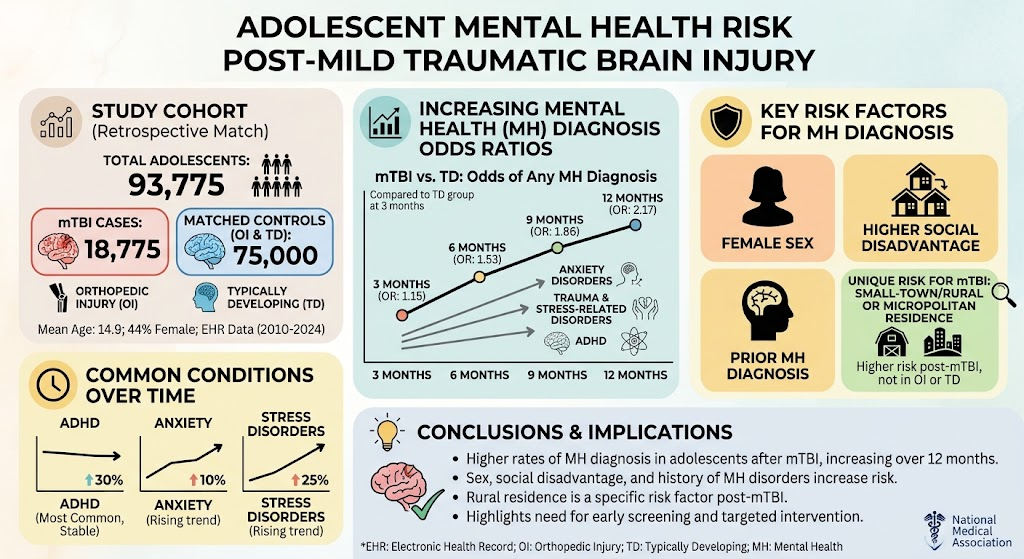
This large retrospective cohort study analyzed electronic health record (EHR) data to examine the prevalence and risk factors for mental health (MH) diagnoses following mild traumatic brain injury (mTBI) in adolescents aged 11 to 17.
The study found a progressive increase in risk of MH diagnoses in the mTBI group over 12 months compared to typically developing controls, with odds ratios more than doubling by one year post-injury.
Risk was further elevated in females, adolescents with higher socio-economic disadvantage, prior MH diagnoses, and those residing in small-town or rural areas following mTBI.
Attention-deficit/hyperactivity disorder (ADHD) was the most commonly coded MH disorder post-mTBI, with anxiety and trauma or stress-related disorders increasing progressively over time.
Study Background
Mild traumatic brain injury, commonly known as concussion, affects millions of adolescents each year and is recognized to have potential lasting effects beyond immediate physical symptoms. Emerging evidence suggests a substantial burden of mental health sequelae following mTBI during this vulnerable developmental period. However, quantification of MH diagnosis rates and identification of at-risk subgroups remain limited, hampering targeted interventions and resources allocation. This study aimed to leverage diagnostic coding from a large pediatric tertiary medical center’s EHR to characterize MH diagnosis prevalence, time course, and associated demographic and clinical risk factors in adolescents post-mTBI.
Study Design
This retrospective matched cohort study utilized EHR data from 2010 to 2024, identifying 18,755 cases of adolescents aged 11 to 17 diagnosed with mTBI. Two matched comparison groups — orthopedic injury (OI) and typically developing (TD) adolescents — were established at a 1:2 ratio (total controls n=93,775).
Participants were identified using International Classification of Diseases (ICD) diagnostic codes along with Abbreviated Injury Scale (AIS) and Injury Severity Score (ISS) to confirm injury severity. The study setting was a tertiary children’s medical center with a predominance of Caucasian (77%) and nearly balanced gender representation (44% female). The primary outcome was the occurrence of MH diagnoses coded in the EHR, classified by the Clinical Classifications Software Refined categories.
Key Findings
Risk of Mental Health Diagnoses Post-mTBI
The mTBI group demonstrated a significantly increased risk of any MH diagnosis compared to the TD group at all post-injury timepoints assessed: 3 months (OR 1.15, 95% CI 1.07–1.24), 6 months (OR 1.53, 95% CI 1.42–1.64), 9 months (OR 1.86, 95% CI 1.73–1.99), and 12 months (OR 2.17, 95% CI 2.03–2.31). Notably, risk increased steadily over time, indicating a cumulative or delayed emergence of MH concerns.
Influence of Demographic and Clinical Factors
Females were consistently at higher risk for post-injury MH diagnoses across all groups, aligning with prior epidemiological findings of sex differences in adolescent psychiatric disorders. Socio-economic disadvantage was a strong risk factor, underscoring the role social determinants play in MH vulnerability post-injury. A prior MH diagnosis markedly increased the probability of subsequent MH coding, suggesting mTBI may exacerbate pre-existing vulnerabilities.
Importantly, residency in small-town, rural, or micropolitan areas conferred increased MH risk following mTBI but not in OI or TD groups, possibly reflecting disparities in healthcare access, social support, or environmental stressors unique to these locations.
Mental Health Diagnostic Patterns
Attention-deficit/hyperactivity disorder emerged as the most common MH diagnosis coded post-mTBI. However, the study also identified that diagnoses of anxiety disorders and trauma or stress-related disorders showed progressive increases over the year after injury, indicating evolving MH profiles that may necessitate dynamic clinical monitoring.
Expert Commentary
This investigation robustly confirms the growing clinical recognition that mTBI in adolescence does not solely represent a transient physical injury but carries substantial psychiatric sequelae. The use of a large EHR dataset and rigorous matching enhances the validity of these findings. Clinicians should maintain vigilance for emerging MH symptoms beyond the acute post-concussion period and consider integrating routine, standardized MH screening into follow-up protocols for adolescents with mTBI.
Despite the study’s strengths, including a large, well-characterized cohort and longitudinal follow-up, limitations arise from its retrospective design and dependence on diagnostic codes, which may underestimate MH diagnoses not captured in medical visits or coded inconsistently. Additionally, generalizability may be constrained by demographic composition and single-center data.
Future prospective studies employing diagnostic interviews and neuropsychological assessments will be valuable to elucidate the mechanistic links between mTBI pathology and MH outcomes. The observed association with rural residence merits deeper exploration into resource accessibility and environmental modifiers.
Conclusion
The elevated and progressively increasing risk of mental health diagnoses after mild traumatic brain injury in adolescents, particularly among females, socio-economically disadvantaged youth, prior MH patients, and rural residents, underscores the critical importance of early identification and targeted intervention strategies. Screening protocols for MH disorders should be embedded in routine post-mTBI care, and health systems must aim to mitigate disparities related to socio-demographic factors.
This study adds a significant epidemiological dimension to understanding mTBI’s longer-term impact on adolescent mental health, highlighting research and clinical gaps that warrant attention to improve outcomes for this vulnerable population.
Reference
Bhatnagar S, Zhang N, Guzman T, Babcock L, Wade SL, Kurowski BG. Adolescent Mental Health Risk post-mild Traumatic Brain Injury: Examination of Diagnostic codes in Electronic Health Records. Arch Phys Med Rehabil. 2026 Oct 4:S0003-9993(26)00939-1. doi: 10.1016/j.apmr.2026.09.019. Epub ahead of print. PMID: 42830126.