Highlight
Remote blood pressure monitoring in pregnant women at high risk of preeclampsia is noninferior to conventional office-based monitoring for key fetal and maternal outcomes. It reduces outpatient antenatal visits and hospital admissions and is associated with increased antihypertensive medication adherence.
Study Background
Preeclampsia remains a significant contributor to maternal and perinatal morbidity worldwide, particularly in women identified as high risk. Intensive blood pressure surveillance is critical for early detection and management to prevent adverse outcomes such as fetal growth restriction, preterm birth, and maternal complications including hypertensive crises and organ damage. Traditional care typically involves frequent outpatient clinic visits, which can be burdensome for women and healthcare systems alike. Remote blood pressure (BP) monitoring, facilitated by automated devices and digital health technologies, offers a promising alternative that could optimize resource utilization while maintaining clinical safety. However, robust evidence comparing remote monitoring with standard in-person surveillance, particularly regarding clinical outcomes and healthcare utilization, remains limited.
Study Design
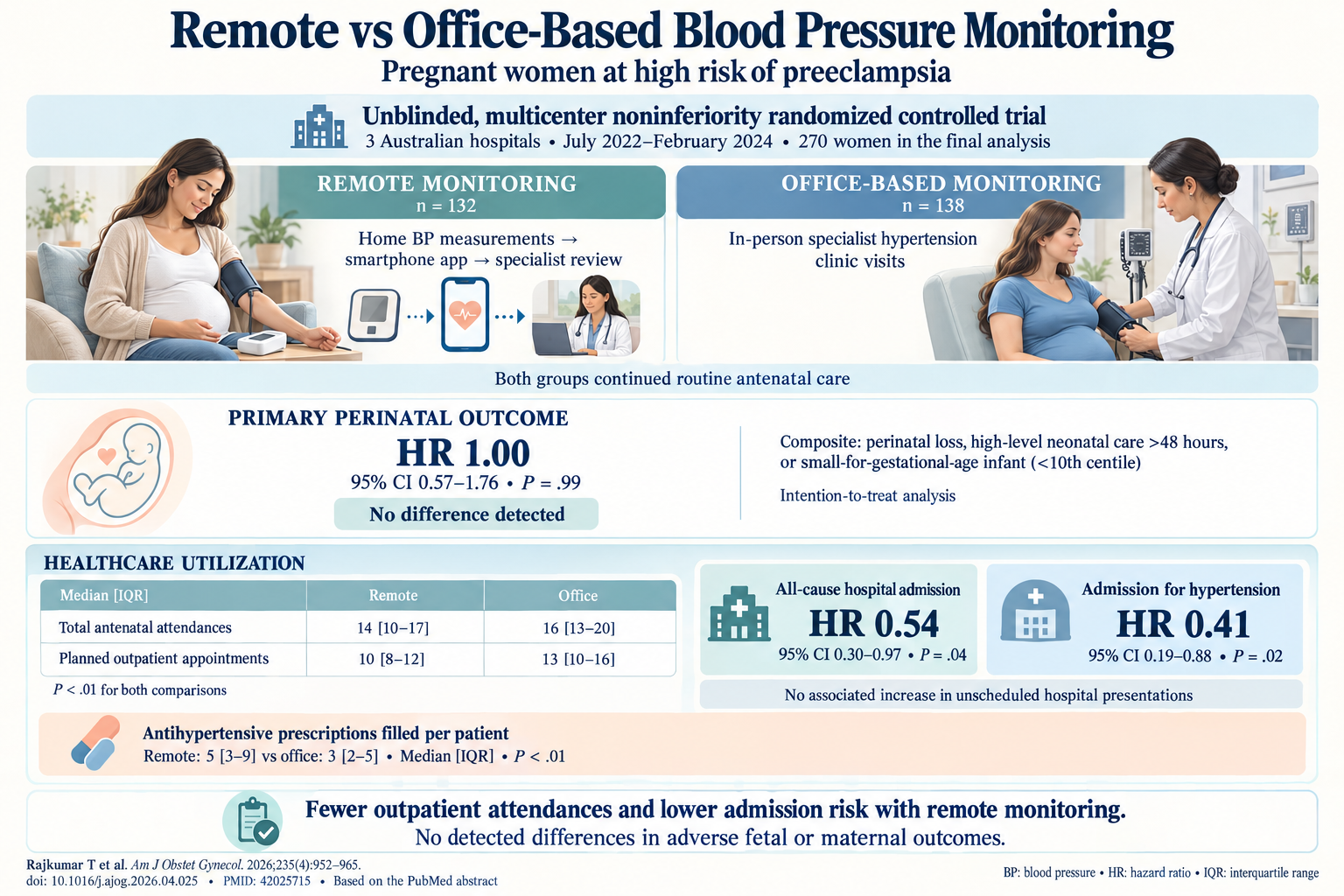
This was an unblinded, noninferiority, multicenter randomized controlled trial conducted from July 2022 to February 2024 at three metropolitan hospitals in Australia. The study enrolled 270 pregnant women at high risk for preeclampsia, who were routinely managed with additional BP surveillance as part of a specialist hypertension service.
Participants were randomized to either usual care involving in-person specialist hypertension clinic visits as clinically indicated, or to remote BP monitoring. The intervention group measured their own BP using automated devices at home, transmitting readings via a smartphone application for remote specialist review, alongside routine antenatal care.
The primary composite perinatal outcome included any one of the following: perinatal loss, admission to high-level neonatal care for more than 48 hours, or birth of a small-for-gestational-age infant (<10th centile for fetal weight). Secondary outcomes assessed maternal and fetal complications, healthcare utilization metrics including number and nature of outpatient visits, unscheduled hospital presentations, and antihypertensive medication prescriptions filled.
Key Findings
Baseline characteristics were well balanced, with a mean maternal age of 34 years and 60.4% from self-reported non-Caucasian ethnic groups.
Primary Outcome: There was no difference in the composite primary perinatal outcome between remote monitoring and usual care (hazard ratio [HR], 1.0; 95% confidence interval [CI], 0.57–1.76; P = .99), supporting noninferiority of remote BP monitoring.
Secondary Maternal and Fetal Outcomes: No significant differences were observed in individual fetal complications or maternal adverse events, suggesting safety equivalence.
Healthcare Utilization: Women in the remote monitoring group attended fewer total antenatal visits (median 14 vs 16; P < .01) and planned outpatient appointments (median 10 vs 13; P < .01) compared to usual care. There was no increase in unscheduled hospital visits, indicating appropriate clinical monitoring without heightened risk of emergency presentations.
Hospital Admissions: Remote monitoring was associated with a significantly reduced likelihood of hospitalization for any cause (HR 0.54; 95% CI 0.30–0.97; P = .04) and specifically for hypertensive indications (HR 0.41; 95% CI 0.19–0.88; P = .02).
Medication Adherence: The intervention group filled more antihypertensive prescriptions per patient (median 5 vs 3; P < .01), suggesting improved adherence or earlier pharmacologic intervention driven by timely remote BP data.
Expert Commentary
This trial robustly supports the clinical safety of substituting traditional office-based BP monitoring with remote monitoring in a high-risk obstetric population. The reduction in outpatient visits reflects a potential to improve patient convenience and reduce healthcare system burden without compromising care quality. The increased antihypertensive medication use coupled with fewer hospital admissions may imply better blood pressure control facilitated by real-time data transmission, enabling earlier treatment adjustments. These findings align with emerging telemedicine trends and bolster advocacy for integrating remote BP monitoring into prenatal care for high-risk groups.
Limitations include the unblinded design and focus on metropolitan centers with established specialist services, which may limit generalizability to rural or resource-limited settings. Long-term maternal and child outcomes beyond birth were not assessed.
Conclusion
Remote blood pressure monitoring in women at high risk of preeclampsia is a safe and effective alternative to office-based monitoring. It decreases antenatal hospital visits and admissions without compromising maternal or fetal outcomes and enhances antihypertensive medication adherence. This strategy has the potential to streamline high-risk pregnancy care and warrants broader implementation studies, including cost-effectiveness analyses and adaptation in diverse healthcare settings.
Funding and ClinicalTrials.gov Registration
The trial was prospectively registered with the Australian and New Zealand Clinical Trials Registry (ACTRN12620001049965p). Details on funding sources were not provided in the primary publication.
References
Rajkumar T, Hennessy A, Shanmugalingam R, et al. A randomized controlled trial comparing remote blood pressure monitoring with office-based blood pressure monitoring for women at high risk of preeclampsia. American Journal of Obstetrics and Gynecology. 2026;235(4):952-965. PMID: 42025715.
American College of Obstetricians and Gynecologists. Practice Bulletin No. 222: Gestational Hypertension and Preeclampsia. Obstet Gynecol. 2020;135(6):e237–e260.
Homko CJ, et al. Telemedicine and remote monitoring for hypertension in pregnancy: a systematic review. J Clin Hypertens. 2021;23(8):1447-1455.