Highlights
- Longitudinal changes in serum neurofilament light chain (sNfL) z-scores correlate with subsequent disease activity in relapsing multiple sclerosis (RMS).
- Failure to reduce sNfL z-scores within the first year of disease-modifying treatment (DMT) is linked to increased odds of evidence of disease activity (EDA), even among clinically stable patients.
- sNfL dynamics provide complementary prognostic information to established treatment response scoring systems (TRSS), improving risk stratification beyond clinical and MRI parameters.
- The correction of sNfL levels for age and BMI via z-scores enhances biomarker precision, supporting standardized clinical application in real-world monitoring.
Background
Multiple sclerosis (MS) is a chronic inflammatory disease of the central nervous system characterized by neuroaxonal damage leading to disability progression, especially in the relapsing-remitting phase. Monitoring disease activity and treatment efficacy remains challenging, relying on a combination of clinical examination, MRI, and patient-reported outcomes. Serum neurofilament light chain (sNfL), a sensitive biomarker of neuroaxonal injury, has emerged as a promising tool to reflect ongoing disease activity and provide early insight into treatment response. However, the interpretation of absolute sNfL values is confounded by age, body mass index (BMI), renal function, and other variables; thus, age- and BMI-adjusted z-scores optimize clinical utility. Despite growing evidence from controlled trials, data on expected longitudinal changes in sNfL under various disease-modifying treatments (DMTs) in real-world settings are limited, underscoring the need for robust biomarkers to refine personalized disease management.
Key Content
Prospective Real-World Cohort Study Evaluating sNfL Z-Score Dynamics
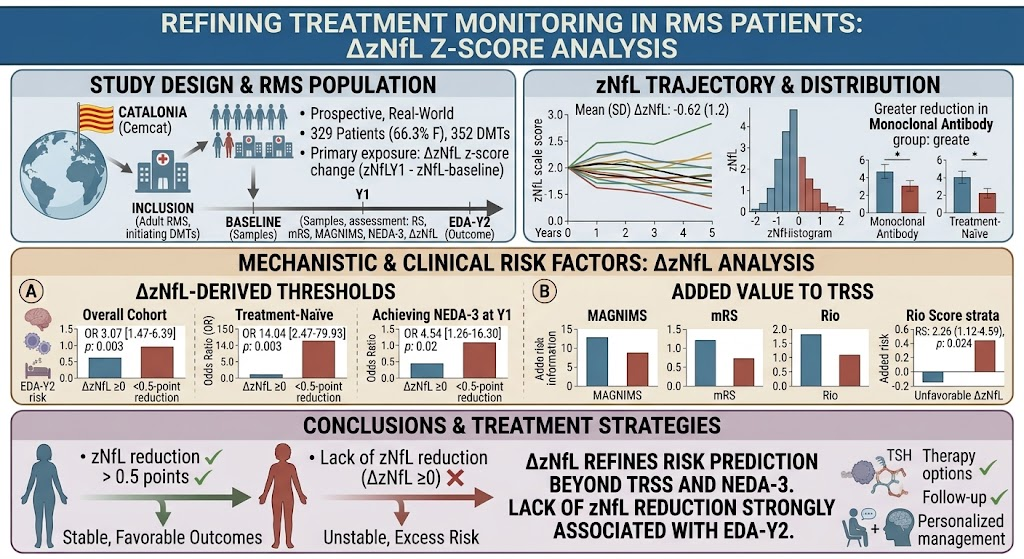
Fernández et al. (2026) conducted a large prospective cohort study at the Multiple Sclerosis Center of Catalonia (Cemcat) involving 329 RMS patients initiating DMTs. Serum samples were collected at baseline and after 1 year to calculate change in sNfL z-scores (ΔzNfL). Clinical and MRI assessments, including Expanded Disability Status Scale (EDSS) progression and radiologic disease activity, were performed concurrently. Treatment response was classified using three established scoring systems: Rio score (RS), modified Rio score (mRS), and MAGNIMS criteria. The primary outcome was evidence of disease activity (EDA) between years 1 and 2.
Crucially, mean ΔzNfL was -0.62, indicating overall reduction, with more pronounced decreases observed in monoclonal antibody-treated and treatment-naïve patients. Patients who failed to demonstrate a reduction (ΔzNfL ≥ 0) exhibited significantly higher odds of subsequent EDA (OR 3.07 overall; OR 14.04 in treatment-naïve subgroup). Notably, even patients meeting No Evidence of Disease Activity (NEDA-3) criteria at year one but with absent sNfL reductions had increased risk of EDA at year two (OR 4.54). Incorporating ΔzNfL into TRSS models improved prediction of EDA risk, underscoring its additive prognostic value.
Comparative Evidence on sNfL as a Biomarker in MS
Several studies corroborate the role of sNfL dynamics in monitoring MS disease activity and treatment responses. For instance, a 2026 study of treatment-naïve MS patients demonstrated significant reductions in sNfL following initiation of moderate- and high-efficacy DMTs, paralleling clinical improvement in disability scores. Age- and BMI-corrected z-scores outperform absolute sNfL concentrations in predicting relapses and new MRI lesions, enhancing risk stratification precision (Ann Clin Transl Neurol 2025).
Other research validates the utility of sNfL in pediatric MS, where baseline elevations correlate with early disease severity and predict escalation to high-efficacy therapies. Longitudinal monitoring assists in capturing subclinical disease progression and differentiating relapses from pseudo-relapses.
Furthermore, integration of sNfL with other biomarkers such as glial fibrillary acidic protein (GFAP) offers complementary insights into neuroinflammation and progressive MS biology, as highlighted by recent large cohort studies demonstrating differential prognostic values for relapse-related activity and progression independent of relapse activity (JAMA Neurol 2026).
Analytical and Methodological Advances
The standardization of sNfL measurement using ultra-sensitive single molecule array (SiMoA) technology has improved analytical reliability. Adjusting sNfL values for age and BMI through standardized reference populations to derive z-scores addresses confounding variables affecting serum concentrations. This has been pivotal in translating biomarker data to clinical practice by allowing individualized interpretation. Serial measurement outperforms isolated sampling, providing dynamic assessment critical for disease monitoring.
The incorporation of sNfL changes into established treatment response scoring systems represents a methodological advance enabling early identification of suboptimal therapeutic effects, potentially guiding timely treatment adaptations.
Expert Commentary
The evidence synthesizes a compelling role for sNfL z-score dynamics as an adjunctive biomarker in RMS management. Fernández et al.’s study robustly demonstrates that lack of sNfL reduction during the first year of treatment presages future inflammatory disease activity, even in patients meeting clinical and MRI criteria for stability. This suggests that sNfL can detect subclinical neuroaxonal injury undetectable by conventional means, thus refining risk stratification and treatment monitoring.
While sNfL dynamics add value, their modest discriminative capacity mandates a complementary role rather than replacement of clinical and imaging assessments. Limitations include incomplete follow-up and variability across DMT classes. The strongest sNfL reductions occurred with monoclonal antibody treatments and in treatment-naïve patients, pointing to therapy-specific biomarker modulation.
The biological rationale rests on sNfL as a structural neuroaxonal protein released during active injury. Decreasing levels reflect reduced inflammatory assault and preserved neuronal integrity. Combining sNfL with complementary markers, e.g., GFAP for astroglial damage, structural MRI graph theory metrics, or clinical scores, may enhance multidimensional monitoring.
Guidelines are evolving to incorporate sNfL metrics, but prospective trials addressing NfL-guided treatment algorithms are needed. Standardization across assays and integration into routine workflows remain priorities.
Conclusion
Longitudinal monitoring of serum neurofilament light chain z-scores refines treatment monitoring in relapsing MS by providing sensitive, complementary information on treatment response and risk of future disease activity. Age- and BMI-corrected z-score assessments outperform absolute concentrations, facilitating individualized biomarker interpretation. Incorporation of sNfL dynamics into established clinical and imaging monitoring frameworks enhances prognostic precision, potentially enabling earlier therapeutic interventions and improved patient outcomes. Future research should focus on harmonization of NfL assays, prospective validation of NfL-guided clinical decision algorithms, and integration with multimodal biomarker panels to optimize personalized MS care.
References
- Fernández V et al. Refining Treatment Monitoring in Patients With Relapsing Multiple Sclerosis Based on Changes on Neurofilament Light Chain Z-Scores. Neurology. 2026;107(6):e218451. PMID: 42623577.
- Barro C et al. Serum Neurofilament Light Chain in Multiple Sclerosis: Superiority of Age- and BMI-Corrected Z Scores/Percentiles Over Absolute Cutoff Values for Prediction of Treatment Response. Ann Clin Transl Neurol. 2025;12(11):2214-2225. PMID: 40755082.
- Tolman AW et al. Serum Glial Fibrillary Acidic Protein Dynamics, Disease Progression, and Therapy Response in Multiple Sclerosis. JAMA Neurol. 2026 Aug; e262500. PMID: 42545715.
- Manouchehrinia A et al. Blood Neurofilament Light Levels Predict Non-relapsing Progression Following Anti-CD20 Therapy in Relapsing and Primary Progressive Multiple Sclerosis: Findings From the Ocrelizumab Randomised, Double-Blind Phase 3 Clinical Trials. EBioMedicine. 2023;93:104662. PMID: 37354600.
- Sejbaek T et al. Age-corrected Neurofilament Light Chain Ratio Decreases but Does Not Predict Relapse in Highly Active Multiple Sclerosis Patients Initiating Natalizumab Treatment. Mult Scler Relat Disord. 2024;88:105701. PMID: 38889559.
- Vågberg M, et al. Tracking the Invisible: Impact of Disease-Modifying Therapies on Serum Neurofilament Light Chain and Clinical Outcomes in Treatment-Naïve Multiple Sclerosis. J Neuroimmunol. 2026;417:578928. PMID: 41936332.
- Pfaehler E et al. Pretreatment Neurofilament Light Chain Serum Levels, Early Disease Severity, and Treatment Response in Pediatric Multiple Sclerosis. Neurology. 2023;101(19):e1873-e1883. PMID: 37748882.