Highlight
- Current non-invasive diagnostic algorithms for HFpEF show limited sensitivity and moderate accuracy when used with exercise stress echocardiography.
- Incorporation of resting left atrial compliance, measured as LA reservoir strain divided by E/e’, significantly enhances sensitivity but increases false positives.
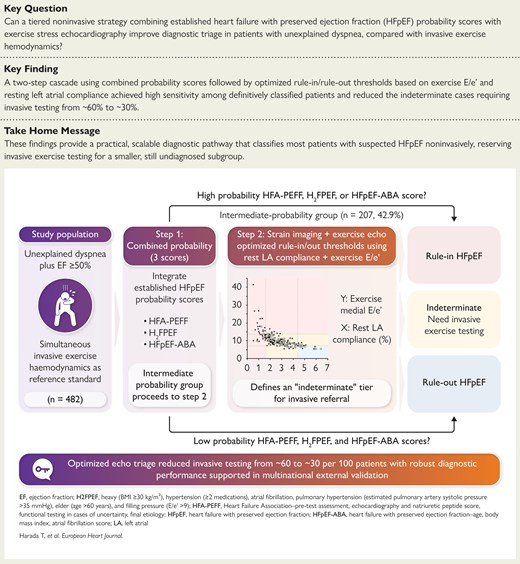
- Using optimized dual cut points for exercise E/e’ and LA compliance enables effective rule-in/rule-out classification reducing the need for invasive testing from 60% to approximately 30% of patients.
- Findings were prospectively validated in an international multicentre cohort, reinforcing generalizability and clinical applicability.
Study Background
Heart failure with preserved ejection fraction (HFpEF) constitutes a substantial proportion of heart failure cases globally, characterized by symptoms of heart failure despite normal left ventricular ejection fraction. Its diagnosis remains challenging, particularly in patients presenting with unexplained chronic dyspnoea. Accurate diagnosis requires evidence of elevated left heart filling pressures, traditionally confirmed by invasive haemodynamic exercise testing, which is resource-intensive and not widely accessible. Consequently, exercise stress echocardiography has gained prominence as a non-invasive alternative to detect exercise-induced elevations in left ventricular filling pressure via the transmitral E/e’ ratio. Multiple diagnostic scores such as H2FPEF, HFA-PEFF, and HFpEF-ABA have been developed, yet there is no universally validated, evidence-based framework guiding their integration with exercise echocardiography.
Study Design
This study enrolled 482 patients presenting with chronic unexplained dyspnoea, who underwent invasive haemodynamic exercise testing concurrently with echocardiographic evaluation. The primary hypotheses addressed two key areas: first, whether augmenting existing diagnostic scores (H2FPEF, HFA-PEFF, HFpEF-ABA) with exercise echocardiography enhances diagnostic accuracy for HFpEF; second, whether adding resting left atrial (LA) compliance—defined as LA reservoir strain divided by E/e’—further refines diagnostic stratification.
Diagnostic performance was assessed using sensitivity, specificity, and accuracy metrics. Separate optimized cut points maximizing sensitivity and specificity for exercise E/e’ and resting LA compliance were identified to offer a pragmatic rule-in and rule-out approach. The approach was externally validated using an independent, international multicentre cohort undergoing both rest-exercise echocardiography and invasive exercise hemodynamic testing.
Key Findings
Among the 482 patients, invasive measurements confirmed HFpEF in 386 and non-cardiac dyspnoea in 96. When applying currently recommended non-invasive diagnostic scores combined with exercise echocardiography, sensitivity to identify HFpEF was modest (55%-60%), with overall diagnostic accuracy ranging between 61% and 67%. This highlighted limitations in relying solely on exercise E/e’ and established scores for accurate HFpEF diagnosis.
Incorporating resting LA compliance significantly increased sensitivity to 84%-85%, indicating improved detection of true HFpEF cases. However, this gain was offset by a higher false-positive rate (31%-43%), reflecting trade-offs between sensitivity and specificity.
To surmount these limitations, the investigators proposed an operational framework employing separate cut points: an exercise E/e’ ≥ 13.8 or resting LA compliance ≤ 1.6% was used to rule-in HFpEF, while combining exercise E/e’ 4.4% ruled out HFpEF. Patients with intermediate values were classified as indeterminate and recommended for invasive testing.
This dual-threshold approach yielded a sensitivity of 95%-99% among definitively classified patients and decreased the proportion of cases requiring invasive testing from approximately 60% to about 30%, representing a substantial improvement in non-invasive diagnostic triage efficiency.
These findings were successfully replicated in a multinational validation cohort, confirming robustness and potential for broad clinical implementation.
Expert Commentary
This study addresses an important unmet clinical need in the accurate, non-invasive diagnosis of HFpEF, a condition with diverse pathophysiology and complex diagnostic requirements. The integration of resting LA compliance measurement with exercise stress echocardiography represents a novel, physiology-based enhancement reflecting left atrial functional adaptation to elevated filling pressures. This approach extends beyond the isolated reliance on E/e’ ratios, which are sensitive but can yield variable specificity depending on loading conditions and patient characteristics.
While the increase in false positives with resting LA compliance incorporation may raise concerns about overdiagnosis, the authors’ use of distinct rule-in and rule-out cut points pragmatically balances the risks of misclassification and supports a precision medicine strategy. Patients falling into the indeterminate zone warrant invasive testing, thus maintaining diagnostic rigor where clinical uncertainty persists.
Study limitations include potential variability in echocardiographic strain imaging techniques and the necessity for high-quality resting and exercise imaging. Future prospective studies should evaluate the clinical outcomes associated with this diagnostic framework and its cost-effectiveness in diverse care settings.
Conclusion
Despite growing adoption, current non-invasive echocardiographic approaches for diagnosing HFpEF have inadequate sensitivity and cannot replace invasive haemodynamic exercise testing. This multicentre study demonstrates that combining resting LA compliance with exercise stress echocardiography enhances diagnostic sensitivity and refines patient stratification using optimized rule-in and rule-out thresholds. This strategy improves non-invasive triage, identifies candidates for invasive testing, and holds promise for improving the diagnostic pathway for patients with unexplained dyspnoea and suspected HFpEF.
Clinicians should consider incorporating these metrics within established clinical and echocardiographic evaluations to facilitate earlier and more precise HFpEF diagnosis, potentially improving patient management and outcomes.
Funding and Registration
The study was conducted by an international team affiliated with multiple centers, though specific funding sources were not detailed in the abstract. The clinical trial registration number was not provided.
References
- Harada T, Reddy YNV, Sorimachi H, et al. Exercise stress echocardiography for diagnosis of heart failure with preserved ejection fraction: a multicentre study. European Heart Journal. 2026 Sep 10. PMID: 42720269.
- Packer M. Evaluation and Management of Heart Failure with Preserved Ejection Fraction. Nat Rev Cardiol. 2020;17(12):769–770.
- Obokata M, Reddy YN, Melenovsky V, Borlaug BA. Exercise Hemodynamics Enhance Diagnosis of Early Heart Failure with Preserved Ejection Fraction. Circ Heart Fail. 2017;10(8):e004875.