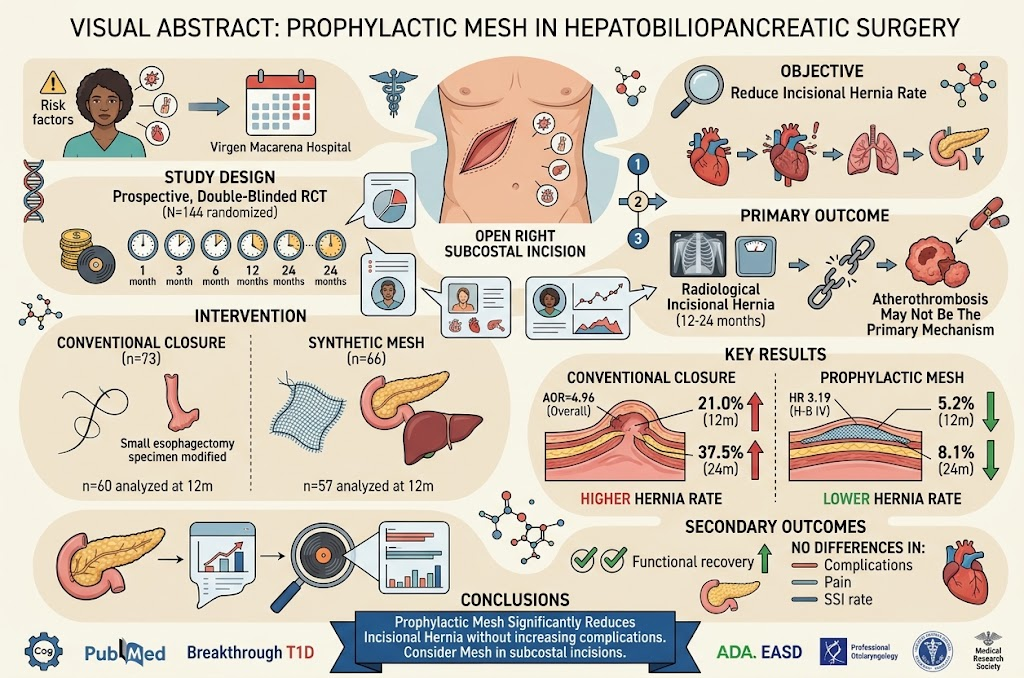
Highlight
- Prophylactic synthetic mesh placement during abdominal wall closure significantly reduces incisional hernia rates after hepatobiliopancreatic surgery.
- No increase in postoperative complications, surgical site occurrences, or pain was observed with mesh reinforcement.
- Mesh placement was associated with better functional recovery postoperatively.
- J-type incisions were linked to a higher incidence of incisional hernias compared to Kocher incisions.
Study Background
Hepatobiliopancreatic (HBP) surgery, which involves complex interventions on the liver, biliary tract, and pancreas, often requires large subcostal abdominal incisions such as Kocher or J incisions. Postoperative incisional hernias represent a common and challenging complication following these surgeries, with reported incidence rates reaching up to 40%. Incisional hernias can result in pain, impaired physical function, and may require further surgical repair, adding to patient morbidity and healthcare costs.
While prophylactic mesh placement during abdominal closure has been shown to reduce incisional hernia incidence in some surgical contexts, evidence specific to subcostal incisions in HBP surgery remains scarce. This randomized clinical trial addresses this critical gap by evaluating whether the addition of prophylactic synthetic mesh during abdominal wall closure decreases the rate of incisional hernias without increasing adverse events.
Study Design
This prospective, double-blinded randomized clinical trial was conducted at Virgen Macarena Hospital, Seville, Spain, from July 2020 to December 2024. The study enrolled patients undergoing open right subcostal access for HBP surgery who had two or more risk factors for incisional hernia formation. Exclusion criteria included emergency surgeries, presence of metastatic disease, or unresectable malignant neoplasm discovered intraoperatively.
Participants were randomized into two groups: one receiving conventional abdominal wall closure and the other receiving conventional closure reinforced with a prophylactic synthetic mesh. The mesh was placed at the time of abdominal wall closure to provide structural reinforcement.
Patients were followed prospectively with clinical and radiological assessments at 1, 3, 6, 12, and 24 months postoperatively. The primary endpoint was the incidence of incisional hernia detected on imaging at 12 to 24 months. Secondary endpoints included the type of incision used (Kocher versus J), postoperative complications (including surgical site occurrences such as infection or seroma), postoperative pain, and functional recovery quality.
Key Findings
A total of 144 patients were randomized (69 to conventional closure and 75 to mesh-reinforced closure). After excluding five patients due to intraoperative criteria, 66 patients remained in the mesh group and 73 in the nonmesh group.
At 12 months, 57 patients in the mesh group and 60 in the nonmesh group were evaluable. Radiological incisional hernia was identified in 5.2% of patients with mesh reinforcement compared to 21% in the conventional closure group (p < 0.05), showing a statistically significant reduction in hernia incidence.
At 24 months, the analysis included 49 patients in the mesh group and 48 in the nonmesh group. The incisional hernia rate was markedly lower in the mesh group (8.1%) compared to the nonmesh group (37.5%), confirming durable long-term benefits of mesh reinforcement (p < 0.01).
Notably, there were no significant differences between groups in terms of surgical site occurrences, postoperative complications, or levels of postoperative pain, indicating that the prophylactic mesh did not confer additional risk. Functional recovery assessments favored the mesh group, with patients reporting better physical function and less recovery delay.
A subgroup analysis revealed that patients undergoing J incision had a significantly higher rate of incisional hernia compared to those with Kocher incisions, irrespective of mesh use, highlighting incision type as an independent risk factor.
Expert Commentary
The findings of this rigorous randomized trial contribute robust evidence supporting prophylactic mesh use in high-risk patients undergoing HBP surgery with subcostal incisions. The significant reduction in incisional hernias without the trade-off of increased complications bolsters the clinical value of mesh reinforcement for abdominal wall closure in this setting.
Previous concerns regarding mesh-related infections or chronic pain were not substantiated in this study, which employed a synthetic mesh with careful surgical technique. The improved functional recovery suggests enhanced abdominal wall integrity likely fosters better mobility and quality of life post-surgery.
However, limitations include the single-center design and the potential for variability in surgical technique and mesh types beyond this trial’s context. Future multicenter studies could further validate these outcomes and optimize patient selection criteria.
The increased hernia risk associated with J incisions emphasizes the need for particular vigilance in these cases and may inform incision selection or tailored mesh strategies.
Conclusion
This randomized clinical trial establishes the efficacy and safety of prophylactic synthetic mesh placement during abdominal closure in reducing incisional hernia rates after hepatobiliopancreatic surgery through subcostal incisions. Given the substantial clinical and functional benefits without added postoperative complications, prophylactic mesh reinforcement should be strongly considered in patients at increased risk of incisional hernia.
The data also highlight the elevated hernia risk linked to J incisions, suggesting surgical technique influences outcomes and warrants further evaluation.
Incorporating mesh in closure protocols may improve long-term patient outcomes, reduce the burden of incisional hernia repair surgeries, and enhance recovery after complex hepatobiliary procedures.
Funding and Trial Registration
This study was conducted at Virgen Macarena Hospital, Seville, Spain. The trial is registered on ClinicalTrials.gov under the identifier NCT07433439.
References
1. Bellido-Luque J, Sanchez-Matamoros Martín I, Reguera-Rosal J, et al. Prophylactic Mesh Placement and Incisional Hernia Incidence in Hepatobiliopancreatic Surgery: A Randomized Clinical Trial. JAMA Surgery. 2026 Sep 9. PMID: 42714891.
2. Henriksen NA, et al. Prophylactic mesh reinforcement for prevention of incisional hernias: A systematic review and meta-analysis of randomized controlled trials. Surgery. 2019;165(1):58-65.
3. Agha RA, et al. The role of prophylactic mesh in prevention of incisional hernia: Evidence and controversies. Hernia. 2018;22(3):339-346.