Study Background
Solid pseudopapillary tumor of the pancreas (SPT) is an uncommon neoplasm that predominantly affects young women and generally exhibits an indolent clinical course with excellent prognosis following surgical resection. Despite its rarity, prognostic stratification remains challenging due to the extremely low incidence of cancer-specific deaths, which limits the utility of conventional survival analysis models. Standard statistical approaches often fail to identify subgroups at high risk of adverse outcomes owing to data sparsity and class imbalance. Thus, there is an unmet clinical need for innovative methodologies capable of uncovering hidden patterns associated with aggressive phenotypes within ostensibly low-risk diseases like SPT.
Study Design
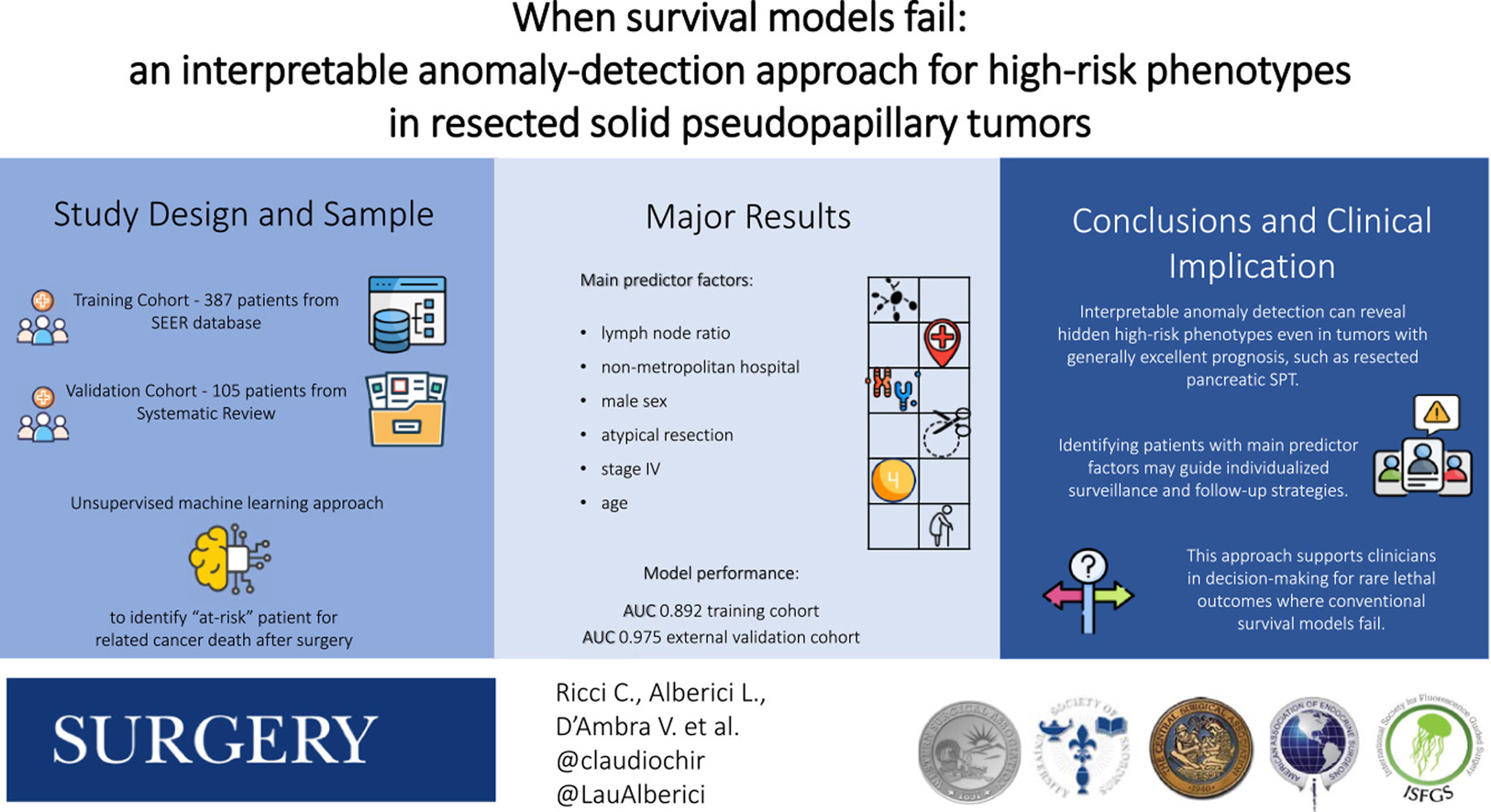
This retrospective study utilized data from the Surveillance, Epidemiology, and End Results (SEER) registry, encompassing patients who underwent pancreatic resection for SPT from 2000 to 2021. The primary endpoint was cancer-specific mortality, recognized as an ultrarare event in this cohort. To address the limitations of traditional survival models, two unsupervised anomaly-detection algorithms—the Isolation Forest and Local Outlier Factor—were employed to model the rarity of cancer-specific death as an anomaly in multidimensional clinicopathologic feature space.
Statistical comparisons of anomaly scores between patients who died from SPT and survivors were performed using the Mann-Whitney U test, with Cliff’s δ statistic quantifying effect sizes. To enhance interpretability, feature importance contributing to anomaly scores was estimated via a Random Forest surrogate model coupled with SHapley Additive exPlanations (SHAP) interpretation. External validation was conducted on an independent cohort reconstructed through a systematic review of published cases to assess generalizability.
Key Findings
Analysis of 387 patients from the SEER database revealed that individuals who ultimately died from SPT demonstrated significantly higher anomaly scores, confirming the effectiveness of the anomaly-detection approach in recognizing the rare high-risk phenotype (Isolation Forest scores: -0.07 ± 0.06 vs 0.02 ± 0.05; P = .007; Cliff’s δ = 0.783). The top contributors to the death-associated anomaly profile identified by SHAP values were:
- Lymph node ratio (mean contribution 0.204 ± 0.083)
- Hospital type, specifically treatment in nonmetropolitan facilities (0.168 ± 0.037)
- Male sex (0.130 ± 0.028)
- Atypical resection techniques (0.120 ± 0.028)
- Stage IV disease at diagnosis (0.096 ± 0.047)
The anomaly detection model demonstrated robust predictive performance, achieving an in-sample area under the receiver operating characteristic curve (AUROC) of 0.892, with cross-validation AUROC averaging 0.733 ± 0.351, and an exceptional external-validation AUROC of 0.975. These results underline the capability of this novel approach to discriminate high-risk cases despite the extremely low absolute event rate.
Expert Commentary
Traditional survival models struggle when events are sparse and class distributions heavily skewed, as is typical in SPT-related mortality. The use of anomaly-detection methods innovatively reframes rare cancer deaths as outliers in a multidimensional clinicopathologic feature space rather than relying on conventional hazard modeling. Importantly, the integration of Random Forest and SHAP allows for clinically interpretable insights into features driving high-risk phenotypes.
The findings that elevated lymph node ratios and advanced disease stages correlate with higher cancer-specific mortality are consistent with existing literature on oncologic prognosticators. Notably, male sex and treatment in nonmetropolitan hospitals emerged as significant factors, raising considerations about potential biological differences and disparities in care access or quality. Atypical resections implicate surgical technique variability affecting outcomes.
Limitations include the retrospective design and reliance on registry data, which may lack granular pathologic or molecular details. Additionally, external validation was based on reconstructed cohorts rather than prospective data. Despite these constraints, this work sets a precedent for applying machine-learning anomaly detection to rare-event clinical phenotyping.
Conclusion
This study demonstrates that interpretable anomaly-detection algorithms offer a powerful alternative to classical survival models for identifying elusive high-risk phenotypes in resected solid pseudopapillary tumors of the pancreas. Elevated lymph node ratio, male sex, atypical resection methods, advanced stage, and nonmetropolitan hospital treatment define a clinically relevant high-risk subgroup otherwise obscured by low event rates. Adoption of such analytic frameworks could facilitate individualized risk stratification and guide surveillance strategies in rare indolent neoplasms. Further prospective validation and incorporation of molecular biomarkers may enhance model utility and translational relevance.
Funding and ClinicalTrials.gov
The study was supported by institutional research funds. No registered clinical trials were associated with this analysis.
References
1. Papavramidis T, Papavramidis S. Solid pseudopapillary tumors of the pancreas: review of 718 patients reported in English literature. J Am Coll Surg. 2005;200(6):965-972.
2. Ricci C, Alberici L, et al. When survival models fail: An interpretable anomaly-detection approach for high-risk phenotypes in resected solid pseudopapillary tumors. Surgery. 2026;197:110381.
3. Lundberg SM, Lee SI. A unified approach to interpreting model predictions. Adv Neural Inf Process Syst. 2017;30:4765-4774.
4. Breunig MM, Kriegel HP, Ng RT, Sander J. LOF: identifying density-based local outliers. ACM SIGMOD. 2000;93-104.
5. Liu FT, Ting KM, Zhou Z-H. Isolation forest. 2008 Eighth IEEE International Conference on Data Mining. 2008:413-422.