Highlight
- Children with Type 1 diabetes (T1D) manage their care in various school locations, primarily classrooms, designated rooms, and restrooms.
- Restroom use for diabetes care is significantly associated with higher HbA1c indicating poorer glycemic control compared to classroom or designated room care.
- Usage of insulin pumps, continuous glucose monitoring (CGM), and male sex correlated with increased classroom-based care and decreased restroom care.
- Transitions in school stages (elementary to high school) influence shifts in care locations, emphasizing the need for adaptive support systems.
Study Background
Type 1 diabetes (T1D) in children necessitates rigorous daily management to optimize glycemic control and prevent acute and chronic complications. Successful care includes blood glucose monitoring, insulin administration, and dietary considerations integrated across settings including home, school, and social environments. Schools present unique challenges and opportunities for diabetes management. Understanding where and how children perform self-care during school hours and how this correlates with glycemic outcomes is critical to tailoring supportive interventions. Despite technological advances like insulin pumps and continuous glucose monitors (CGM), glycemic control often remains suboptimal in pediatric populations, partly due to environmental and psychosocial factors influencing care behaviors at school. This study addresses important gaps by investigating care locations at school, factors influencing location choices, and their associations with glycemic control among Japanese children with T1D.
Study Design and Methods
This was a multicenter, cross-sectional analysis of 2018 registry data encompassing 1,105 children and adolescents with diagnosed T1D attending elementary to high school or preschool settings in Japan. The study evaluated self-reported primary locations where children performed diabetes self-care during school hours: classroom, designated care rooms (such as nurse offices), and restrooms. Clinical data included HbA1c values as the primary glycemic outcome measure, treatment modalities (pump use, CGM), sex, and age. Statistical analyses determined factors associated with care location choice and examined their relationships with HbA1c, adjusting for potential confounders. Joinpoint analysis was employed to assess age-related shifts in care location patterns, particularly across critical school transition ages (elementary and high school entry).
Key Findings
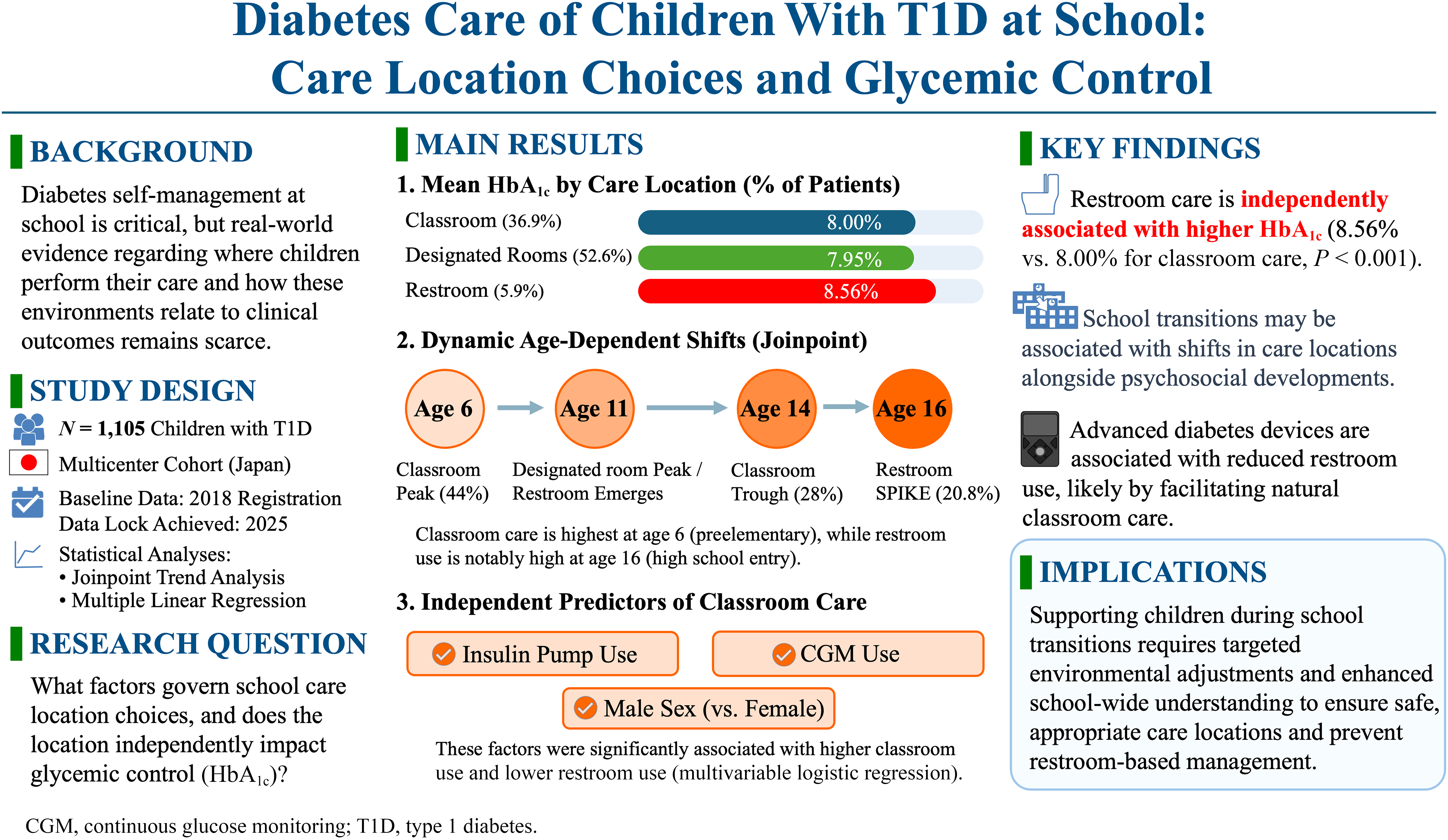
The mean HbA1c was 8.01% (64 mmol/mol), indicating suboptimal overall glycemic control against typical pediatric targets. Care location distribution was: classroom (36.9%), designated rooms (52.6%), and restroom (5.9%). Statistical comparison revealed that children utilizing restrooms for diabetes care exhibited significantly higher mean HbA1c at 8.56% (70.1 mmol/mol) compared to classroom (8.00%, 63.9 mmol/mol) and designated room users (7.95%, 63.4 mmol/mol), with P < 0.001.
Multivariate analysis identified restroom use and skipping prelunch blood glucose monitoring as independent predictors of higher HbA1c. Conversely, insulin pump use, CGM use, and male sex independently predicted greater likelihood of classroom-based care and less restroom care. These findings suggest technological aids and possibly gender-related psychosocial factors may promote more open and integrated self-care behaviors in school.
Joinpoint analysis demonstrated dynamic shifts in care location preferences with age: classroom use declined sharply after age 6, corresponding to elementary school start; restroom use emerged around age 11 and spiked notably at 16 years, aligned with high school entry. Notably, restroom use increased markedly even among children using insulin pumps, highlighting persistent barriers to visible care despite advanced technology.
Expert Commentary
This study provides valuable insight into the complex interaction of developmental, technological, and environmental factors that shape diabetes care behaviors in pediatric populations at school. The association of restroom care with worse glycemic control underscores the potential negative impact of concealment and lack of appropriate school-based spaces or support. Children may opt for restrooms due to stigma, privacy concerns, or inadequate staff support in designated care rooms or classrooms, which leads to suboptimal self-management.
Technology adoption (pump and CGM) appears to facilitate more open care in classrooms, reflecting reduced burden and increased confidence. However, the observed increase in restroom use during adolescence despite pump use suggests that psychosocial challenges such as peer acceptance and self-image remain significant barriers.
Limitations include cross-sectional design precluding causality inference, possible reporting bias regarding care locations, and regional factors specific to Japan limiting generalizability. Future studies should explore longitudinal associations, incorporate qualitative assessments of school environment and psychosocial domains, and test interventions improving school support and reducing stigma.
Conclusion and Clinical Implications
Self-care location at school is a modifiable factor linked to glycemic outcomes in children with T1D. Restroom use, often chosen for privacy or stigma avoidance, correlates with poorer glycemic control. The transition through school stages alters care location choices, highlighting critical windows for structured intervention.
School-based strategies should prioritize creating inclusive environments, enhancing staff training, and ensuring availability of comfortable, accessible designated care spaces. Promoting usage of diabetes technology integrated within supportive school climates can empower children to maintain optimal glycemic control.
Collaboration among healthcare providers, families, and educational institutions is essential to address environmental and psychosocial barriers comprehensively. Tailored interventions that acknowledge developmental stage and individual preferences will likely improve school diabetes care quality and reduce long-term health risks.
Funding and Trial Registration
The original study was funded and conducted by a Japanese multicenter consortium. Details on direct funding sources and clinical trial registration numbers are not provided in the abstract.
References
1. Matsui K, Nemoto C, Tagawa K, et al. Diabetes care of children with type 1 diabetes at school: Factors related to the choice of care location and association with glycemic control. Diabetes Care. 2026 Oct 7. PMID: 42844149.
2. American Diabetes Association. Children and Adolescents: Standards of Medical Care in Diabetes—2024. Diabetes Care. 2024;47(Supplement 1):S208-S220.
3. Buckingham BA, et al. Psychosocial factors associated with diabetes management in school-aged children. Pediatr Diabetes. 2021;22(7):932-940.
4. Patton SR, et al. School and diabetes care: implications for policy and practice. Pediatr Diabetes. 2020;21(4):555-569.