Highlight
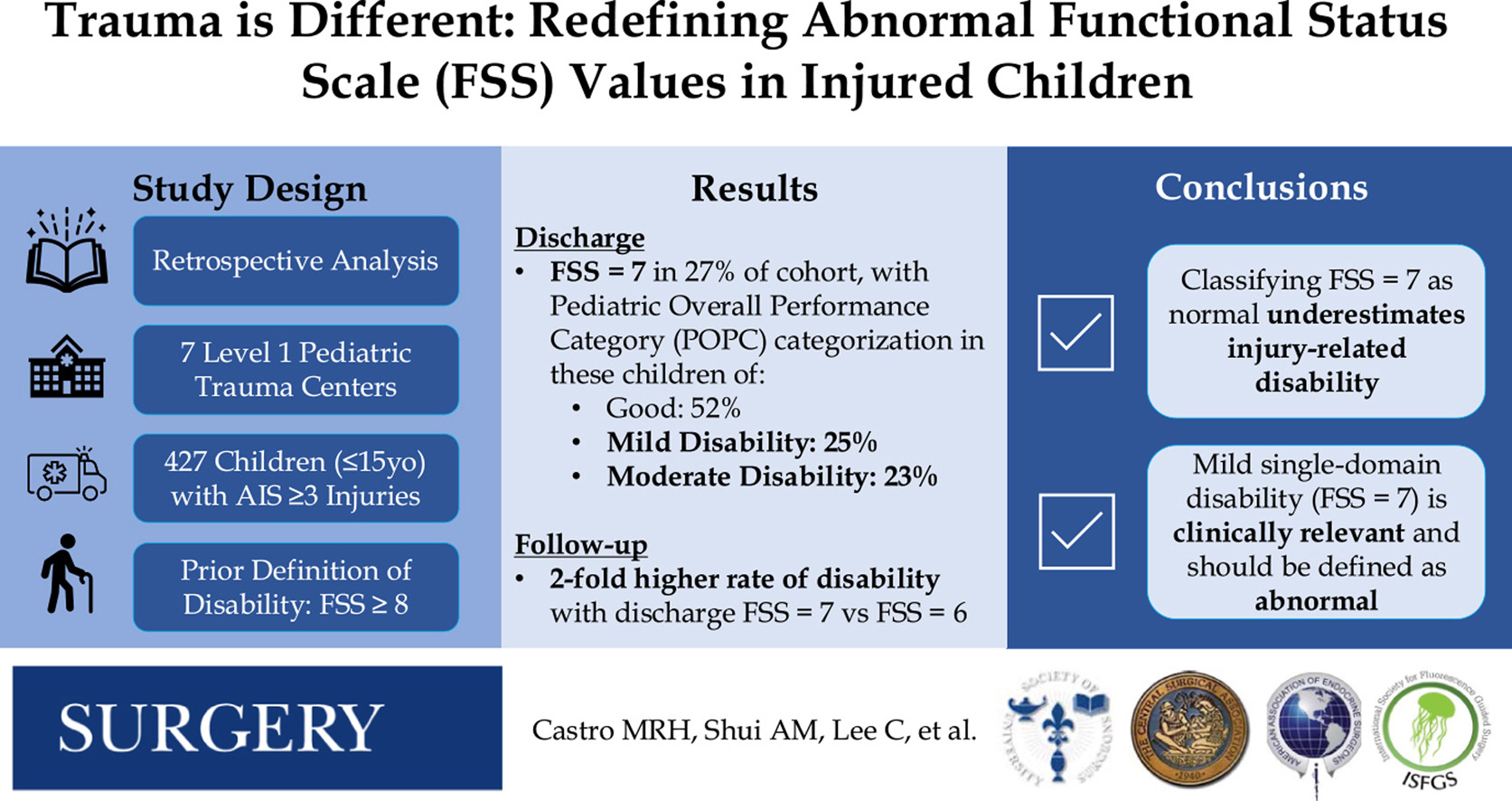
– The Functional Status Scale (FSS), originally validated in critically ill children, may underestimate disability in pediatric trauma patients when scores of 7 are classified as normal.
– Nearly half of children discharged with FSS=7 demonstrate detectable disability both at discharge and on 6-month follow-up.
– Children with discharge FSS=7 exhibit significantly higher rates of long-term disability than those with FSS=6.
– Findings support revising FSS classification in injured children and highlight the importance of follow-up functional assessments post-discharge.
Study Background
Pediatric trauma remains a leading cause of disability and morbidity worldwide, and accurate assessment of functional outcomes is critical to guide clinical care, rehabilitation, and family counseling. The Functional Status Scale (FSS), developed primarily in critically ill pediatric populations, is increasingly utilized to standardize measurement of pediatric functional outcomes across multiple domains including mental status, sensory function, communication, motor function, feeding, and respiratory status.
In its original validation, an FSS score of 6 corresponds to normal function, while scores ≥8 are defined as abnormal, indicating disability. However, prior research noted a discrepancy wherein roughly 51% of injured children who developed disability at follow-up were not categorized as disabled at hospital discharge using the ≥8 abnormal cutoff. This suggests that defining FSS = 7 as normal may miss subtle yet clinically meaningful impairments, especially in children with mild single-system disabilities. Accurately categorizing these children is vital to avoid under-recognition of injury-related functional impairment and to inform appropriate discharge planning and follow-up care.
Study Design
This analysis utilized data from the prospective multicenter “Assessment of Health-Related Quality of Life and Functional Outcomes after Pediatric Trauma” cohort. The study population included 427 children with available discharge and 6-month follow-up functional status assessments. Functional outcomes were measured using the Functional Status Scale (FSS) at both discharge and follow-up, alongside the Pediatric Overall Performance Category (POPC) scale, an established measure of pediatric disability.
The primary objective was to evaluate whether an FSS score of 7 at hospital discharge correlates with disability as measured by POPC and to assess the rates of persistent disability at 6 months compared to children with FSS = 6 (normal) and ≥8 (abnormal). Agreement between the FSS and POPC scales was analyzed, and disability prevalence at follow-up was compared across these discharge FSS categories.
Key Findings
Among the 427 pediatric trauma patients analyzed, 114 had a discharge FSS score of 7. Of these, 48% (55/114) were identified as having detectable disability by POPC at discharge. At the 6-month follow-up, 50% (20/40) of children with discharge FSS=7 maintained disability by POPC assessment.
Analysis comparing disability prevalence at follow-up demonstrated that children discharged with an FSS=7 had significantly higher rates of functional impairment than those discharged with a normal FSS=6 score. Specifically, 26% of patients with discharge FSS=7 had disability by FSS criteria at 6 months, compared to only 13% with discharge FSS=6 (P ≤ 0.01). Similarly, POPC detected disability in 19% of the FSS=7 group versus 3.8% in the FSS=6 group (P ≤ 0.01).
These results indicate that children with discharge FSS=7 have a substantial risk of persistent functional impairment and that current classification schemes underrepresent the burden of disability by considering FSS=7 as normal or “good” outcome.
Expert Commentary
The study underscores an important limitation of adopting scoring thresholds developed in mixed or critically ill pediatric populations when applied to pediatric trauma cohorts. Trauma-specific recovery trajectories may include subtle deficits that are clinically relevant but fail to cross traditional abnormality thresholds. Recognizing FSS=7 as potentially abnormal in this context aligns with clinical observations that mild functional deficits often warrant rehabilitation and follow-up care.
While the FSS provides a practical and quantifiable measure of function, it remains essential to contextualize scores within the injury pattern, patient baseline status, and family-reported outcomes. Multi-domain evaluation including quality of life and neurocognitive testing may further enhance detection of mild disability. Limitations of the study include potential attrition bias at follow-up and the inherent challenges of subjective disability scales, which should prompt further validation studies and exploration of biomarker or imaging correlates.
Conclusion
This investigation provides compelling evidence that classifying an FSS score of 7 as “normal” overlooks a substantial proportion of injured children who experience persistent disability. For pediatric trauma populations, redefining abnormal FSS values to include scores ≥7 improves sensitivity for detecting long-term impairment. Clinicians should consider targeted follow-up functional assessments for all injured children discharged with FSS ≥7 to facilitate timely intervention and optimize recovery trajectories.
Future research should aim to standardize trauma-specific functional assessment tools and develop integrated approaches that reflect patient-centered outcomes, guiding personalized rehabilitation strategies.
Funding and ClinicalTrials.gov
The study was supported by institutional research grants; further funding details were not provided. This prospective multicenter study was registered and conducted under appropriate ethical approvals, as previously described in the parent cohort study documentation.
References
1. Pollack MM, Holubkov R, Funai T, et al. Functional Status Scale: new pediatric outcome measure. Pediatrics. 2009;124(1):e18-e28.
2. Castro MR, Shui AM, Lee C, et al. Trauma is different: Redefining abnormal Functional Status Scale values in injured children. Surgery. 2026 Aug 3;199:110496. doi:10.1016/j.surg.2026.110496.
3. Fiser DH, Long N, Roberson PK, et al. Relationship of Pediatric Overall Performance Category and Pediatric Cerebral Performance Category scores at PICU discharge with outcome measures collected at hospital discharge and again at 1- and 6-month follow-ups. Crit Care Med. 2000;28(7):2606-11.
4. Anderson V, Catroppa C, Morse S, et al. Functional recovery after pediatric traumatic brain injury: validation of the Pediatric Overall Performance Category scale. J Pediatr Psychol. 2001;26(6):427-35.