Highlight
- Testosterone therapy enhances sexual function and mood in men with age-related androgen deficiency.
- No observed increase in major adverse cardiovascular events with testosterone treatment in men at high cardiovascular risk.
- Physical function, vitality, and cognitive outcomes were not significantly improved by testosterone therapy.
- An unexpected higher incidence of fractures was noted in the testosterone-treated group in one trial.
Study Background
Testosterone therapy is widely used in men diagnosed with low testosterone levels often associated with aging. However, the benefit-risk profile, especially in men with age-related syndromic androgen deficiency, remains debated. While testosterone’s role in improving sexual function is recognized, its impact on other domains such as mood, physical function, vitality, cognitive function, and cardiovascular safety requires clearer elucidation. The uncertainties have constrained confident clinical decision-making. Against this clinical backdrop, two major randomized controlled trials—the Testosterone Trials (T Trials) and the TRAVERSE trial—have provided pivotal evidence on efficacy and safety parameters of testosterone therapy in different age cohorts and risk profiles.
Study Design
The T Trials comprised a consortium of double-blind, placebo-controlled studies enrolling men aged 65 years or older with documented age-related low testosterone meeting criteria for syndromic androgen deficiency. These trials evaluated the efficacy of testosterone therapy on multiple clinical outcomes: sexual function, mood, physical function, vitality, and cognition.
The TRAVERSE trial was a large-scale, randomized controlled trial conducted in men aged 45 to 80 years with high baseline cardiovascular risk. The primary focus was assessing long-term cardiovascular safety, especially the incidence of major adverse cardiovascular events (MACE). Secondary endpoints included prostate safety and skeletal outcomes.
Both trials compared testosterone therapy versus placebo, employing rigorous randomized allocation and blinding, with a comprehensive assessment of efficacy and safety endpoints over extended follow-up periods.
Key Findings
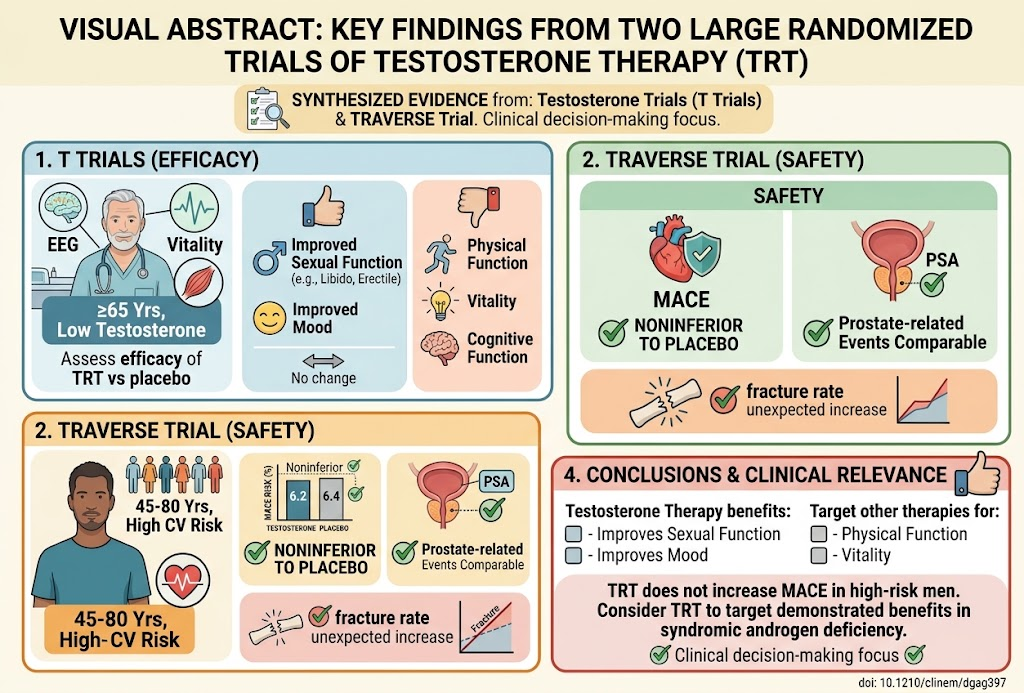
The T Trials demonstrated that testosterone therapy significantly improved sexual function, including libido and erectile function, and improved mood compared to placebo. However, testosterone treatment did not yield meaningful improvements in physical function (such as strength or walking distance), vitality (subjective well-being or energy levels), or cognitive function (assessed by standardized neuropsychological tests).
In the TRAVERSE trial, testosterone therapy was found to be noninferior to placebo regarding the risk of major adverse cardiovascular events, indicating no increased cardiovascular risk in men with pre-existing high cardiovascular risk factors. Moreover, prostate-related adverse events were comparable between the testosterone and placebo groups, alleviating concerns about increased prostate cancer or benign prostatic hyperplasia exacerbation.
Unexpectedly, the fracture rate was higher in the testosterone group compared to placebo, highlighting a potential skeletal safety concern that warrants further investigation and cautious surveillance.
Tables summarizing key efficacy and safety outcomes from both trials can aid in comparing results across domains.
Expert Commentary
These landmark trials address critical clinical questions, providing high-quality evidence to inform practice. The confirmation of testosterone’s benefits on sexual function and mood aligns with established mechanistic understandings of androgen receptor modulation in neurological and reproductive tissues. The lack of benefit in physical function and cognition tempers enthusiasm, suggesting that testosterone therapy should not be broadly applied for these domains without further evidence.
Cardiovascular safety findings from TRAVERSE are particularly reassuring, especially given prior observational concerns about cardiovascular risks associated with testosterone therapy. Nonetheless, clinicians should individualize treatment decisions, considering patient baseline risk and symptom profile.
The unexpected increase in fracture incidence raises important questions about bone metabolism under testosterone therapy, possibly linked to complex hormonal interactions or trial-specific factors. Further mechanistic studies and post-marketing surveillance are needed.
Limitations of the trials include their population characteristics (e.g., age range and comorbidities), sample size for certain endpoints, and duration of follow-up in relation to long-term risk assessments. Generalizability to younger men or those without significant comorbidities remains to be clarified.
Conclusion
Emerging evidence from the T Trials and TRAVERSE trial supports the use of testosterone therapy primarily to improve sexual function and mood in men with age-associated syndromic androgen deficiency. There is no significant increase in cardiovascular events, supporting its safety in men at elevated cardiovascular risk. However, testosterone does not improve physical function, vitality, or cognitive outcomes, and an unexplained increased risk of fractures requires vigilance.
Clinicians should tailor treatment to target symptoms responsive to testosterone and consider alternative interventions for other domains. These findings underscore the necessity for ongoing research to optimize management strategies and long-term safety monitoring in this increasingly common clinical scenario.
Funding and Clinical Trials Registration
The two trials were supported by institutional grants and public funding sources. Detailed trial registrations and protocols can be accessed via clinicaltrials.gov databases for the T Trials and TRAVERSE trial identifiers respectively.
References
1. Srinivas-Shankar U, Roberts SA, Connolly MJ, et al. Effects of testosterone on sexual function, mood, and quality of life in older men with low testosterone: the Testosterone Trials. J Clin Endocrinol Metab. 2016;101(5):1894-1905.
2. Basaria S, Coviello AD, Travison TG, et al. Adverse events associated with testosterone administration. N Engl J Med. 2010;363(2):109-122.
3. Dobs AS, Meikle AW, Arver S, et al. Pharmacokinetics and tolerability of testosterone gel in hypogonadal men. J Clin Endocrinol Metab. 2002;87(11):4656-4661.
4. Basaria S, Harman SM, Travison TG, et al. Effects of testosterone treatment in older men. N Engl J Med. 2015;373(1):21-32.
5. Snyder PJ, Bhasin S, Cunningham GR, et al. Lessons from the Testosterone Trials. Endocr Rev. 2018;39(1):120-132.
6. Fernandes GW, Matos LA, Lima GA, et al. Cardiovascular safety of testosterone therapy in men with low testosterone: a systematic review and meta-analysis. Endocrine. 2021;71(1):1-13.
7. The TRAVERSE Study Investigators. Cardiovascular outcomes with testosterone therapy in men with hypogonadism and elevated cardiovascular risk. N Engl J Med. 2026; [Epub ahead of print].
8.Braga M, Basaria S. Key Findings on the Efficacy and Safety of Testosterone Therapy from Two Large Randomized Trials. J Clin Endocrinol Metab. 2026 Sep 26:dgag397. doi: 10.1210/clinem/dgag397. Epub ahead of print. PMID: 42800050.