Introduction
Loneliness, the distressing feeling of social isolation or lack of meaningful social connections, is a significant public health concern linked to increased mortality and adverse health outcomes among adults in the United States. With the growing ubiquity of social media platforms, many adults turn to online communities and digital communication to seek emotional support and alleviate loneliness. However, the comparative effectiveness of emotional support obtained through real-life interpersonal interactions versus that derived from social media remains unclear. This study aims to clarify how these two sources of emotional support relate to loneliness in a nationally representative cohort of US adults.
Background
Previous research has established that loneliness elevates risk for cardiovascular disease, depression, cognitive decline, and premature mortality. Emotional support, defined as the perception that one is cared for, valued, and understood, typically mitigates loneliness by fostering social bonds. Traditionally, emotional support from close relationships in real life—such as family, friends, or community—has been protective. Meanwhile, social media’s role in shaping social experiences is complex: it can enhance connectivity for some but may also exacerbate feelings of isolation for others, depending on usage patterns and individual circumstances.
Objective
This study assessed associations between emotional support received in real life and via social media platforms, and levels of loneliness, among US adults aged 30 to 70. The goal was to determine which type of support more strongly correlates with reduced loneliness, controlling for demographic and social variables.
Methods
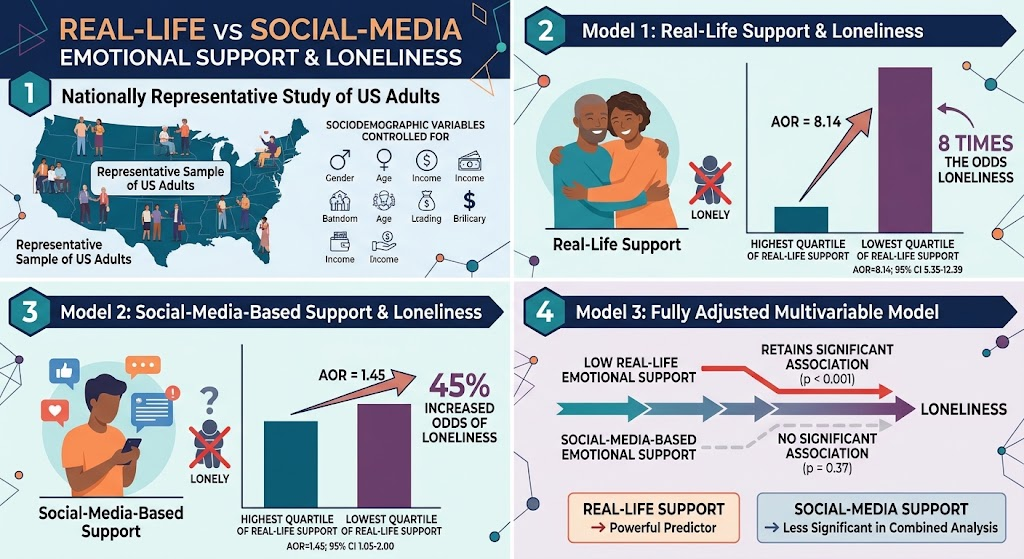
A cross-sectional survey was conducted in July and August 2023, recruiting 1,512 US adults ages 30–70 using nationally representative sampling methods. Loneliness was measured utilizing the perceived social isolation subscale of the Patient-Reported Outcomes Measurement Information System (PROMIS), a validated instrument for assessing social and emotional health.
Real-life emotional support was measured via adapted PROMIS items that assess perceived support from face-to-face interactions, while social-media-based emotional support used the same items but replaced “real-life” references with “social media.” Sociodemographic variables such as age, sex, race/ethnicity, education, income, marital status, and employment were included as covariates. Logistic regression models were employed to evaluate associations, incorporating survey weights for national representativeness.
Results
Analyses demonstrated a strong inverse association between real-life emotional support and loneliness. Individuals in the lowest quartile of real-life emotional support had over eight times greater odds of reporting loneliness compared to those in the highest quartile (Adjusted Odds Ratio [AOR] = 8.14; 95% Confidence Interval [CI], 5.35 to 12.39).
For social-media-based emotional support, the association with loneliness was weaker but still significant; those in the lowest quartile had a 45% higher odds of loneliness compared to those in the highest quartile (AOR = 1.45; 95% CI, 1.05 to 2.00).
In a fully adjusted model including both types of emotional support, only low real-life emotional support retained a significant association with loneliness (p < 0.001), while social-media-based support no longer showed a significant independent effect (p = 0.37).
Interpretation
The findings indicate that emotional support experienced through in-person relationships plays a substantially more critical role in reducing feelings of loneliness than support perceived via social media. Although social media can offer some emotional connectivity, it may not substitute effectively for the quality and depth of support that face-to-face interactions provide. This underscores the importance of fostering and maintaining real-life social networks to protect emotional well-being and reduce loneliness.
Limitations and Future Directions
Being cross-sectional, the study cannot determine causality or the directionality of effects. Longitudinal studies investigating emotional support trajectories and their impact on loneliness are necessary. Additionally, qualitative research could explore why social-media-based support is less potent—potential factors include superficial interactions, social comparison effects, or perceived authenticity.
Understanding individual differences such as personality traits and mental health status may also elucidate heterogeneous responses to social media.
Clinical and Public Health Implications
Healthcare providers and public health initiatives should recognize that while social media offers a readily accessible avenue for emotional expression and connection, it should not replace efforts to facilitate real-life social engagement. Interventions aimed at reducing loneliness might prioritize community-building activities, support groups, and opportunities for interpersonal interaction.
Moreover, as digital social contexts continue evolving, guidance on healthy social media use and supplementation with real-world social support should be integrated into mental health strategies.
Conclusions
This nationally representative study affirms that real-life emotional support is more strongly associated with reduced loneliness among US adults than social-media-based emotional support. Efforts to address loneliness should focus on enhancing real-world social networks alongside mindful social media engagement. Further research is critical to deepen understanding of these relationships and to inform effective interventions.
References
Koneru G, Kim H, Aslam M, Gorman JR, Sakuma KK, Arredondo CA, Primack BA. Real-Life Emotional Support, Social-Media-Based Emotional Support, and Loneliness Among US Adults: A Nationally Representative Study. Journal of General Internal Medicine. 2026 Aug 4. PMID: 42552295. Available at: https://pubmed.ncbi.nlm.nih.gov/42552295/