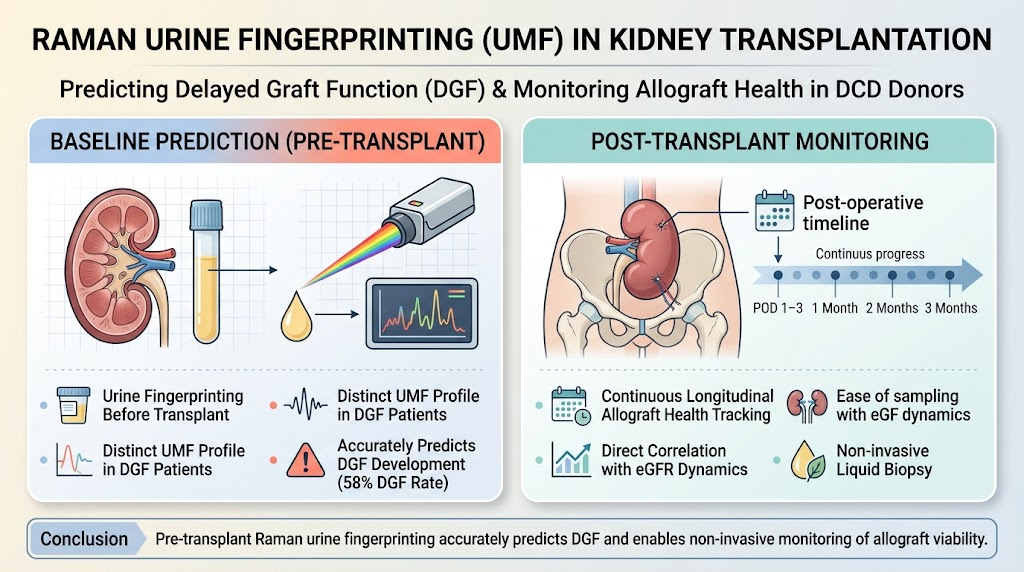
Raman spectroscopy-based urine molecular fingerprinting (UMF) can predict delayed graft function (DGF) before kidney transplantation.
Distinct UMF profiles differentiate DGF patients from non-DGF patients post-transplant.
UMF correlates with renal function as measured by eGFR, offering a tool for continuous monitoring of allograft health.
No specific UMF signatures for acute rejection or viral infections (CMV, BK) were identified in this pilot study.
Study Background
Kidney transplantation remains the preferred treatment for end-stage renal disease, substantially improving survival and quality of life compared to dialysis. However, delayed graft function (DGF)—commonly defined as the need for dialysis within the first week post-transplant—is a frequent complication, especially in donations after circulatory death (DCD). DGF is associated with increased risk of acute rejection, chronic allograft dysfunction, and reduced graft survival. Current assessment of kidney allograft quality before transplantation mainly relies on donor clinical factors and histopathology, which lack precision and are invasive. Post-transplant monitoring uses serum creatinine and clinical surveillance, but early detection of complications remains challenging. There is an unmet need for a non-invasive, rapid, and reliable biomarker method that can predict and monitor kidney allograft status.
Raman spectroscopy is a vibrational spectroscopic technique capturing molecular fingerprints of biological samples. Its application in urine molecular fingerprinting (UMF) holds promise in reflecting biochemical changes related to graft injury or function without requiring invasive procedures.
Study Design
This exploratory pilot study enrolled 26 patients receiving DCD renal allografts. Urine samples were collected at three key time points: immediately before transplantation (baseline), postoperatively on days 1–3, and monthly thereafter. Raman spectroscopy was applied to generate UMF profiles from these samples. The primary endpoint was identification of a UMF fingerprint predictive of DGF. Secondary endpoints included detection of UMF patterns associated with acute rejection, cytomegalovirus (CMV), BK virus infections, and correlation with estimated glomerular filtration rate (eGFR).
Clinical and laboratory data were correlated with UMF findings. Due to the pilot nature and limited sample size, statistical power was moderate and less likely to detect less frequent events such as rejection or viral infection.
Key Findings
DGF was observed in 58% (15/26) of patients, consistent with the higher incidence reported in DCD transplantation. UMF analysis revealed distinct molecular fingerprints in urine samples from patients who developed DGF compared to those who did not. Remarkably, UMF profiles from baseline urine collected immediately before transplantation predicted DGF development, suggesting biochemical alterations indicative of impaired graft quality or host-graft interactions even prior to engraftment.
Post-transplant UMF continued to differentiate patients with and without DGF, reflecting ongoing allograft injury or recovery states. Furthermore, a significant correlation between UMF signatures and eGFR values was observed, suggesting UMF’s potential utility in non-invasive renal function monitoring.
The study did not identify UMF fingerprints specific for acute rejection or CMV and BK viral infections, likely influenced by the pilot sample size and event frequency. Safety data were not explicitly reported but urine sampling poses minimal risk.
Expert Commentary
This pioneering study demonstrates the feasibility of Raman-based UMF as a predictive and monitoring biomarker in kidney transplantation. The capability to predict DGF pre-transplant is particularly valuable, as DGF contributes to early graft dysfunction and potentially long-term outcomes. Non-invasive molecular profiling offers advantages over biopsy, including safety, repeatability, and ease of sampling.
However, the study’s small size and single-center setting limit generalizability. Larger multicenter studies are needed to validate UMF’s predictive accuracy and to explore its role in detecting other complications such as rejection and viral nephropathy. Integration with other omics or imaging modalities could further refine allograft monitoring.
Mechanistically, Raman spectroscopy captures a broad array of molecular changes, including metabolites, proteins, and nucleic acids. These biochemical alterations may reflect ischemia-reperfusion injury, inflammation, and cellular stress underlying DGF.
Conclusion
The application of Raman spectroscopy-based urine molecular fingerprinting represents an innovative and promising approach to kidney allograft evaluation. This pilot study supports UMF as a non-invasive tool capable of predicting delayed graft function prior to transplantation and continuously monitoring graft health thereafter. If validated in larger cohorts, UMF could transform perioperative risk stratification and personalized management of transplant recipients, potentially improving graft survival and patient outcomes.
Funding and ClinicalTrials.gov
The study funding sources and clinical trial registration were not provided in the original publication abstract. Further information would be necessary to address these aspects.
References
1. Orlando G, Senger RS, Issa AS, et al. Raman Urine Fingerprinting to Predict DGF, Assess Renal Allograft Quality, and Monitor Its State of Health. Clinical Transplantation. 2026;40(10):e70716. doi:10.1111/ctr.70716
2. Yarlagadda SG, Coca SG, Formica RN Jr, Poggio ED, Parikh CR. Association between delayed graft function and allograft and patient survival: a systematic review and meta-analysis. Nephrol Dial Transplant. 2009;24(3):1039-1047.
3. Matignon M, Lerut E, Rossert J. Delayed graft function: definitions, outcomes and impact on short- and long-term kidney transplant survival. Transplantation Reviews. 2021;35(1):100585.
4. Hernandez-Vargas P, et al. Urine metabolomics analysis by Raman spectroscopy: a potential non-invasive technique in kidney transplant monitoring. Biosensors. 2020;10(4):38.