Cobratide injection demonstrated comparable efficacy to pregabalin in reducing acute herpes zoster pain over 28 days.
Incidence of postherpetic neuralgia at 12 weeks was numerically lower in the cobratide group, though not statistically significant.
Cobratide was associated with fewer treatment-emergent adverse events, indicating a favorable safety profile for older adults.
Exploratory trial design and small sample size call for larger, well-powered randomized trials to confirm findings.
Study Background
Acute herpes zoster (HZ) neuralgia significantly impairs quality of life due to acute pain and can transition into postherpetic neuralgia (PHN), a debilitating chronic neuropathic pain syndrome. PHN prevalence is higher in older adults and often refractory to treatment. Current first-line treatments, such as pregabalin, exhibit efficacy for nerve pain but may cause dose-limiting adverse effects like dizziness and sedation, particularly in the elderly. Therefore, novel therapies with comparable analgesic potency but improved tolerability are needed. Cobratide, a neuroprotective agent derived from cobra venom, has shown potential analgesic and anti-inflammatory effects in neuropathic pain conditions, warranting clinical evaluation in acute HZ neuralgia.
Study Design
This was a multicenter, randomized, double-blind, double-dummy, active-controlled exploratory trial conducted across multiple centers in China. The trial enrolled 80 patients aged 50 to 70 years presenting with moderate-to-severe acute HZ neuralgia. Participants were randomized 1:1 to receive either intramuscular cobratide injection or oral pregabalin over a 28-day treatment period. The double-dummy design ensured blinding by administering placebo injections and placebo capsules correspondingly.
The primary efficacy endpoint was the change in average Numeric Rating Scale (NRS) pain score from baseline to day 28. Secondary outcomes included the incidence of PHN at 12 weeks post-treatment and assessment of safety, including treatment-emergent adverse events (TEAEs). Notably, the study was exploratory and did not perform a formal sample size calculation, limiting statistical power.
Key Findings
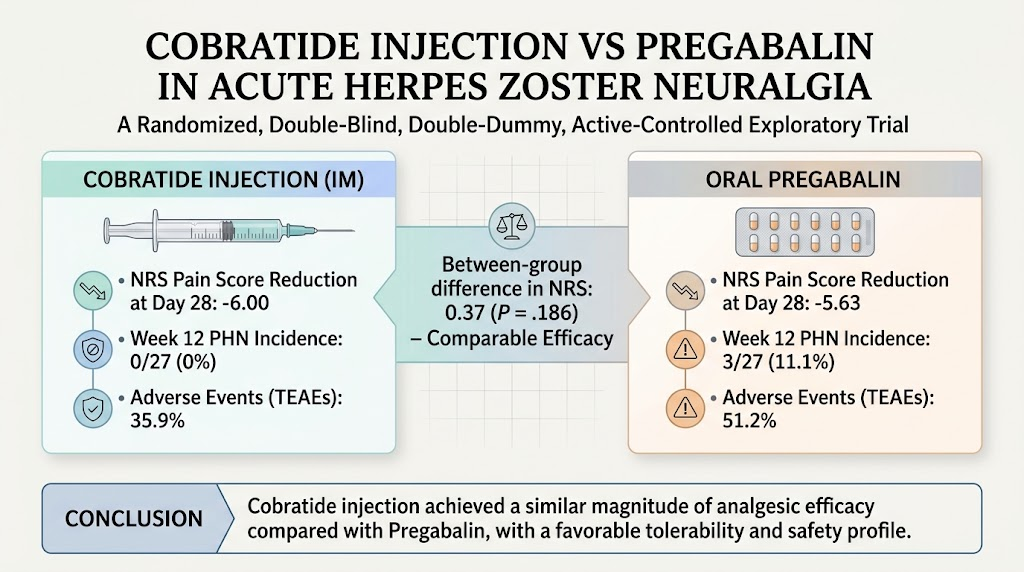
At day 28, pain reduction measured by the least-squares mean change in NRS was 6.00 points in the cobratide group and 5.63 points in the pregabalin group. The between-group difference was 0.37 points (P = .186), indicating no statistically significant superiority but comparable efficacy between the treatments.
The incidence of postherpetic neuralgia at week 12 numerically favored cobratide, with PHN observed in 0 of 27 evaluable patients compared to 3 of 27 in the pregabalin group; however, this difference did not achieve statistical significance (P = .236). This suggests a potential trend toward reduced PHN incidence with cobratide needing validation in larger cohorts.
From a safety perspective, 35.9% of patients receiving cobratide experienced treatment-emergent adverse events, compared to 51.2% in the pregabalin group. This points to a more favorable tolerability profile for cobratide, which may be particularly advantageous in older adults who are more susceptible to adverse drug effects.
Expert Commentary
The trial contributes early clinical evidence that cobratide could be a viable alternative to pregabalin for acute HZ neuralgia with similar analgesic efficacy and potentially improved safety. The neuroprotective mechanisms of cobratide—possibly via modulation of inflammatory mediators and nerve repair enhancement—may underpin its clinical effects and potential in reducing PHN incidence.
However, clinicians should interpret the results cautiously due to the exploratory nature, small sample size, and lack of formal power calculations. Additionally, the study did not systematically collect data on zoster vaccination status or precise rash onset timing, which are important confounders influencing pain trajectory and PHN development.
Future research should aim for adequately powered randomized controlled trials with stratification by vaccination status and timing of antiviral therapy to delineate cobratide’s definitive efficacy and role in clinical practice compared to standard neuropathic agents.
Conclusion
This trial suggests that cobratide injection offers comparable pain relief to pregabalin for moderate-to-severe acute herpes zoster neuralgia and exhibits a promising tolerability profile with fewer adverse events. Although preliminary, the observed trend toward reduced PHN incidence with cobratide is encouraging. These findings support further investigation through larger, confirmatory trials to establish cobratide’s position in managing acute HZ neuralgia and potentially mitigate the progression to debilitating PHN.
Funding and Trial Registration
The study was supported by institutional grants from participating centers. No formal funding statement was provided in the publication. The trial registration details were not specified.
References
1. Xu X, Han X, Li X, et al. Cobratide injection vs pregabalin for moderate-to-severe acute herpes zoster neuralgia: A randomized, double-blind, double-dummy, active-controlled, multicenter exploratory trial. J Am Acad Dermatol. 2026 Jun 19;95(4):1020-1027. doi:10.1016/j.jaad.2026.03.014. PMID: 42320855.
2. Johnson RW, Rice AS. Postherpetic neuralgia. N Engl J Med. 2014 Jun 5;370(24):2348-59. doi:10.1056/NEJMra1302319.
3. Dworkin RH, Johnson RW, Breuer J, et al. Recommendations for the management of herpes zoster. Clin Infect Dis. 2007 Jan 1;44 Suppl 1:S1-26. doi:10.1086/510206.
4. Gilron I, Baron R, Jensen T. Neuropathic pain: principles of diagnosis and treatment. Mayo Clin Proc. 2015 Apr;90(4):532-45. doi:10.1016/j.mayocp.2015.01.018.