Introduction
Gout is a common and painful form of inflammatory arthritis caused by the deposition of monosodium urate crystals in joints, which arises from elevated serum urate levels, known as hyperuricaemia. However, not all individuals with high urate levels develop gout, and the mechanisms determining why only a subset progress to clinical disease remain unclear. Recent scientific attention has turned toward epigenetic modifications, particularly DNA methylation, which may influence gene expression relevant to gout’s pathogenesis beyond the known genetic risk factors.
This study aimed to identify and characterize DNA methylation patterns in peripheral blood that distinguish gout from asymptomatic hyperuricaemia and normouricaemic states, and to explore how these epigenetic markers relate to established genetic risk loci associated with immune and metabolic pathways.
Methods
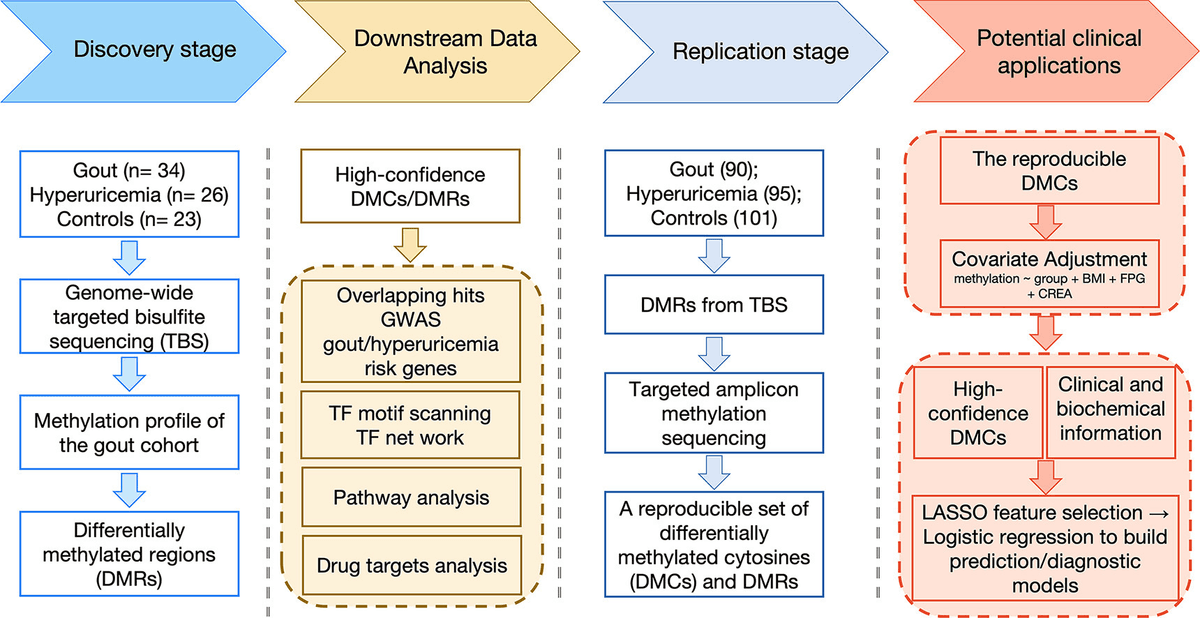
A two-stage, case-control epigenetic investigation was conducted involving three participant groups: gout patients (n=124), asymptomatic individuals with hyperuricaemia (n=121), and normouricaemic controls (n=124). The primary discovery cohort consisted of 83 participants across these groups, where peripheral blood DNA methylation profiling was performed using genome-wide targeted bisulphite sequencing. This technique maps methylation at cytosines across the genome, allowing identification of differentially methylated regions (DMRs) and cytosines (DMCs).
The identified epigenetic changes were integrated with known genome-wide association study (GWAS) loci linked to gout and serum urate levels and examined for overlap with transcription factor binding sites (TFBSs), implicating potential regulatory roles in gene expression. Candidate methylation signatures discovered were then validated in an independent replication cohort of 286 subjects using targeted amplicon methylation sequencing.
To assess clinical utility, logistic regression models utilizing least absolute shrinkage and selection operator (LASSO) methods constructed methylation-only classifiers and combined epigenetic-clinical classifiers to differentiate gout from other groups.
Results
Significant DMRs were identified in all pairwise comparisons between gout, hyperuricaemia, and normouricaemic controls. These epigenetic changes corresponded to 84 genes that included well-established genetic risk loci for gout and serum urate, such as HLA-DRB1, TAP2, and GNAS. Importantly, many DMRs coincided with transcription factor binding sites—suggesting functional impact on gene regulation—with the zinc finger protein ZNF571 region linked to inflammatory mediators IL27 and serum amyloid A2 (SAA2).
One hundred thirteen DMCs replicated successfully in the validation cohort and were employed to build methylation classifiers. The methylation-only model effectively discriminated gout patients from normouricaemic controls, achieving an impressive area under the receiver operating characteristic curve (AUC) of 0.96, indicating high accuracy.
When comparing gout to nongout controls (including hyperuricaemic individuals), the methylation-based classifier outperformed traditional clinical variables, with an AUC of 0.91 versus 0.78 (statistically significant with P = 0.032). The most challenging distinction—gout versus asymptomatic hyperuricaemia—was markedly improved when integrating methylation data with clinical metrics, increasing AUC from 0.67 to 0.87 (P = 0.018).
Discussion
This research demonstrates that peripheral blood DNA methylation patterns provide reproducible, stage-specific epigenetic signatures that distinguish gout from hyperuricaemia and normal serum urate states. The convergence of these methylation changes with immune-metabolic genetic risk loci suggests a biological interplay where genetic predisposition and epigenetic regulation collectively impact disease development.
The identification of methylation changes near key immunologically relevant genes such as HLA-DRB1 and IL27 supports the role of immune regulation in gout pathogenesis beyond crystal deposition and inflammation. Furthermore, these epigenetic markers offer potential for improved molecular stratification of patients, facilitating earlier and more accurate diagnosis, potentially guiding personalized treatment and monitoring.
However, it is important to note that while these methylation signatures show promise for clinical application, prospective studies are required to validate their predictive power in diverse populations and determine if they can inform therapeutic decision-making.
Clinical Implications and Future Directions
Currently, gout diagnosis heavily relies on clinical features and serum urate levels, with limitations in predicting who among hyperuricaemic individuals will develop gout. Incorporating DNA methylation profiles may help overcome this gap by identifying individuals at high risk of progression, enabling preventive strategies such as lifestyle modification or earlier pharmacological intervention.
Moreover, understanding the epigenetic regulation of immune-metabolic genes in gout pathogenesis provides avenues for novel therapeutic targets, including epigenetic modifiers or agents influencing specific immune pathways.
Future research should focus on longitudinal cohort studies to track methylation changes over time, explore their modification by environmental factors, and assess the effects of current gout treatments on epigenetic signatures.
Conclusion
This study reveals distinct DNA methylation signatures in peripheral blood that differentiate gout from asymptomatic hyperuricaemia and normal urate states, aligned with key genetic risk loci in immune-metabolic pathways. These findings highlight the potential for epigenetic biomarkers in improving gout diagnosis and understanding its complex pathobiology. While promising, further prospective validation is required before these molecular classifiers can be adopted routinely in clinical practice.
References
Chen Z, Ren H, Ji X, Dong B, Ji A. DNA methylation signatures distinguish gout from asymptomatic hyperuricaemia and converge with genetic risk at immune-metabolic loci. Ann Rheum Dis. 2026 Sep 29. PMID: 42810907. https://pubmed.ncbi.nlm.nih.gov/42810907/