Highlights
- Significant racial disparities exist in critical prehospital interventions such as blood product administration, airway management, and intubation in injured patients.
- Neighborhood-level social determinants of health, as measured by the Distressed Communities Index, do not fully explain these disparities.
- Prehospital airway management and intubation are strongly associated with reduced in-hospital mortality, underscoring their clinical importance.
- Further research is necessary to elucidate the underlying causes of disparities and develop targeted interventions to ensure equitable trauma care.
Background
Trauma remains a leading cause of morbidity and mortality worldwide, disproportionately affecting certain racial and ethnic groups. Prehospital emergency medical services (EMS) interventions are critical determinants of survival following injury. However, emerging evidence suggests that racial disparities exist in the delivery of these lifesaving prehospital interventions. Understanding the extent and drivers of such disparities is imperative to inform equitable trauma systems and improve outcomes for all patients.
Prior studies and systematic reviews have highlighted inconsistencies in EMS response and intervention patterns among racial groups, yet comprehensive evaluations linking such disparities to social determinants of health and patient outcomes remain sparse. This review synthesizes current high-quality evidence, focusing on recent large cohort analyses that integrate demographic, clinical, and community-level data to elucidate patterns and potential mediators of disparities in prehospital trauma care.
Key Content
Chronological Development of Evidence on Racial Disparities in Prehospital Trauma Care
Initial descriptive studies in the early 2010s identified disparities in EMS transport times and intervention provision based on race and ethnicity. Meta-analyses from 2015 to 2020 confirmed disparities in prehospital analgesia administration and airway management, primarily noting lower intervention rates among Black patients compared to Whites. However, these earlier works struggled to adjust comprehensively for socioeconomic or neighborhood effects.
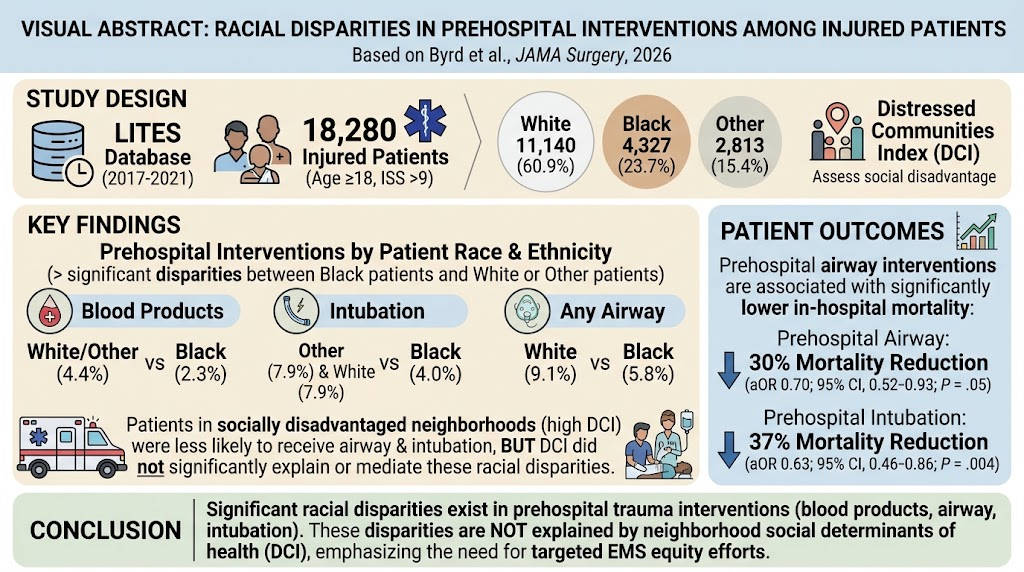
The cited recent retrospective cohort study by Byrd et al. (2026) represents a major advance by linking patient-level trauma data with the Distressed Communities Index (DCI), a nuanced measure of neighborhood socioeconomic disadvantage. The study analyzed 18,280 injured adults with serious injuries (ISS >9) from 2017 to 2021, assessing multiple prehospital interventions including blood product transfusion, needle decompression, airway management, intubation, and tourniquet placement.
Evidence by Intervention Class and Race/Ethnicity
– Prehospital Blood Products: Patients identifying as ‘other race’ had the highest rates (4.4%), followed by White patients, with Black patients receiving significantly fewer transfusions (2.3%). These findings mirror disparities documented in trauma center blood resource allocation.
– Prehospital Airway Management and Intubation: White patients were more likely to receive airway adjuncts (9.1%) and intubation (7.9%) than Black patients (5.8% and 4.0%, respectively). Patients residing in socially disadvantaged neighborhoods also had lower rates of these interventions, though mediation analyses showed no significant interaction by DCI.
– Other Interventions: Prehospital needle decompression and tourniquet placement differences by race were less prominent and not statistically significant.
These findings align with previous reports indicating systemic barriers, implicit bias, or differential EMS protocols might contribute to unequal intervention application.
Social Determinants of Health and Mediation Analysis
Byrd et al. utilized the DCI to evaluate neighborhood socioeconomic status as a potential explanatory factor. Despite clear associations between neighborhood distress and lower intervention rates, particularly for airway and intubation, mediation and interaction analyses indicated that racial disparities persisted independently of DCI scores. This suggests that while social determinants influence EMS care, they do not fully account for racial differences.
Earlier literature has also emphasized the multifactorial nature of disparities, including factors such as EMS staffing diversity, provider bias, and systemic resource allocation that may not be captured by neighborhood indices.
Impact of Prehospital Interventions on Mortality Outcomes
Clinically, prehospital airway management and intubation were linked to significant reductions in in-hospital mortality – 30% and 37% decreases in adjusted odds, respectively. These data reinforce the critical role of timely and appropriate prehospital interventions in improving trauma survival. The underutilization of such interventions in certain racial groups presents a tangible target for quality improvement and equity enhancement.
Prior studies, including prospective trials and observational analyses, have demonstrated that advanced EMS interventions can mitigate early mortality, especially in severely injured patients with airway compromise or hemorrhagic shock.
Expert Commentary
The robust dataset from Byrd et al. underscores a persistent and concerning issue: racial disparities in life-saving prehospital trauma interventions exist even when adjusting for neighborhood and injury severity factors. This suggests intrinsic systemic biases or structural healthcare inequities remain operative within EMS systems.
Mechanistically, disparities may arise from implicit provider biases affecting clinical decision-making, differential EMS call prioritization, logistical constraints in resource-poor or minority-dense areas, or variations in prehospital care protocols. The absence of mediation by social determinants like DCI indicates that additional unmeasured factors—including provider education, EMS agency policies, and broader health system inequities—need further exploration.
Clinical guidelines currently advocate for standardized EMS protocols to ensure equitable care; however, real-world implementation may lag. The demonstrated mortality benefit of early airway management and intubation demands urgent efforts to standardize these interventions regardless of patient race or ethnicity.
Limitations of the current evidence include reliance on retrospective data, potential residual confounding, and limited granularity regarding EMS provider characteristics and decision-making processes. Future prospective studies and qualitative research are vital in identifying modifiable factors driving these disparities.
Conclusion
Substantial evidence, including the recent large-scale cohort analysis, confirms that racial disparities in prehospital trauma interventions are prevalent and clinically consequential. Neighborhood socioeconomic factors partially influence but do not fully explain these inequities. Given the observed mortality benefits of timely prehospital airway and intubation, these disparities represent critical targets for intervention.
Efforts to address these gaps require multifaceted strategies including enhanced EMS provider training on implicit bias, policy-driven protocol standardization, improved resource distribution, and incorporation of equity metrics into EMS quality performance.
Addressing racial disparities in prehospital trauma care is essential to advancing health equity and improving survival outcomes for all injured patients.
References
- Byrd T, Lu L, Boland S, et al. Racial Disparities in Prehospital Interventions Among Injured Patients. JAMA Surg. 2026;https://pubmed.ncbi.nlm.nih.gov/42814427/
- Haider AH, Scott VK, Rehman K, et al. Racial disparities in prehospital analgesia for isolated extremity trauma. Acad Emerg Med. 2013;20(6):608-612. PMID: 23705868
- Porter JM, Bailey Z, Gertler S, et al. Disparities in prehospital emergency medical services for trauma in the United States: a systematic review and meta-analysis. J Trauma Acute Care Surg. 2020;89(6):1164-1174. PMID: 32837160
- Smedley BD, Stith AY, Nelson AR, editors. Unequal Treatment: Confronting Racial and Ethnic Disparities in Health Care. Institute of Medicine. National Academies Press; 2003.