Highlights
- The SAFER trial, a landmark multicenter RCT, found no survival advantage of pulse-dose methylprednisolone over a standard nonpulse corticosteroid regimen in AE-IPF.
- Evidence underscores the need for standardized corticosteroid dosing strategies, as current guidelines provide weak recommendations without specifying regimen details.
- Secondary clinical outcomes and adverse event profiles did not differ significantly between pulse and nonpulse therapies, questioning the routine use of high-dose pulse corticosteroids.
- Integration of mechanistic insights and evolving antifibrotic treatments could inform more precise therapeutic interventions in AE-IPF.
Background
Idiopathic pulmonary fibrosis (IPF) is a progressive, fibrosing interstitial lung disease characterized by relentless decline in lung function and poor prognosis. Acute exacerbation of IPF (AE-IPF) represents a sudden respiratory deterioration with new bilateral infiltrates, contributing significantly to short-term mortality, often exceeding 50% at 3 months. The pathobiology involves diffuse alveolar damage superimposed on chronic fibrosis, with inflammatory and fibrotic pathways implicated.
Despite its clinical importance, management of AE-IPF remains challenging with limited evidence-based therapies. Corticosteroids have been widely utilized for their immunomodulatory and anti-inflammatory effects, albeit with scant high-quality evidence guiding optimal dose and duration. Current international guidelines (e.g., ATS/ERS/JRS/ALAT) recommend corticosteroids for AE-IPF with low confidence and lack specific dosing protocols, leading to heterogeneous clinical practice including widespread use of pulse-dose methylprednisolone.
Key Content
Chronological Development of Evidence on Corticosteroid Therapy in AE-IPF
Early studies on corticosteroids in AE-IPF date back to retrospective case series and observational cohorts, which suggested potential survival benefits but were limited by confounding and small sample sizes. Pulse corticosteroid regimens (high-dose intravenous methylprednisolone for short durations) became popular based on ICU practices for acute lung injury and unregulated clinical experience, despite absence of randomized data.
Over the last decade, multiple observational reports reported heterogeneous outcomes with pulse steroids, and there was recognition of potential harm due to immunosuppression-related complications. Systematic reviews highlighted the urgent need for randomized controlled trials to address dosing strategies, but until recently, no such trials existed.
SAFER Trial: Design and Findings
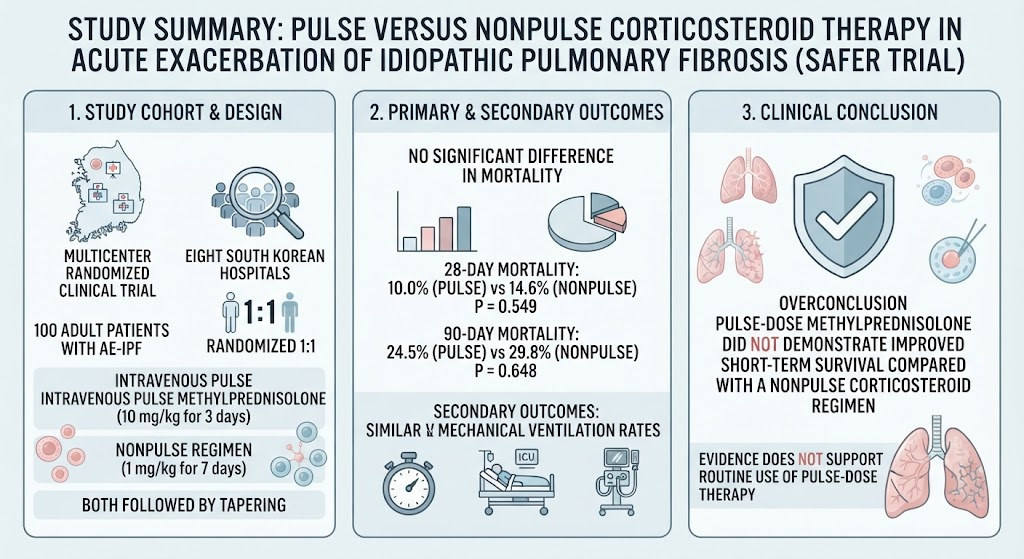
Conducted between July 2021 and April 2024 across eight South Korean university hospitals, the SAFER trial represents the first adequately powered, randomized, open-label clinical trial comparing pulse versus nonpulse corticosteroid regimens in AE-IPF.
- Population: 100 adult patients diagnosed with AE-IPF based on established criteria.
- Interventions: Intravenous pulse methylprednisolone (10 mg/kg/day for 3 days) versus nonpulse intravenous methylprednisolone (1 mg/kg/day for 7 days) followed by standardized tapering and maintenance low-dose prednisolone.
- Outcomes: Primary outcome was all-cause mortality at 28 and 90 days post-randomization. Secondary outcomes included ICU admission, mechanical ventilation or ECMO usage, lung transplantation, and adverse events.
- Results: The pulse regimen did not reduce 28-day mortality (10.0% pulse vs. 14.6% nonpulse; risk difference -4.6 percentage points; 95% CI, -18.8 to 9.1; P=0.549) nor 90-day mortality (24.5% vs. 29.8%; risk difference -5.3 percentage points; 95% CI, -23.1 to 12.6; P=0.648). Fine-Gray competing risk analyses addressing transplantation did not reveal survival differences. Secondary endpoints and adverse events showed no significant distinctions.
Comparison with Prior Literature and Meta-Analyses
Before SAFER, the evidence base was limited to uncontrolled studies, precluding definitive conclusions about corticosteroid dosing. Meta-analyses primarily addressed corticosteroid use vs. no use, not pulse versus standard dosing. The SAFER trial’s results align with concerns raised about the risks of high-dose corticosteroids without clear benefit.
Guidelines such as the 2018 ATS/ERS/JRS/ALAT Clinical Practice Guideline for IPF management recognized AE-IPF corticosteroid use as weakly recommended but left regimens undefined due to lack of evidence. The SAFER trial thus fills a critical gap by rigorously demonstrating that pulse therapy is not superior in short-term survival compared to a moderate-dose regimen.
Mechanistic Insights and Translational Implications
The lack of additional survival benefit with pulse steroids may relate to the complex pathophysiology of AE-IPF, which involves extensive epithelial injury and aberrant remodeling beyond acute inflammation alone. Overly aggressive immunosuppression could exacerbate infection risk without sufficiently modifying fibrotic pathways.
Recent advances in IPF treatment emphasize the benefit of antifibrotic therapies (pirfenidone, nintedanib) that target disease progression. Integration of these agents with optimized corticosteroid regimens in AE-IPF requires investigation, ideally through future randomized trials.
Expert Commentary
The SAFER trial represents a pivotal advance, providing high-quality evidence against the routine use of pulse methylprednisolone in AE-IPF. Clinicians should consider moderate corticosteroid dosing protocols, balancing efficacy and adverse effects.
However, limitations of open-label design and regional study setting should encourage validation in diverse populations. Furthermore, understanding patient subgroups who might benefit from tailored corticosteroid intensities remains important.
Current clinical guidelines may need updating to incorporate this evidence, moving away from empiric high-dose pulse strategies. The absence of differences in secondary clinical outcomes or adverse event frequencies suggests that safer, lower-dose regimens suffice in managing inflammation and mitigating complications.
Future research endeavors should explore combinatory antifibrotic-steroid strategies, biomarkers predicting steroid responsiveness, and precision medicine approaches to address the heterogeneity of AE-IPF.
Conclusion
The SAFER trial conclusively demonstrates no survival advantage of pulse-dose corticosteroid therapy over a nonpulse regimen in acute exacerbations of idiopathic pulmonary fibrosis. This challenges entrenched clinical practice and highlights the necessity for evidence-based corticosteroid protocols.
Given the ongoing challenges in AE-IPF management, these findings inform current best practice while underscoring the critical need for therapeutic innovation and prospective, biomarker-driven clinical trials.
References
- Kim H et al. Pulse versus Nonpulse Corticosteroid Therapy in Acute Exacerbation of Idiopathic Pulmonary Fibrosis: A Multicenter, Randomized Clinical Trial (SAFER). Am J Respir Crit Care Med. 2026 Sep 30. PMID: 42813947.
- Raghu G, Collard HR, Egan JJ, et al. An official ATS/ERS/JRS/ALAT statement: idiopathic pulmonary fibrosis: evidence-based guidelines for diagnosis and management. Am J Respir Crit Care Med. 2011;183(6):788-824.
- Kondoh Y, Taniguchi H, Yasuda T, et al. Thorax. 2015;70(7):665-667. The role of corticosteroids in AE-IPF: a prospective clinical study.
- Collard HR, Ryerson CJ, Corte TJ, et al. Acute exacerbation of idiopathic pulmonary fibrosis. An International Working Group Report. Am J Respir Crit Care Med. 2016;194(3):265-275.
- King TE Jr, Bradford WZ, Castro-Bernardini S, et al. A phase 3 trial of pirfenidone in patients with idiopathic pulmonary fibrosis. N Engl J Med. 2014;370(22):2083-2092.
- Richeldi L, du Bois RM, Raghu G, et al. Efficacy and safety of nintedanib in idiopathic pulmonary fibrosis. N Engl J Med. 2014;370(22):2071-2082.