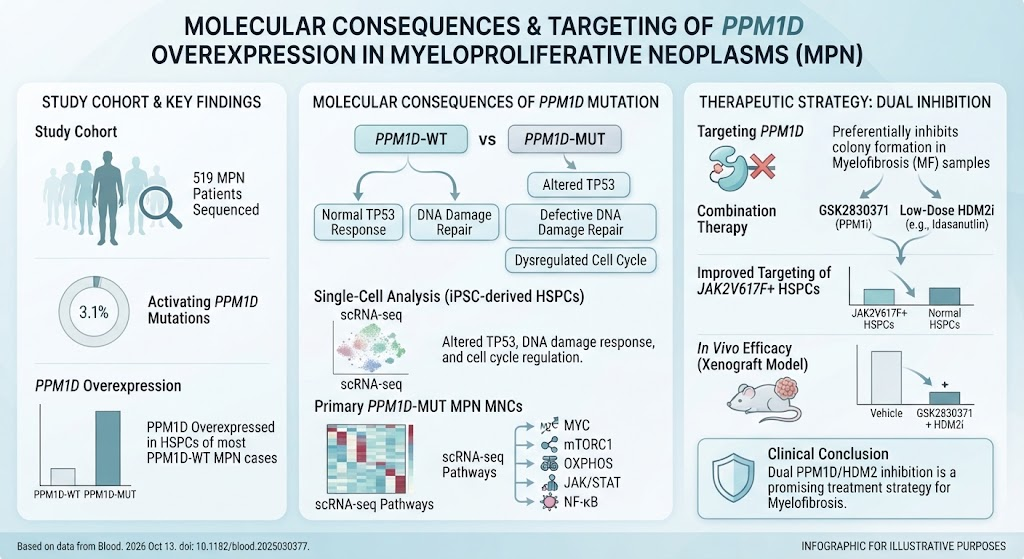
Activating mutations of PPM1D occur in approximately 3.1% of myeloproliferative neoplasms (MPN) patients, with widespread PPM1D overexpression even in wild-type cases.
PPM1D mutation and overexpression dysregulate TP53 signaling, DNA damage response, and multiple oncogenic pathways including MYC, mTORC1, JAK/STAT, and NF-κB in hematopoietic stem and progenitor cells (HSPCs).
The allosteric PPM1D inhibitor GSK2830371 preferentially suppresses colony formation in myelofibrosis samples and synergizes with HDM2 inhibition to selectively reduce malignant HSPCs while sparing normal counterparts.
Dual PPM1D/HDM2 inhibition significantly reduces leukemic burden in xenograft MPN models, highlighting a novel therapeutic avenue for treatment-resistant MPNs.
Study Background
Myeloproliferative neoplasms (MPNs) are a heterogeneous group of clonal hematopoietic stem cell disorders characterized by excessive proliferation of myeloid lineages. Driver mutations such as JAK2V617F underpin most MPN cases, but additional genetic and epigenetic alterations influence disease phenotype, progression, and transformation into myelofibrosis (MF) or acute myeloid leukemia (AML). Therapy-related myelodysplastic syndromes (t-MDS) and AML have previously been associated with activating mutations in protein phosphatase Mg2+/Mn2+-dependent 1D (PPM1D), a serine/threonine phosphatase that regulates oncogenic pathways including TP53 and DNA damage response (DDR). However, the role of PPM1D mutations and overexpression in MPNs remains underexplored.
This study addresses a critical gap in MPN biology by investigating the prevalence of PPM1D mutations, their functional consequences in hematopoietic stem and progenitor cells (HSPCs), and potential targeted therapies exploiting PPM1D dependence in MPN, especially in MF cases with limited treatment options.
Study Design
The authors performed targeted sequencing of 519 MPN patient samples to assess the frequency and spectrum of activating PPM1D mutations. They evaluated PPM1D protein expression in HSPCs from both PPM1D mutant and wild-type patients.
To mechanistically dissect the impact of PPM1D mutations, isogenic induced pluripotent stem cell (iPSC) lines were engineered from a JAK2V617F+ MPN patient, differing only in PPM1D status (wild-type vs. mutant). Single-cell RNA sequencing (scRNA-seq) was employed to compare transcriptomic alterations in iPSC-derived HSPCs.
Further, scRNA-seq analysis of primary mononuclear cells (MNCs) from PPM1D-mutant MPN patients substantiated pathways dysregulated by PPM1D alterations.
Pharmacological inhibition studies were conducted using the allosteric PPM1D inhibitor GSK2830371 alone and combined with an HDM2 inhibitor, targeting the p53 pathway regulator, in primary patient samples and xenograft MPN mouse models. Colony formation assays, mutational clonality analyses, and leukemia burden assessments were key experimental endpoints.
Key Findings
Prevalence and Overexpression of PPM1D in MPN
Activating mutations within the PPM1D gene were identified in approximately 3.1% of MPN patients, underscoring a niche but clinically relevant subset. Importantly, PPM1D protein was found overexpressed in HSPCs even among most PPM1D wild-type MPN patients, indicating a broader role in MPN pathogenesis beyond mutation-associated activation.
Molecular Dysregulation Driven by PPM1D Mutation and Overexpression
Single-cell transcriptome profiling of isogenic JAK2V617F+/PPM1D-MUT versus wild-type iPSC-derived HSPCs revealed significant alterations in TP53 signaling and DNA damage response pathways, alongside dysregulated cell cycle programs. Enhanced activation of oncogenic pathways was evident, including upregulation of MYC, mechanistic target of rapamycin complex 1 (mTORC1), oxidative phosphorylation (OXPHOS), JAK/STAT, and nuclear factor kappa-light-chain-enhancer of activated B cells (NF-κB) signaling.
These data were corroborated in primary MPN patient MNCs harboring PPM1D mutations, which exhibited similar molecular signatures, validating the translational relevance.
Therapeutic Targeting of PPM1D in MPN
The selective inhibition of PPM1D phosphatase activity using GSK2830371 demonstrated preferential suppression of colony formation in myelofibrosis samples compared to controls, indicating functional dependency of malignant HSPCs on PPM1D.
More strikingly, combined treatment with low-dose HDM2 inhibitors—blocking a critical negative regulator of p53—potentiated the targeting of mutant JAK2V617F+ HSPCs while sparing normal HSPCs. This synergy leveraged restored p53 activity, enhancing apoptosis in malignant cells.
Single-cell mutational and proteomic analyses of clonally complex MF patient samples under this dual therapy revealed a marked reduction in mutant clones by over fourfold, with concomitant expansion of wild-type hematopoietic populations, suggesting selective clonal suppression.
In vivo, dual PPM1D and HDM2 inhibition significantly reduced leukemic burden in an MPN xenograft model, highlighting the translational potential of this combination approach.
Expert Commentary
This study provides compelling evidence identifying PPM1D not only as a mutational driver in a subset of MPNs but also as a broadly overexpressed modulator of malignant hematopoiesis. The comprehensive integration of genomic, transcriptomic, functional, and pharmacologic analyses provides mechanistic insights into how PPM1D deregulation fosters oncogenic signaling and impairs TP53-mediated tumor suppressor functions.
Importantly, the therapeutic implications extend beyond rare PPM1D-mutant cases to potentially encompass PPM1D overexpressing MPN patients, especially those with myelofibrosis, who currently face limited effective treatment options.
However, challenges remain regarding the generalizability of dual PPM1D/HDM2 targeting to diverse MPN molecular subtypes and the long-term safety profile of manipulating TP53 pathway regulators. Future clinical trials will be critical to define the optimal dosing, combinatorial partners, and patient selection strategies.
Conclusion
This work illuminates PPM1D as a critical regulator of myeloproliferative neoplasm stem and progenitor cell function, highlighting its role in dysregulated DNA damage response and oncogenic signaling networks. The findings advocate for the clinical development of dual PPM1D and HDM2 inhibition as a novel, mechanistically grounded treatment strategy for myelofibrosis and possibly other MPN phenotypes.
Such targeted therapeutic approaches could improve disease control by selectively eradicating malignant clones while sparing normal hematopoiesis, thereby addressing a vital unmet clinical need in MPN management.
Funding and ClinicalTrials.gov
The study was supported by institutional and federal grants as detailed in the original publication. No registered clinical trials are reported for this combination therapy yet, underscoring the preclinical stage of these findings.
References
1. Mia MB, Schaniel C, Clementelli C, et al. Molecular Consequences and Targeting of PPM1D Overexpression in Myeloproliferative Neoplasms. Blood. 2026 Oct 13. PMID: 42868262.
2. Papaemmanuil E, et al. Genomic classification and prognosis in acute myeloid leukemia. N Engl J Med. 2016;374(23):2209-2221.
3. Levine AJ et al. The role of p53 in hematologic malignancies. Blood. 1999;93(7):2143-2156.
4. Rampal RK et al. Targeting JAK-STAT signaling in myeloproliferative neoplasms. Blood Rev. 2014;28(4):189-200.