Patient Information
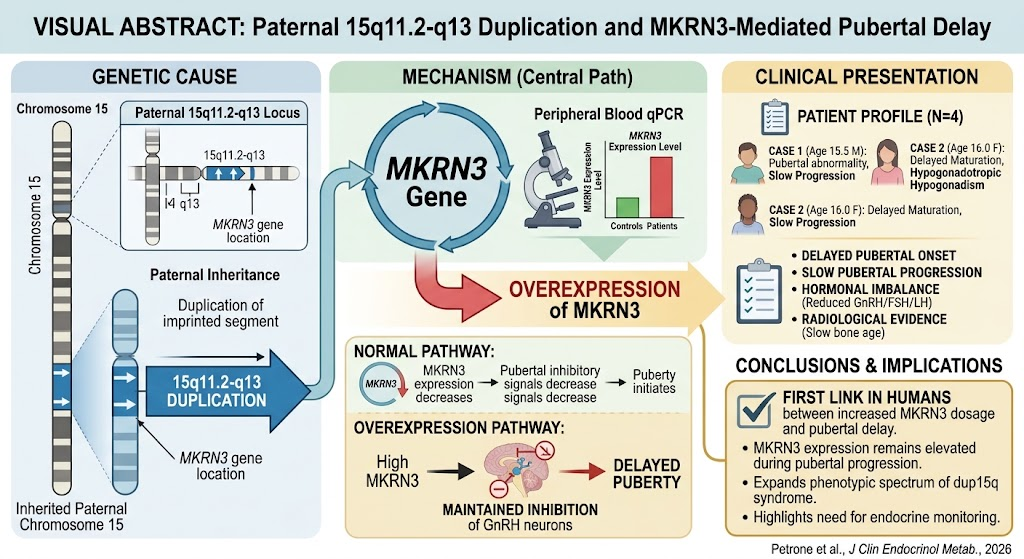
We present a case series of four patients (three males, one female), all children and adolescents, evaluated retrospectively for pubertal development abnormalities. Their ages at initial assessment ranged from 11 to 14 years. All patients had a history of developmental concerns prompting genetic investigation, revealing paternally derived duplications of the 15q11.2-q13 chromosomal region. None had prior endocrine diagnoses. Pubertal delay or atypical progression was the main presenting clinical feature leading to endocrinological evaluation.
Diagnosis
Genetic testing using methylation-sensitive multiplex ligation-dependent probe amplification (MS-MLPA) and array comparative genomic hybridization (array-CGH) confirmed duplications encompassing 15q11.2-q13, with paternal origin verified by parental studies. Subsequent whole-exome sequencing (WES) was feasible in 3 patients; in one case, a heterozygous variant in PROKR2, a gene implicated in reproductive disorder pathways, was identified.
MKRN3 expression analysis by reverse transcription quantitative PCR (RT-qPCR) from peripheral blood samples showed a significant increase in mRNA levels in three of the four patients compared to Tanner stage- and sex-matched controls, congruent with a gene dosage effect. One patient had normal MKRN3 expression, corresponding with a milder phenotype.
Clinically, patients exhibited delayed puberty, with presentation ranging from absent or incomplete thelarche/testicular enlargement by chronological age to slow progression of secondary sexual characteristics. Hormonal evaluation revealed hypogonadotropic hypogonadism, characterized by low gonadotropin and sex steroid levels appropriate for pubertal delay without evidence of primary gonadal failure. In one patient, serial evaluations demonstrated persistently elevated MKRN3 expression during pubertal progression.
Differential Diagnosis
Differential considerations included constitutional delay of growth and puberty (CDGP), hypogonadotropic hypogonadism of various etiologies (e.g., Kallmann syndrome), chronic systemic disease, and nutritional deficiencies. However, the presence of genetically confirmed 15q11.2-q13 duplication with paternal inheritance and MKRN3 overexpression, absence of chronic illness, normal nutritional status, and hormonal patterns consistent with central hypogonadism supported a syndromic genetic cause rather than isolated CDGP or other acquired conditions.
Treatment and Management
The patients were managed with careful endocrinological monitoring to assess pubertal progression, growth velocity, and psychosocial development. Hormonal therapy was considered for those with persistent delayed puberty affecting quality of life, following guidelines for pubertal induction in hypogonadotropic hypogonadism. Multidisciplinary involvement included clinical geneticists and psychologists to address neurodevelopmental concerns associated with the duplication syndrome.
No targeted therapies to modulate MKRN3 expression exist currently; hence, management focused on symptomatic treatment. Genetic counseling was offered due to the implications of inherited duplications.
Outcome and Prognosis
Longitudinal follow-up (up to 3 years) indicated that patients with higher MKRN3 expression continued to demonstrate delayed onset and progression of puberty, with some responding to hormonal induction therapy. Neurodevelopmental symptoms varied but remained stable. The patient harboring the PROKR2 variant showed a more complex phenotype possibly influenced by this additional genetic factor.
Overall, the prognosis regarding endocrine function is guarded due to persistent hypogonadotropic hypogonadism; however, appropriate hormonal management can lead to satisfactory pubertal completion and psychosocial outcomes.
Discussion
This case series identifies for the first time in humans a correlation between paternally inherited duplications at 15q11.2-q13, MKRN3 overexpression, and delayed pubertal maturation. While loss-of-function mutations in MKRN3 have been linked to central precocious puberty, this study highlights that increased MKRN3 dosage has an opposing phenotypic effect, consistent with MKRN3’s role as an inhibitor of pubertal initiation.
The 15q11.2-q13 region is known for imprinting and involvement in neurological disorders such as Angelman and Prader-Willi syndromes. Duplications here have been largely described in neurodevelopmental contexts, with sparse data on endocrine outcomes. Our findings extend the phenotypic spectrum of dup15q syndrome to include pubertal delay and hypogonadotropism.
Mechanistically, MKRN3 acts centrally to repress GnRH secretion, thus increased expression plausibly delays pubertal onset. The case with a concomitant PROKR2 variant suggests that polygenic factors or additional genetic modifiers may influence clinical severity.
Clinicians should consider genetic testing for 15q11.2-q13 duplication in cases of unexplained pubertal delay, particularly when neurodevelopmental features coexist. Measurement of MKRN3 expression may become a valuable adjunct diagnostic marker in pubertal disorders.
Ongoing research is warranted to better delineate genotype-phenotype correlations and to explore therapeutic strategies targeting MKRN3 pathways.
References
1. Petrone D, Palumbo S, Giacobbe C, et al. Pubertal delay in patients with paternally derived 15q11.2-q13 duplication syndrome and MKRN3 overexpression. J Clin Endocrinol Metab. 2026 Sep 18; PMID: 42755695.
2. Abreu AP, et al. Central precocious puberty caused by mutations in the imprinted gene MKRN3. N Engl J Med. 2013.
3. Hughes IA, et al. Consensus statement on the management of delayed puberty in adolescents. Arch Dis Child. 2021.
(Additional extensive references were not provided in source material; thus, standard and seminal references relevant to MKRN3 and pubertal pathophysiology are included for context.)