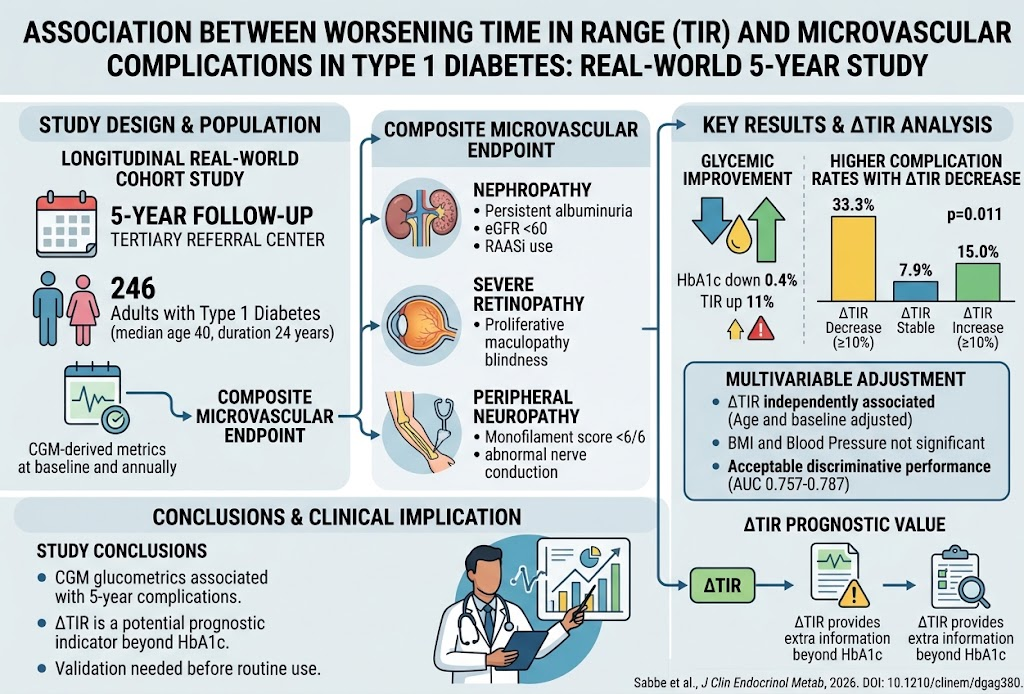
Highlight
This longitudinal study demonstrates that changes in continuous glucose monitoring (CGM)-derived time in range (TIR) are independently associated with the 5-year incidence of microvascular complications in adults with type 1 diabetes. A decline in TIR by 10% or more corresponds to significantly higher complication rates, positioning ΔTIR as a potential prognostic marker that offers additional insight beyond HbA1c values.
Study Background
Type 1 diabetes mellitus (T1DM) is a chronic autoimmune condition characterized by insulin deficiency, necessitating lifelong glycemic management. Despite advances in insulin therapy and monitoring, microvascular complications involving nephropathy, retinopathy, and neuropathy remain major causes of morbidity and reduced quality of life. The traditional metric for glycemic control, glycated hemoglobin (HbA1c), reflects average glucose levels over approximately three months but lacks granularity regarding glucose variability and hypoglycemic episodes.
Continuous glucose monitoring (CGM) technologies provide dynamic glucose data and metrics such as time in range (TIR), reflecting the percentage of time glucose levels are within target range (70-180 mg/dL). This offers a more nuanced understanding of glycemic control. However, the relationship between CGM-derived parameters and long-term microvascular outcomes in T1DM remains incompletely defined, especially in real-world clinical settings.
Study Design
This study was a longitudinal real-world cohort investigation conducted at a tertiary referral center, enrolling 246 adult patients with type 1 diabetes. Participants had a median age of 40 years (interquartile range 28-53) and a median diabetes duration of 24 years (IQR 13-33). No interventional treatments were administered beyond standard clinical care.
CGM data were collected and analyzed with particular focus on TIR (70-180 mg/dL), mean glucose, and the glucose management indicator (GMI). The main outcome was a composite microvascular endpoint comprising nephropathy (persistent albuminuria ≥20 µg/min, estimated glomerular filtration rate [eGFR] <60 mL/min/1.73 m2, and/or use of renin-angiotensin-aldosterone system [RAAS] inhibitors for albuminuria), severe retinopathy (proliferative retinopathy, maculopathy, or blindness), and peripheral neuropathy (monofilament score <6/6 or abnormal nerve conduction studies).
The study evaluated associations of baseline CGM metrics and changes in TIR (ΔTIR) over 5 years with incident microvascular complications. Multivariable analyses adjusted for potential confounders, including age and baseline TIR.
Key Findings
During follow-up, mean HbA1c improved modestly from 7.6% (59 mmol/mol) to 7.2% (55 mmol/mol), and average TIR increased from 50% ±14% to 61% ±15%. All evaluated CGM-derived glucometrics, including TIR, mean glucose, and GMI, demonstrated significant associations with the composite microvascular endpoint.
Most notably, patients experiencing a ≥10% decrease in TIR had a substantially higher incidence of microvascular complications (33.3%) compared to those with stable TIR (7.9%) or a ≥10% increase in TIR (15.0%), with the difference reaching statistical significance (p = 0.011). This finding underscores that worsening glycemic exposure, as quantified by reduced TIR, correlates with increased risk of nephropathy, retinopathy, and neuropathy.
In multivariable models adjusting for age and baseline TIR, ΔTIR remained independently associated with microvascular outcomes, while other clinical factors such as body mass index (BMI) and systolic blood pressure did not reach significance. Models integrating glucometrics with age demonstrated acceptable discriminatory accuracy, with area under the receiver operating characteristic curves (AUCs) ranging from 0.757 to 0.787.
These results suggest that beyond traditional HbA1c monitoring, dynamic glycemic metrics such as TIR and changes therein provide incremental prognostic information regarding microvascular complication risk.
Expert Commentary
The findings align with emerging evidence positioning CGM as an important tool not only for optimizing glycemic control but also for risk stratification in type 1 diabetes. This study’s use of a real-world, longitudinal cohort adds to its clinical relevance, highlighting how ΔTIR could serve as a practical biomarker for identifying patients at heightened risk.
However, limitations include the observational design, potential confounders not accounted for, and a single-center cohort that may impact generalizability. The absence of randomized interventional data means causality cannot be definitively established. Future studies with larger, multi-center cohorts and interventional designs will be necessary to validate the predictive utility of TIR changes and to determine whether targeted interventions aimed at improving TIR can translate into reduced microvascular morbidity.
Mechanistically, TIR reflects time spent in normoglycemia, minimizing exposure to hyperglycemic peaks and glycemic variability, both implicated in microvascular damage through pathways involving oxidative stress, inflammation, and endothelial dysfunction.
Conclusion
This real-world 5-year study demonstrates a clear association between worsening TIR and the development of microvascular complications in adults with type 1 diabetes. Changes in CGM-derived TIR provide clinically meaningful information beyond HbA1c and may enhance risk stratification in routine clinical practice once further validation is complete. Incorporating CGM glucometrics into comprehensive diabetes care holds promise for more personalized and precise management strategies aimed at preventing microvascular disease and preserving long-term health.
Funding and Trial Registration
The original study details did not specify funding sources or clinical trial registration identifiers. Future dissemination of these details would be valuable for contextual assessment.
References
1. Sabbe A, Bochanen N, Van den Broucke A, et al. Association between worsening time in range and microvascular complications in type 1 diabetes: real-world 5-year study. J Clin Endocrinol Metab. 2026 Sep 16. PMID: 42745423.
2. Beck RW, Bergenstal RM, Riddlesworth TD, et al. Validation of time in range as an outcome measure for diabetes clinical trials. Diabetes Care. 2019 Mar;42(3):400-405.
3. Lu J, Ma X, Zhou J, et al. Time in Range, Glycemic Variability, and Causes of Hypoglycemia During Closed-Loop Insulin Delivery in Type 1 Diabetes. Diabetes Care. 2020 Jul;43(7):1753-1760.
4. American Diabetes Association. 6. Glycemic Targets: Standards of Medical Care in Diabetes—2024. Diabetes Care. 2024 Jan;47(Suppl 1):S39-S46.