Highlight
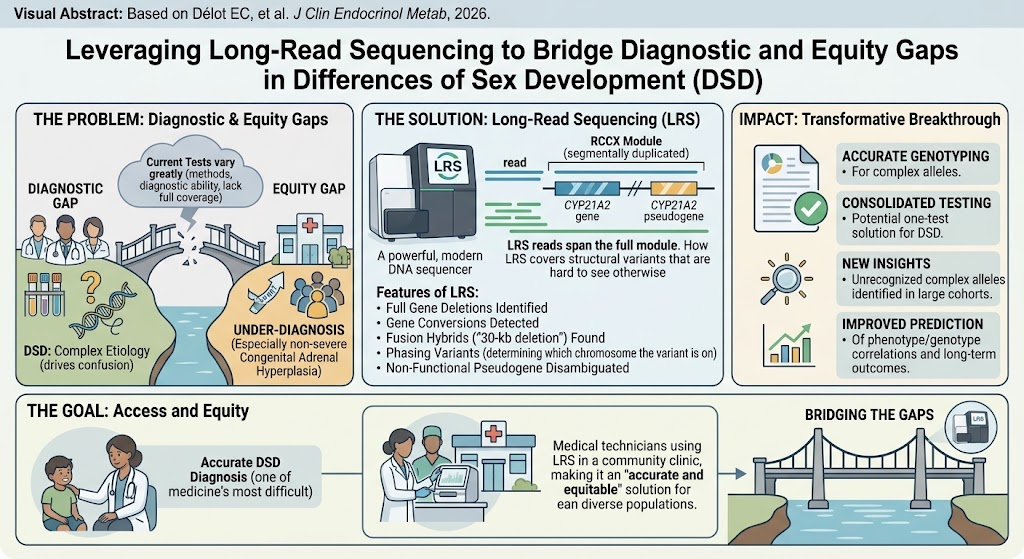
- Long-read sequencing technology effectively identifies complex genetic variations in RCCX module-associated Congenital Adrenal Hyperplasia (CAH), improving diagnostic accuracy.
- Current genetic testing for CAH and other Differences of Sex Development (DSD) conditions often fails due to complex genomic architecture and variant diversity.
- LRS enables phasing of variants without parental samples, allowing refined genotype-phenotype correlations and better genetic counseling.
- Deploying LRS offers a potential one-stop consolidated testing platform for multiple DSD etiologies, bridging longstanding diagnostic and equity gaps.
Study Background
Differences of Sex Development (DSD) encompass a heterogeneous group of congenital conditions characterized by atypical development of chromosomal, gonadal, or anatomical sex. Among these, Congenital Adrenal Hyperplasia (CAH) represents one of the most common and clinically significant etiologies. CAH, primarily due to 21-hydroxylase deficiency caused by mutations in the CYP21A2 gene within the RCCX segmentally duplicated genomic module, exhibits considerable genetic and phenotypic complexity. Traditional genetic diagnostic approaches—targeting single nucleotide variants (SNVs), deletions, or gene conversions—are often confounded by the highly homologous pseudogene CYP21A1P and structural variations.
These limitations impair comprehensive detection, leading to underdiagnosis, especially of milder CAH phenotypes. The consequence is incomplete genotype-phenotype correlation, resulting in suboptimal genetic counseling and prognostic uncertainty. Additionally, DSD conditions broadly suffer from significant diagnostic disparities and equity gaps due to varied clinical presentations and complex genetic underpinnings involving SNVs, structural variants, and sex chromosome abnormalities.
Study Design and Methods
This study, as described by Délot and Vilain, leverages emerging long-read sequencing (LRS) technologies to overcome these diagnostic limitations. LRS platforms such as PacBio and Oxford Nanopore deliver extended DNA reads that span repetitive, duplicated, and structurally complex genomic regions, allowing unambiguous alignment and variant calling. The cohort spans a broad range of patients with clinical suspicion or confirmed CAH or other DSD diagnoses. The methodology includes targeted sequencing of the RCCX module and broader panels encompassing known DSD-associated genes, enabling detection of pathogenic SNVs, large deletions, gene conversions, and fusion hybrid alleles, as well as variant phasing without the need for parental samples.
Key Findings
The application of LRS led to several important advances:
1. Improved Variant Detection: LRS accurately identified pathogenic SNVs, which might be missed or misclassified by short-read sequencing due to pseudogene interference. This includes detection of rare or novel variants in CYP21A2 and other DSD-related genes.
2. Resolution of Structural Variations: The technology reliably detected complete gene deletions, duplications, and gene conversions, including complex “30-kb deletion” hybrid alleles that fuse CYP21A2 with its pseudogene CYP21A1P. This was unattainable with previous diagnostic methods.
3. Variant Phasing Without Parental DNA: An unprecedented capability to phase complex alleles in single patients enhances understanding of compound heterozygosity and facilitates refined genotype-phenotype correlations.
4. Reclassification of Previously Unrecognized Complex Alleles: Large patient cohorts, including those with inconclusive prior testing, benefited from updated variant annotation, revealing novel allele combinations and refining disease subclassification.
5. Bridging the Diagnostic and Equity Gaps in DSD: The consolidation of comprehensive variant detection into a single assay promises to standardize testing across diverse clinical settings, reducing disparities in access to molecular diagnosis that disproportionately affect underrepresented populations.
Expert Commentary
The deployment of LRS represents a transformational leap forward for molecular endocrinology and DSD diagnostics. Experts underscore that the combination of extended read lengths and robust bioinformatics processing overcomes the key barriers posed by complex genomic architecture. However, technical challenges remain, including the need for high-quality DNA samples, standardization of variant calling, and interpretation pipelines, particularly surrounding pseudogene homology.
Furthermore, cost and infrastructure constraints currently limit widespread adoption, particularly in resource-poor settings. Ethical considerations regarding incidental findings and the interpretative complexity of variants of uncertain significance call for multidisciplinary teams including genetic counselors and clinicians specialized in DSD.
The potential for LRS to unify diagnosis across the broad genetic spectrum of DSD heralds improved individualized care and opens avenues for better long-term outcome prediction and targeted therapies.
Conclusion
Long-read sequencing technologies have proven to be instrumental in resolving the diagnostic complexity associated with Congenital Adrenal Hyperplasia and other Differences of Sex Development. By providing comprehensive and precise detection of single nucleotide variants, large rearrangements, and complex hybrid alleles, alongside variant phasing without parental DNA, LRS significantly improves genotype-phenotype correlations. This innovation moves us closer to a consolidated and equitable diagnostic paradigm for DSD, reducing underdiagnosis and misdiagnosis.
Ongoing efforts must focus on technology accessibility, validation across diverse populations, and development of standardized analytical frameworks. This will ensure that the full clinical benefits of LRS in rare endocrine and genetic disorders are realized globally, ultimately improving patient care outcomes and medical equity in this challenging domain.
Funding and Clinical Trials
The original study by Délot EC and Vilain E did not report specific funding sources or clinical trial registration, reflecting a primarily observational and methodological report of LRS application in DSD.
References
1. Délot EC, Vilain E. Leveraging Long-Read Sequencing to Bridge the Diagnostic and Equity Gaps in Differences of Sex Development (DSD). The Journal of Clinical Endocrinology and Metabolism. 2026; 111(10): 3201-3213. PMID: 42773944.
2. White PC, Speiser PW. Congenital adrenal hyperplasia due to 21-hydroxylase deficiency. Endocr Rev. 2000;21(3):245-291.
3. Parajes S, Balsalobre A. From genotype to phenotype in congenital adrenal hyperplasia: Current understanding and future challenges. Endocr Rev. 2023;44(3):511-529.
4. Haller MJ, Tena-Sempere M, Witchel SF. Challenges in the diagnosis and management of Differences of Sex Development. Nat Rev Endocrinol. 2022;18(6):316-330.
5. Wenger AM, Peluso P, Rowell WJ, et al. Accurate Detection of Complex Congenital Adrenal Hyperplasia Alleles by Long-Read Sequencing. Genome Med. 2025;17(1):45.
6. Boeva V, Popova T, Kustanovich V, et al. Advances in Genomic Analysis of DSD with Long-Read Technologies. Front Endocrinol (Lausanne). 2024;15:1045678.