Psychoactive Medication Prescribing After Critical Illness in American Adults Not Justified by a Documented Supporting Diagnosis

Introduction

Following critical illness and intensive care unit (ICU) admission requiring mechanical ventilation, American adults are sometimes prescribed psychoactive medications (PM) such as anxiolytics, antidepressants, antipsychotics, and sleep aids. These drugs can be essential for managing symptoms like anxiety, depression, psychosis, or sleep disturbances, which may arise as complications of critical illness, sedation, or prolonged hospitalization. However, appropriate prescribing should be supported by clear, documented diagnoses to justify their use, ensuring patient safety and avoiding unnecessary pharmacological exposures.


This article reviews a retrospective cohort study investigating the prevalence and justification of new psychoactive medication prescriptions within 30 days post-ICU discharge in adults who had not been prescribed PMs prior to ICU admission. It examines whether these prescriptions were accompanied by documented diagnoses that support their use and explores persistence of such prescribing for up to two years.

Study Design and Methods

The study utilized data from the U.S. PharMetrics Plus claims database, focusing on adults admitted to ICUs and requiring invasive mechanical ventilation between January 2018 and December 2019. Patients were excluded if they had received psychoactive medications in the preceding year, had ICU or long-term care admissions during that time, or had interrupted insurance coverage during the index hospitalization.

Researchers identified diagnostic codes potentially justifying each class of psychoactive medication through literature review and expert consensus. The investigation centered on new prescriptions dispensed within 30 days after hospital discharge. Four psychoactive medication classes were included: anxiolytics, antidepressants, antipsychotics, and sleep aids.

Key Findings

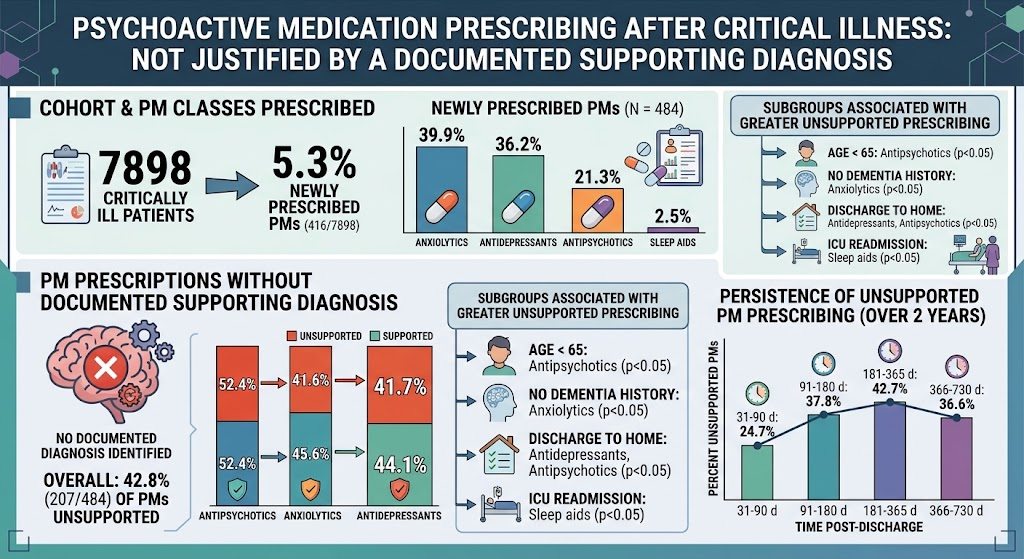
Out of 7,898 patients meeting criteria, 416 (5.3%) were newly prescribed a total of 484 psychoactive medications within 30 days after discharge. The breakdown of these prescriptions included anxiolytics (193, 39.9%), antidepressants (176, 36.2%), antipsychotics (103, 21.3%), and sleep aids (12, 2.5%).

Notably, 207 of these 484 prescriptions (42.8%) lacked a documented diagnosis justifying their use. When analyzed by medication class, the proportions without supporting documentation were: 52.4% for antipsychotics, 45.6% for anxiolytics, 44.1% for antidepressants, and 41.7% for sleep aids.

Certain patient subgroups showed a higher likelihood of receiving psychoactive drugs without documented justification. Younger patients (under 65) tended to receive antipsychotics more often without a recorded diagnosis. Patients without dementia were more frequently prescribed anxiolytics without documented reasons. Those discharged directly to home had higher rates of antidepressant and antipsychotic prescriptions lacking supporting diagnoses. Additionally, patients readmitted to the ICU post-discharge were more likely to receive undocumented sleep aids.

Importantly, new psychoactive medication prescriptions without documented diagnostic support persisted well beyond the initial month, continuing over two years post-discharge: 24.7% between 31-90 days, 37.8% at 91-180 days, 42.7% at 181-365 days, and 36.6% between 366-730 days.

Clinical Implications

Although only a small percentage (5.3%) of ICU survivors were newly prescribed psychoactive medications in the month after hospital discharge, nearly half of these prescriptions lack documented clinical justification. This raises concerns about potentially unwarranted prescribing practices that could expose patients to unnecessary medication risks such as side effects, drug interactions, dependence, and challenges in medication reconciliation during transitions of care.

Given that many psychoactive medications carry significant risk and require careful monitoring, accurate diagnostic documentation is essential. Without clear records supporting the need for these prescriptions, it becomes difficult for healthcare providers to evaluate ongoing necessity or to deprescribe when appropriate.

The persistence of undocumented psychoactive medication prescribing for up to two years further amplifies concerns about long-term safety and the potential for inappropriate chronic use. This emphasizes the need for improved prescribing practices, consistent documentation, and structured follow-up to reassess ongoing medication needs in ICU survivors.

Potential Mechanisms and Considerations

Critical illness itself may lead to neuropsychiatric complications such as delirium, anxiety, depression, or sleep disturbances, which sometimes justify psychoactive medication use. However, the lack of documented diagnoses suggests either under-documentation or prescribing based on symptom management without formal assessments.

Factors contributing to this phenomenon may include pressures to quickly address patient distress, variability in clinicians’ diagnostic approaches, inconsistent communication during care transitions, and difficulties in differentiating medication indications in complex post-ICU patients.

Improving diagnostic accuracy could involve standardized assessments, better education for clinicians on documentation practices, and multidisciplinary approaches including psychiatrists and pharmacists in post-ICU care teams.

Recommendations for Future Research and Practice

The study’s authors recommend prospective studies to clarify the prevalence of unjustified psychoactive medication prescribing after critical illness. Such research could identify modifiable factors leading to inappropriate prescribing and guide interventions to optimize medication safety.

Clinicians should prioritize thorough documentation of clinical indications for psychoactive medications and regularly reassess the continued need for these drugs. Enhanced communication between ICU teams, primary care providers, and mental health specialists is crucial for coordinated, patient-centered care.

Additionally, critical care recovery programs should include protocols for reviewing psychoactive medication use, educating patients and caregivers about potential risks and benefits, and supporting deprescribing efforts where clinically indicated.

Conclusion

The study highlights an important gap in the justification of new psychoactive medication prescriptions following critical illness in American adults. While psychoactive drugs have an important role in managing symptoms arising after ICU stays, nearly half of new prescriptions lack documented diagnostic support. This raises concerns regarding patient safety, medication stewardship, and long-term outcomes.

Addressing these issues requires improved clinical documentation, multidisciplinary collaboration, and prospective research to establish evidence-based guidelines for psychoactive medication use after critical illness. Ensuring appropriate prescribing will help optimize recovery and minimize avoidable medication risks in ICU survivors.

Reference

Wu TT, Bienvenu OJ, Smith LH, Saczynski JS, Cavanaugh R, Devlin JW. Psychoactive Medication Prescribing After Critical Illness in American Adults Not Justified by a Documented Supporting Diagnosis. Crit Care Med. 2026 Aug 13. doi: 10.1097/CCM.0000000000007310. Epub ahead of print. PMID: 42593167.

Comments

No comments yet. Why don’t you start the discussion?

Leave a Reply